FYI: The Morbid Fact Du Jour newsletter will be on hiatus from Friday, February 23rd through Tuesday, March 19th while the Comtesse attends to family in Catatonia. While she’s away, you can always peruse the archives here.
Please, stay morbid in my absence!
Today’s Penetrating Yet Truly Morbid Fact!
At exactly 8:15:17 a.m. on August 6, 1945, the ‘Little Boy’ atomic bomb was released from the bomb bay of the Enola Gay as it passed over Hiroshima. The following is a discussion of the aftermath of the blast.
Compared to the human suffering, the physical damage to the city seems almost irrelevant, but of course it represented an additional misery to the population. Of the 76,000 buildings in the city, 48,000 were completely destroyed, whilst most public utilities and services were wrecked. The direct result of the damage was that the people of Hiroshima were unable to help themselves, particularly as unseasonable bad weather brought a black rain of dust onto the town. The US Strategic Bombing Survey reported that:
Those who were able made a mass exodus from the city into the outlying hills. There was no organised activity. The people appeared stunned by the catastrophe and rushed about as jungle animals suddenly released from a cage.
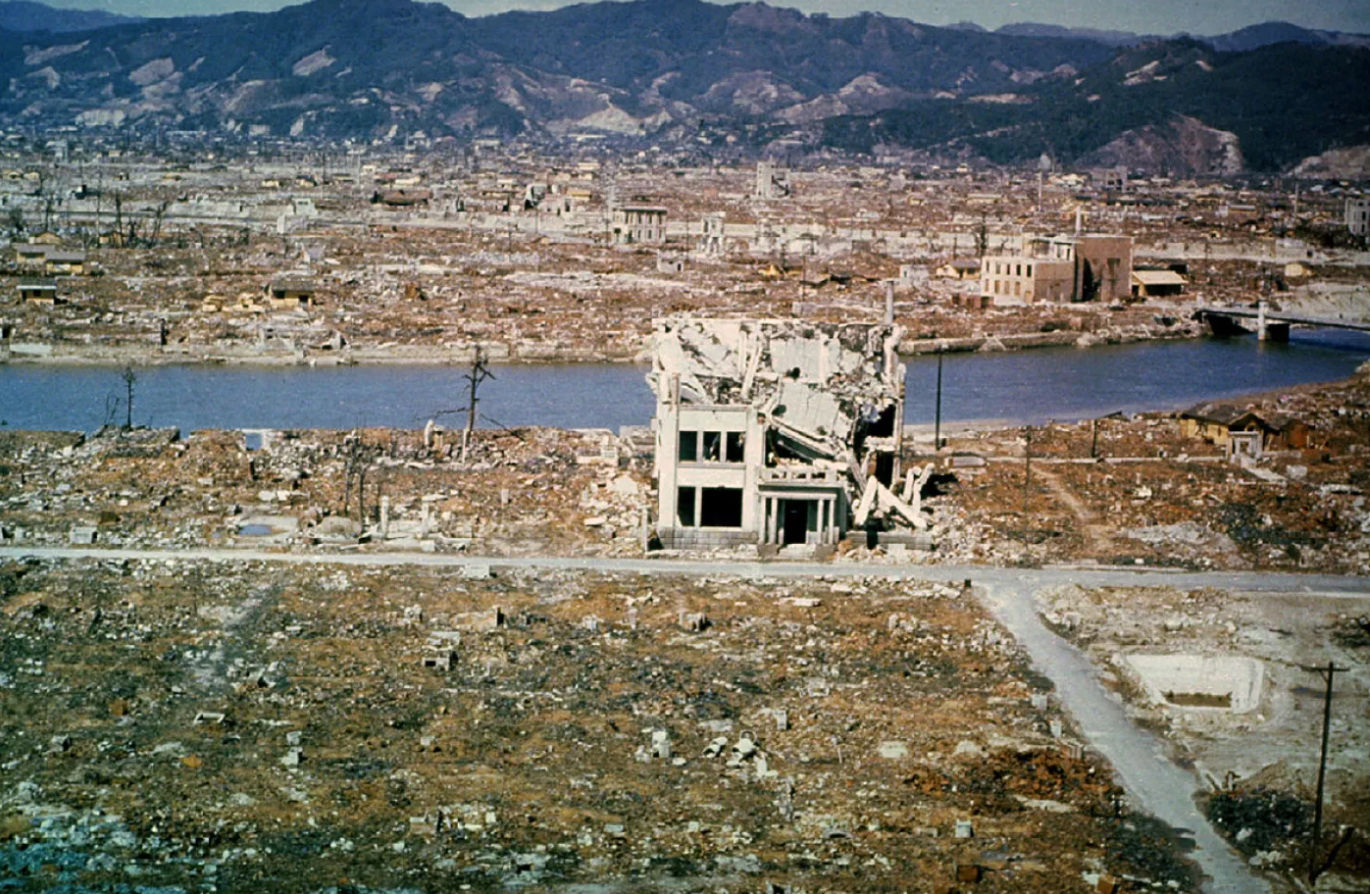
The aftermath, Hiroshima
But even as outside relief began to arrive in the town in the days after the explosion, a further horror appeared to strike down those who thought that they had survived the bomb: radiation sickness. The British study observed that:
The gamma rays were very penetrating and passed through the skin without affecting it. As a result, those exposed to gamma rays, if they were protected from flashburn and from indirect injury, showed no immediate ill-effect. Even those severely irradiated probably did not show the characteristic symptoms, nausea, vomiting and fever, for 24 hours, and rarely died in less than one week. These symptoms were followed by bloody diarrhoea, occurring most frequently in the second week, at which time loss of appetite and general malaise also became marked. Patients begin to lose their hair after the first week.
Thereafter, in the severe cases, the clinical picture came to be dominated by signs of deficient blood formation. This effect on the blood is indirect, and therefore delayed: the gamma rays do not attack the cells in the bloodstream, but the primitive cells in the bone marrow, from which most of the different types of cells in the blood are formed. Therefore serious effects begin to appear only as the fully-formed cells already in the blood die off gradually and are not replaced as they would be normally by new cells formed in the bone marrow. In severe cases, it was apparent that the gamma rays had virtually killed the entire bone marrow. In such cases, all three types of cells formed in the marrow became deficient: red cells, platelets, and white cells. As red cell formation ceased, the patient began to suffer from progressive anaemia. As platelet formation ceased, the thin blood seeped in small and large haemorrhages into the skin and the retina of the eye, and sometimes into the intestines and the kidneys. The fall in the number of white cells, which was useful in diagnosing mild cases because it could be detected by taking blood counts, in severe cases lowered resistance, so that the patient inevitably fell prey to some infection, usually spreading from the mouth and accompanied by gangrene of the lips, the tongue and sometimes the throat. Death in these cases was the result of a combination of anaemia, internal bleeding, and infection. Deaths probably began in about a week after the explosion, reached a peak in about three weeks, and had for the most part ceased after six to eight weeks.
The distances at which these effects were felt are not easy to determine. It is thought that gamma rays ultimately caused the death of everyone who was fully exposed to them up to a distance of 1/2 mile from the center of damage. A figure can be obtained for the 50 per cent chance of survival, from the evidence of two groups of workers who had been brought into Hiroshima from an outlying village, and who were working in the open but screened by wooden buildings at 1,200 yards from the centre of damage. Of the total of 198 men, 6 were killed immediately by the debris and 95 subsequently died, it is believed all from the effects of gamma rays. Allowing for some small protection afforded by the wooden buildings, it is estimated that people in the open have a 50 percent chance of surviving the effects of gamma radiation at 3/4 mile from the centre of damage. As regards lesser effects, loss of hair was recorded up to 1 1/4 miles from the centre of damage, and some doctors felt that the milder forms of radiation sickness, more difficult to diagnose, may have extended to 2 miles.
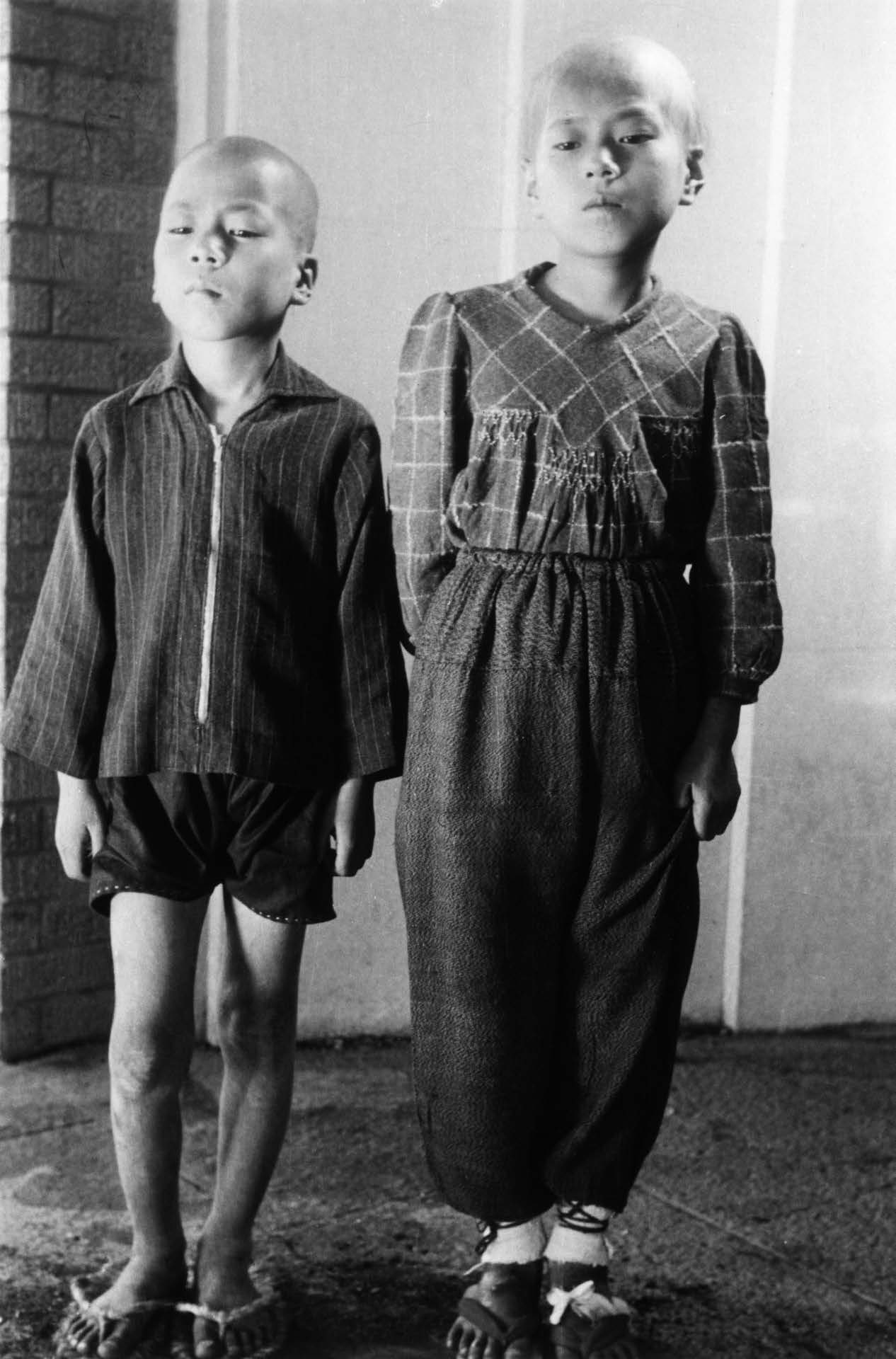
This girl, Aiko (9), and her younger brother, Toru (7), were exposed to the bomb in a wooden building 1,000 m from the hypocenter. After that, they went outdoors and got caught in the black rain. Their hair began falling out four or five days later. Aiko lost her appetite and developed a fever, bleeding from the gums and other symptoms. Both recovered from the acute stage but fell ill in later years. Toru died 4 years after the bombing at the age of 11, and Aiko died 20 years after the bombing at the age of 29.
Culled from: Eye-Witness: Hiroshima
Malady Du Jour!

GIRL WITH HYDROCEPHALUS
H. Glosser, Harrisburg, Illinois, c.1875
4 x 5 1/2″ Albumen Print
Few deformities of the head demand the attention that hydrocephalus does. In infancy, acquired or congenital brain disease results in the obstruction of fluid circulation in the brain. Thus, pressure builds up. Because the skull bones are not totally fused during early infancy, the pressure results in a ballooning enlargement of the brain and skull. Most of these children died in infancy, as vital areas were compressed.
In the second decade of the 20th century, the neurosurgeon Walter Dandy pioneered the use of X-rays using dye and air injection into the brain. He differentiated two types of hydrocephalus: an obstruction in the ventricular system; and obstruction in areas where there was a communication between the brain and the ventricles. In 1922, Dandy pointed out that treatment of obstructive hydrocephalus required drainage of cerebral spinal fluid. Various therapies were developed to successfully treat hydrocephalus.
Culled from: Harms Way
Andersonville Prisoner Diary Entry Du Jour!
This is the continuation of the 1864 diary of Andersonville prisoner Private George A. Hitchcock (see the archived version for all entries up until now).
Here’s today’s entry:
November 8th. Light rain. I had a comfortable night’s sleep. This is supposed to be presidential election day, and a great deal of excitement and sport was made in voting for the two candidates, Little Mac and Old Abe. My vote proved to have been case for the triumphant candidate in camp. Abraham received a majority of nine hundred and seventy-five in a total casting of over nine thousand.
Culled from: Andersonville: Giving Up the Ghost