Today’s Ambiguously Sexed Yet Truly Morbid Fact!
In the eighteenth and nineteenth centuries, the most benign term used to designate ambiguously sexed individuals was “hermaphrodite.” Other, more subjective, labels were frequently applied as well: “hybrid,” “impostor,” “unfortunate monstrosity.” Doctors used similar derogatory descriptions for genital incongruities. In an 1842 article on malformations of the male sexual organs, for example, one doctor referred to “these mortifying and disgusting imperfections.”
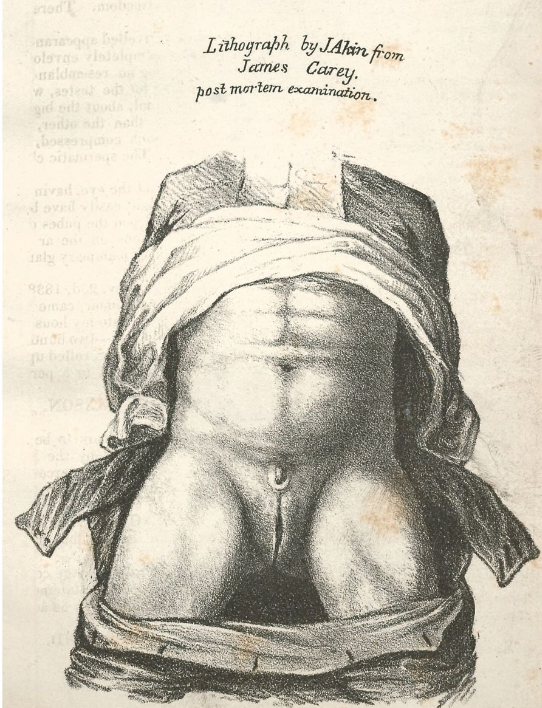
The published story of James Carey, who lived in Philadelphia in the 1830s—which still employed such terms as “hermaphroditic monster” — illustrated the emergence of a new sympathy for those born with unusual genitalia. We learn about Carey through the autopsy report written by the celebrated artist James Akin. According to Akin, Carey lived his entire life as a man, but the account describes a creature more beastly than manly. Akin went to great pains to prove the veracity of his narrative, appending signatures by attending doctors confirming the shape of Carey’s genitals, as well as his general demeanor. Akin recounted Carey’s sad and pitiful life for readers. A self-imposed recluse in particular dread of exposure, Carey vigorously guarded his privacy and shunned any interaction with people beyond that necessary to make a living. Akin wrote:
Conscious that busy intermeddlers might surprise him sleeping, and when in a state of nudity, discover his strange malconformation, he continually girded his pantaloons securely about his loins, and when thus shielded, he would confidently retire to rest, conceiving the vestment a fortress of impregnable strength to protect him against all infractions during repose… or changing his apparel, he would resort to every preventative for guarding against sudden obtrusion, determined to punish with promptitude infringements of the curious, who should violate his sanctuary.
Akin portrayed Carey as a stooped hunchback, “exhibiting features of a grotesque melancholy aspect.” His eyes were heavy and dull, his nose flat, “not unlike the lesser Ouran Outang or Pongo Ape of [the eighteenth-century French naturalist the comte de] Buffon.” He emitted “preternatural discharges” from his nose, “yeiling a horribly foetid stench” that could cause severe nausea or vomiting among onlookers. Provoked by the “very strange and unnatural conformation of his genital organs” and the nasal hemorrhage to which he believed they were connected, Carey took to “venting the most vile and impious imprecations, full of profanation and blasphemy, offensively disgusting to a chaste ear, and outraging all decency.”
Akin’s description, supported by documentation from those who knew Carey and from doctors who witnessed the postmortem, exposed a most distressing and pathetic character. Akin depicted a social recluse. Carey remained chaste throughout his lifetime; indeed, he showed an “incorrigible aversion” to women’s “soft blandishments” and never committed, in Akin’s words, “debasing earthly drudgery in commerce with the sex.” Akin’s tone suggested that this was for the best, given Carey’s bodily conformation. While nineteenth-century doctors argued whether there were “true” hermaphrodites, there lingered in their gradual medicalizing of this condition an older, harsher interpretation of hideous deformity. As the description of James Carey suggests, many doctors and other commentators never entirely abandoned this motif and slipped deprecating words of repugnance into medical descriptions of their patients.
Akin’s report nonetheless combines monstrosity with a touch of humanity. Although Carey would sometimes “storm in phrenzied gusts of furious and ungovernable rage,” frightening those who crossed his path, he was able to contain himself at work, Akin wrote, and he displayed honesty, loyalty, and punctuality in his duties. Whether he was working at a foundry or in a factory or driving a stagecoach, at work he exhibited a “firm and manly deportment”.
But if Akin recognized that Carey was not all monster, neither was he all man. His voice “partook of a faint boyish squeak.” And with his long, lean, and “smooth polished limbs… encased in a skin of delicate whiteness,” Carey had an “effeminate appearance.” Henry G. King, pastor of a Methodist church, attested in an addendum to Akin’s account that Carey’s skin was “smooth and sallow” and that his chin sported no beard. “In a word,” King concluded, “he neither resembled the mascular nor feminine gender.”
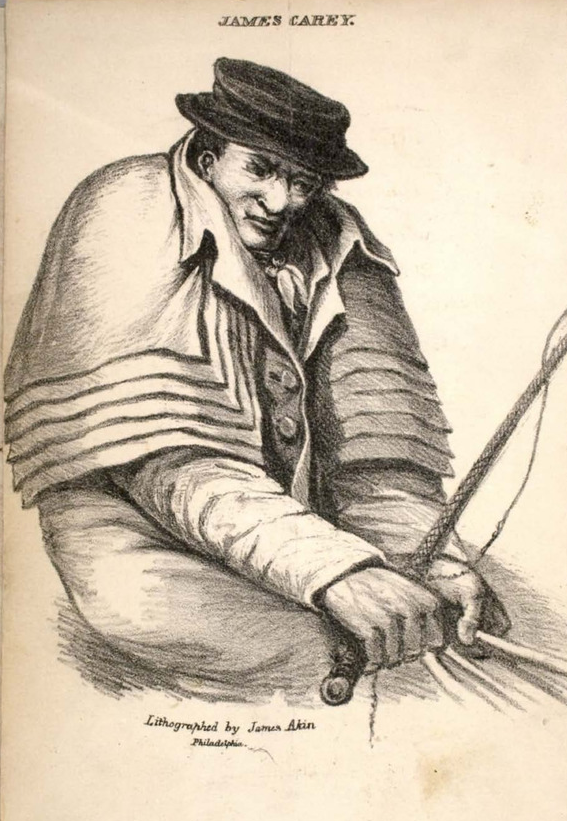
His body may have been ambiguously gendered, but for some observers, like this minister, Carey’s soul humanized him. King, along with employers and landlords, tried to save Carey, especially when he became very ill, exhorting him to prepare to meet God before his death. King’s first visit yielded no signs of repentance; at the second visit he saw “some degree of warmth.” We will never know if Carey experienced conversion since he died before the minister could see him again. That Akin chose to include the minister’s account of his personal interaction with Carey along with the autopsy report is telling. Carey was no longer just a monstrosity or a dissected body, but a human being with a soul that could achieve forgiveness.
Carey spent his entire life protecting his body’s secret, but when he died he could no longer guard his privacy. The coroner “marveled at the novel and singular spectacle” and told others that “all was not right.” These words led some to suspect that Carey’s death itself was suspicious, and so four days after the burial, the coroner ordered an inquest. Carey’s body was exhumed and became available for medical scrutiny, dissection, a published autopsy report, a poem, and subsequent historical analysis. Akin’s story of Carey’s life bridged the gap between an older conception of hermaphrodites as monsters and a newer emphases on personhood that combined a description of anatomical difference with moral evaluations of the person’s life.
Culled from: Bodies In Doubt: An American History of Intersex by Elizabeth Reis
Car Crash Du Jour!
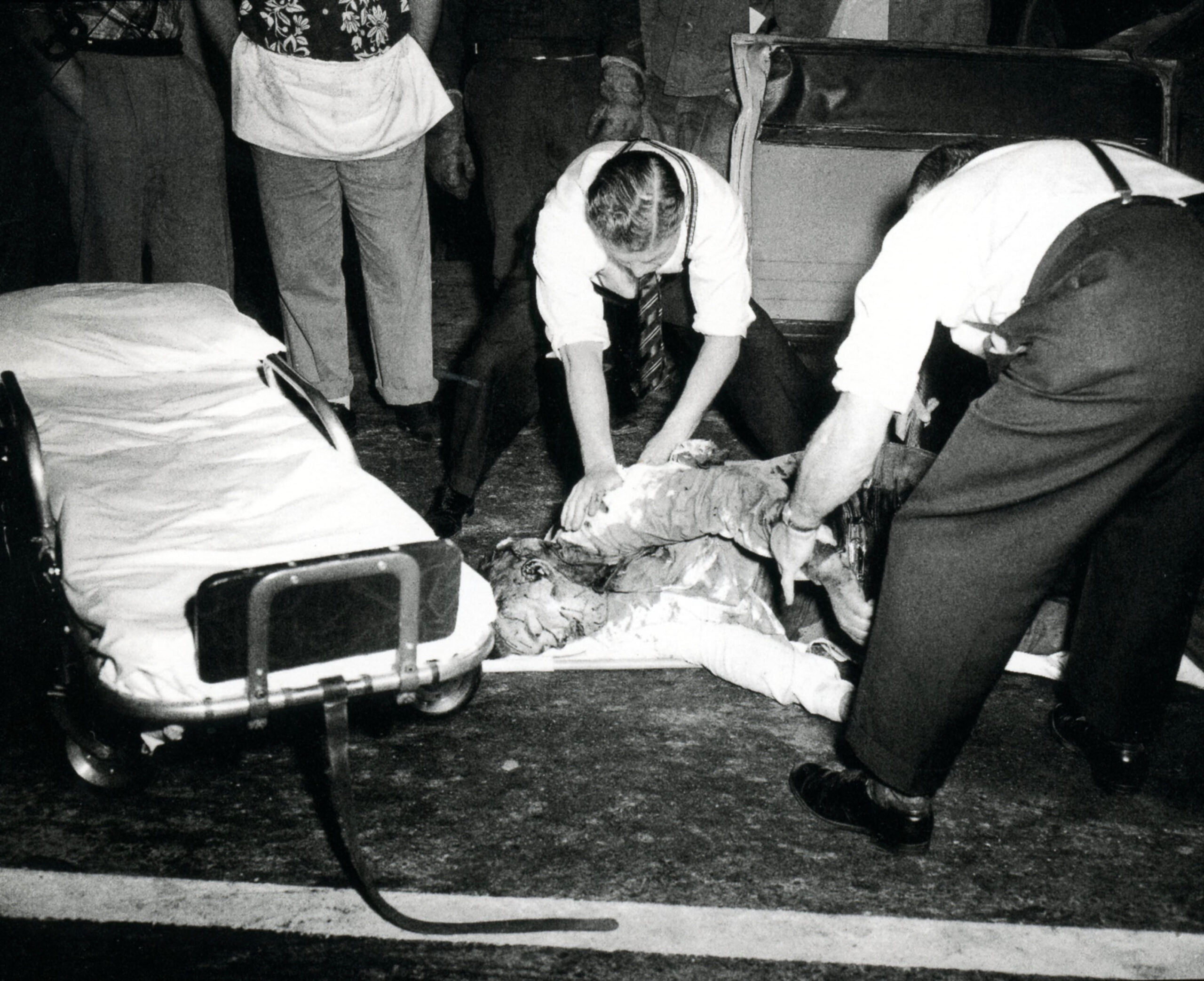
One of my favorite books is Car Crashes and Other Sad Stories by Anaheim photographer Mell Kilpatrick. It’s a collection of car crash photos from the 40’s and 50’s, often with corpses still strewn across the enormous interior (or out of it, since there were no seat belts in those days). It combines my love of old cars with my love of morbidity and is the perfect ambulance chaser book!
Red Hill and Rt. 101
Garretdom (Olde News)
Let’s continue our series of newspaper articles with the title “A Fiendish Woman” with an excerpt from the October 6, 1847 issue of The Luzerne Union (Luzerne County, PA):
A FIENDISH WOMAN.—We learn from the Cumberland (Pa) Mountaineer that a foul murder was committed by a woman upon the preson of her husband, some few days ago.—This woman is the same identical Mrs. Frey who was accused of being accessory to the murder of a former husband, (Mr. Frey,) in the upper part of Allegheny county, Md., some two or three years since and for which Wm. S. Crise suffered death upon the gallows. She committed the foul deed while her husband was sleeping, by pouring hot lead into his ears. This last tragedy was performed in Pennsylvania, and the Maryland line. She is now confined in jail to await her trial.
Okay, so let’s keep track of the manner of fiendishness exhibited by these women!
Sulfuric Acid – 1
Molten Lead – 1
