Today’s Wet Yet Truly Morbid Fact!
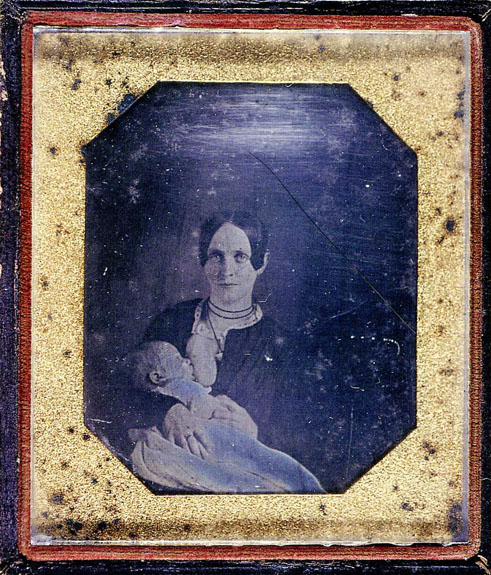
Woman Breast Feeding, 1845
How and what an infant should be fed has long been one of the great controversial medical topics, beginning in the 19th century and persisting even today. Quality of feeding may well be the most important factor in an infant’s surviving the first year of life, so the superiority of mother’s milk versus wet nurses’ milk, animal milk, and prepared “formulas” has been hotly debated. It is now known that breast-feeding offers not only the benefits of nourishment and natural immunization passed on from the mother to her offspring, but a profound direct contact that promotes the psychological health of both mother and child. In past times, however, wet nurses were commonplace, freeing lower-class mothers to go out and earn a living and liberating wealthy mothers from the time and hormonal effects of nursing so they could have more children. Unfortunately, any disease the wet nurse might have could be passed to the baby; thus, syphilis and other deadly maladies were often spread this way. Furthermore, in the 19th century, cows’ milk was frequently infected with tuberculosis and other deadly diseases, as there was no regulation of the animals or of the means of production or delivery of their milk. Thus, summer diarrhea and tuberculosis, responsible for the deaths of tens of thousands of children, were spread through cows’ milk and infected bottles. Infant mortality in the United States ranged from 30-50% in that era.
Culled from: A Morning’s Work: Medical Photographs from The Burns Archive & Collection 1843-1939