Today’s Ill-treated Yet Truly Morbid Fact!
Archaeologists have unearthed hundreds of skeletons at a 16th Century burial ground in the heart of the city that once served London’s most notorious psychiatric hospital, the original “Bedlam.” The bones are expected to yield valuable information about mortality, diet and disease in the period. They were discovered while experts surveyed a site that is destined to become a new ticket hall for the capital’s huge Crossrail project at Liverpool Street Station.
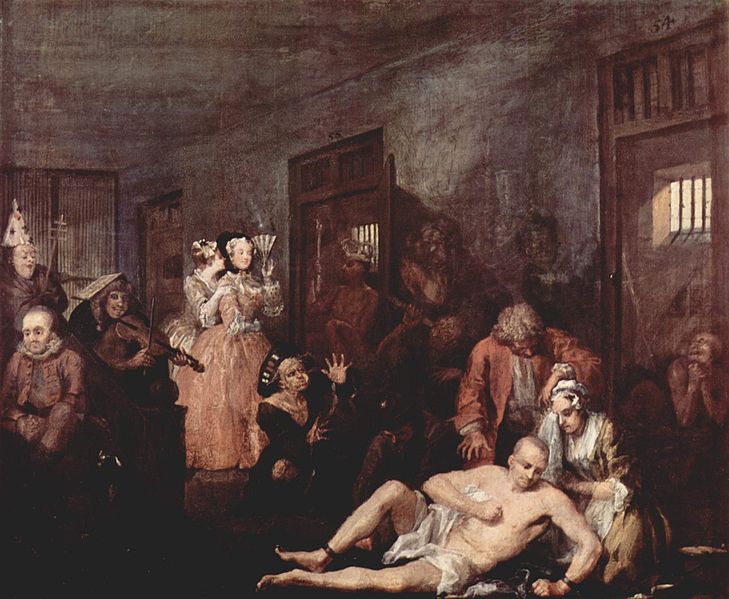
William Hogarth's "A Rake's Progress" Plate 8 - Bedlam.
The burial ground was used from 1569 to the mid 19th century for Bedlam’s patients and local residents when other cemeteries became overcrowded. Jay Carver, lead archaeologist for the huge Crossrail project which bisects the old city of London, said the well-preserved bodies were discovered after trial pits were dug. “We’ve identified at least 100 individual burials within our small trial pit and, extrapolating that, it is very likely there will be several hundred if not a thousand plus..,” he told Reuters. The corpses, many found just 1.5 meters (5 ft) below street level, will be studied by experts at the museum of London, before being reburied. “It’s interesting on the archaeological side because the 16th century is a time of immense poverty really in the outer areas of the city of London. Sites of this type haven’t always been fully investigated,” Carver said.
Toward the end of the 17th Century, the hospital moved to Moorfields in north London, now the site of Finsbury Circus. Despite the new buildings with their well-kept gardens, the treatment of the mentally ill did not greatly improve — in the 18th Century, the public could visit Bedlam to stare at the patients for the price of one penny. That practice died out long ago but the institution, now called the Bethlem Royal Hospital, still exists, in Bromley, southeast of London.
Culled from: Reuters
This is one of the bonuses of living in England. When I was living in York a company down the street from my flat started digging foundations for a building. They found over 100 beheaded Roman soldiers and had to stop the building indefinitely. Several years previous, whilst building a shopping centre they found a Viking village.