Today’s Artistic Yet Truly Morbid Fact!
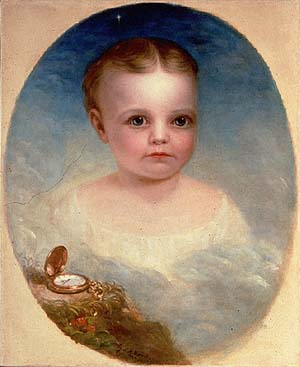
A Portrait Of Camille
Posthumous mourning paintings were a publicly acknowledged and socially acceptable practice in the 19th century. Paintings were hung in public spaces like parlors. Artists placed advertisements in local newspapers offering the service on a regular basis How common these paintings were is only now being recognized. Grete Meilman, Vice President, the American Painting Department of Sotheby Parke-Bernet Inc., estimates that approximately seventy-five percent of the children’s portraits sold through Sotheby fall into this category. The obscurity of the genre is due to the fact that the deceased children are portrayed as if alive with “disguised” death symbols, that is, a willow tree in the background, or a wilted flower in the child’s hand. Sometimes the portrait contains nothing to indicate that it is a posthumous rendition.
With A Portrait of Camille by Shepard Alonzo Mount, documentary evidence of the use of these icons exists. In the artist’s portrait of Camille Mount, painted in 1868, the clouds do signify a posthumous rendering. Camille was Mount’s granddaughter, the child of Joshua Elliott Mount. Shepard was present when the infant died, the cause of her death ascribed to teething. From a life drawing taken while the child was ill, the artist composed a posthumous likeness, which he considered ‘one of the best portraits of a child that I ever painted’. In a letter to his son, William Shepard Mount, he wrote:
Alas! how everything fades from us… She was laid out in a beautiful casket and she looked like an angel – Her eyes were bright and heavenly ’til the last. I painted her with Mr. Searing’s [Camille’s maternal grandfather] watch lying in the foreground. The hands pointing to the hour of her birth while she is seen moving up on a light cloud – the image of the lost Camille. She was in the habit of holding her Grandfather’s watch to her ear, and to all others who came around her, she did the same… Camille moves toward a shining star fixed in the heavens, while the pleasures of adoring grandfathers and ticking pocket watches remain behind.
Culled from: Secure The Shadow: Death and Photography in America
Now that I know that most child paintings from that era are of dead kids, I want one!!
Any portrait of someone from the 19th century is of a dead person. If they weren’t at the time, they are now.
@PurpleVeg*n 😛
She died of teething? Those must have been SOME set of teeth!
Actually, in the 19th c. teething was a stressful time as Americans believed that teething was associated with infant mortality. As Fanny Longfellow noted in 1848: “Poor little Erny was found . . . in his crib in convulsions from teeth.” I currently working on a book that explores a heretofore unidentifed postmortem mourning portrait of Jane Eleanor Sherman Lacey and Her Son Edward by Lilly Martin Spencer. In the book I have a chapater devoted to infant mortality – this may be of interest to many of you. I hope the book will be published through iTunes in digital format in early 2013 – it is titled Dating Jane: Domesticity, Death, and Photography in a 19th Century Portrait. you can follow along on Facebook – https://www.facebook.com/Datingjane and on Twitter @datingjanebook.