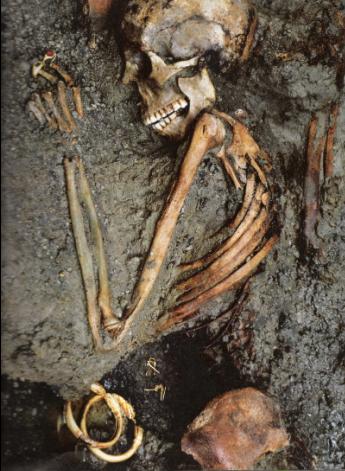
The Ring Lady: one of the bodies found in a boathouse at Herculaneum.
Today’s Pyroclastic Yet Truly Morbid Fact!
A plinian volcanic eruption, the type of eruption that consumed ancient Herculaneum and Pompeii, is one of the most lethal natural disasters on Earth. In this type of eruption, the conduit of the volcano is so tightly corked by solid rock that it takes an enormous amount of pressure building up from below, in the magma chamber, to blow a hole to the surface. When it does, the violence of the explosion propels liquid rock into the air so fast that it breaks the sound barrier, unleashing a sonic boom. During the Avellino eruption of Mt. Vesuvius in 1780 B.C., the blast hurled nearly 100,000 tons a second of superheated rock, cinders, and ash into the stratosphere. As this incredible cloud of material rose, it spread at the top, assuming the classic shape of an umbrella pine tree, the iconic feature of a plinian eruption. It reached an altitude of about 22 miles and hovered in the air for up to 12 hours before collapsing. When a plinian column falls upon itself, it creates a pyroclastic surge – a boiling, turbulent avalanche of debris that shoots out sideways from the slopes of the volcano. This searing cloud can travel for many miles, initially at great speed. Not too many humans have seen (much less survived) a pyroclastic surge at close quarters, but many of us have an image of its horrifying power burned into our memories: it shares many physical properties with the huge clouds of powder and ash produced by the collapse of the World Trade Center towers in 2001.
Unlike the collapsed towers, the material in a pyroclastic surge is baked in a subterranean magma chamber to temperatures of up to 1650°F. The initial surge of the Avellino eruption, especially in the zones closest to Vesuvius, was instantly lethal. Hot, choking wind, advancing at about 240 miles an hour, reached temperatures of at least 900°F, and retained enough heat to bring water to a boil ten miles from the vent. Below 200°F, you can survive for several seconds, perhaps, if the wave passes quickly. But even if you survive the temperature you will suffocate on the fine powder in the air. The entire countryside surrounding Vesuvius was covered by foot upon foot of this powder, 65 feet deep at a distance of three miles from the crater to about ten inches thick at a distance of 15 miles. Eight inches of ash is enough to cause modern roofs to collapse.
The sizzling temperature of a Vesuvian pyroclastic surge has emerged as a key factor in explaining what happened at Pompeii and Herculaneum in the next great eruption, 1900 years later. Hundreds of fugitives who gathered in 12 seafront boathouses facing the beach of Herculaneum died instantly from a pyroclastic surge that reached temperatures of 932 degrees F, vaporizing clothing and flesh within seconds. In a grim bit of forensic paleoanthropology, scientists have reconstructed a parting picture of the victims huddled inside boathouse 5, 10 and 12. The heat would have boiled their brain tissue, which would then have burst out in small scalding explosions that left blue-black burn marks on the bone. Moisture from vaporized flesh and blood combined with volcanic ash in the surge to create a protective, plasterlike material that preserved the bones, and from the posture of the skeletons they could determine that victims in the boathouses died instantly.
Culled from: National Geographic, September 2007
Incidentally, reading a National Geographic article about Herculaneum back in the mid-80’s is what made me decide to become an anthropology major. Fascinating stuff.
When I was nine, I read an article about Mount Vesuvius and the city of Pompeii and Herculaneum in National Geographic World, the kids’ version of NG. I too was fascinated with the whole idea of things being perfectly preserved for thousands of years by the debris.
Man, that seems a long time ago that I read that article. NGW came on a record at the time, that ought to show you how long ago it was.