Today’s Tinted Yet Truly Morbid Fact!
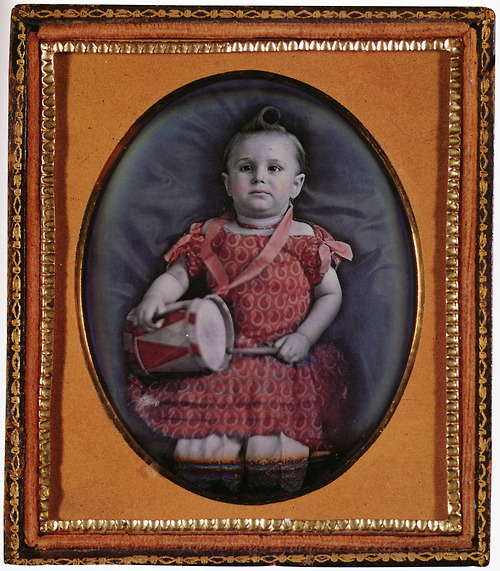
Little Drummer Girl
A Posthumous Mourning Portrait
Sarah A. Lawrence of 119 Hudson Avenue
Green Island, Albany County, New York
Daguerreotype, Tinted, circa 1847
Posed as if she is still alive, this spectacularly tinted daguerreotype must have been the only photograph ever taken of this young girl. Certain conventions, such as flowers in one hand or a recumbent pose, are typical of early postmortem portraiture, and were not generally used in portraits of the living. The cloth behind this girl is another fairly good sign of a postmortem photograph; the wrinkles in it show she was lying down or propped up against it. Images of adults and children can often be identified as postmortems by the blanket, sheet or other cloth placed beneath the body so as to absorb any secretions. Despite the efforts on the part of Sarah Lawson’s parents and her photographer, they could not hide the telltale signs of death.
Most postmortem photographs can be considered under the fine art category of “mortuary paintings.” In these art works the dead are portrayed on their deathbed, bier or other recognized death scene. This photograph is an example of another recognized fine art category – posthumous mourning painting. In these art works, the dead are depicted as if they were alive. Posthumous mourning painting was a socially acceptable part of American and European culture in the 19th century. The environments of these paintings varied from clouds to scenes of everyday life. This practice and style of representation continued in photography. In “posthumous mourning photography,” however, the range of possible presentation was limited. In paintings, any scene could be presented vecause it was a secondary rendition limited only by the imagination and talent of the artist. In many of these paintings, however, the deceased was presented with an object associated with death, such as a clock, wilted flower or willow tree. This daguerreotype uses a drum as the death-associated object.
Sarah is presented in one of the most beautiful and vibrant daguerreotypes ever taken. It has kept her alive for her family and for us. The photograph transcends time to become an important example not only of postmortem photography, but also of all daguerreian art.
Culled from Sleeping Beauty II – Grief, Bereavement and the Family in Memorial Photography by Stanley B. Burns, M.D.
Wonder what she died of? She clearly didn’t starve to death ::snicker::
I presume little Sarah is on the porky side?