Today’s Bitter Smelling Yet Truly Morbid Fact!
One of the most famous cyanide-by-mail murder cases in the United States occurred in New York City at the turn of the 20th century. It involved cyanide, had the son of a Civil War hero as the suspected murderer, and featured the city’s exclusive Knickerbocker Athletic Club as the backdrop to the crime.
Shortly before Christmas 1898, the club’s athletic director, Harry Cornish, received an unexpected package at home. It contained a nice little gift: a blue Tiffany box containing a bottle of Bromo-Seltzer inside a chased silver bottle holder. Cornish shared a house, owned by his aunt, with several other family members. A couple days after the holiday, his aunt developed a severe headache. Remembering the medicine he’d received in the mail, he mixed up a glass to relieve her pain. His aunt swallowed the tonic and then, to his horrified shock, collapsed to the floor, gasping for air, her face darkening to blue as she died.
Panicked family members called the doctor, who immediately detected the characteristic bitter almond smell in the medicine bottle. The resulting autopsy showed classic signs of cyanide poisoning. Anonymous poisonings by mail were usually hard to solve, but the investigators caught a break: Cornish had saved the wrapping that contained the package. A secretary at the Knickerbocker Club recognized the handwriting on the label. That led police directly to a disgruntled former club member named Roland Molineux, who had quit the club after quarreling with Cornish.
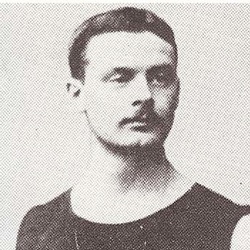
Portrait of the young man as cyanide murderer.
The thirty-one-year-old Molineux seemed an unlikely suspect. He was the elegant and well-educated son of a famous Civil War general. Molineux had an account at Tiffany & Co. and had made a purchase at the Fifth Avenue store in December, which would have provided him with the familiar blue box. He worked for a family dye company, had studied chemistry, and had a personal laboratory equipped with an array of poisons used in dyes – mercury, arsenic, and cyanide-rich Prussian blue. His office was located within blocks of the post office from which the package had been mailed. And the son was nothing like his father: he was a man with an outsize sense of superiority. His quarrels with Cornish had involved the other’s refusal to expel “lesser” families from events. He’d written to the club asking for Cornish’s removal, describing him as a a “vile, bad man.”
The police investigation turned up something even more disturbing. A month earlier, in November 1898, another member of the Knickerbocker Club had died unexpectedly. The dead man, Henry Barnet, had been pursuing a rather beautiful young woman whom Molineux wanted to marry. Barnet’s death had been considered a natural one; the death certificate blamed a sudden weakness of the heart. But now detectives discovered that Barnet had also received an anonymous package of medicine in the mail and died shortly after taking it. They exhumed Barnet’s body and discovered that the stomach and other organs contained a high concentration of cyanide.
Less than three weeks after Barnet’s death, Molineux had married the woman in question. The police were sure that Molineux had killed both people, but prosecutors decided to try him only for the death of Cornish’s aunt, where the evidence – including the handwriting sample – was stronger. The case went to trial in late 1899, and at its conclusion Roland Molineux was sent to Sing Sing to await execution.
But the prosecutor had made an unfortunate decision in his closing argument: he’d repeatedly talked to the jury of Barnet’s death, even though Molineux had not been charged in that case. He dramatically told the jurors that he could hear not one but two voices in the night calling to him for justice: Cornish’s tragically dead aunt, and Henry Barnet, “in the vigor of his youth and manhood, stricken down in that same manner…”
Molineux remained in prison almost two years, writing a book about his experiences called The Room with the Little Door while his father fought to clear him. He was still writing it on October 15, 1901, when the New York State Court of Appeals ruled unanimously that the references to Barnet’s death had been improper and reversed the conviction. A year later the district attorney insisted on trying Roland Molineux again, convinced of his guilt. But this time the general hired an array of handwriting experts to contradict the damaging evidence of the mailing label.
Roland Molineux was acquitted in the second trial, which took place in 1902. His wife promptly divorced him. The verdict in New York drawing rooms was that the son was guilty of both cyanide poisonings but that the second jury had exonerated the father. After his acquittal, Roland Molineux remained obsessed with the life and plight of the unjustly convicted man. He wrote several more books and collaborated on a play about the criminals’ plight, then suffered a mental breakdown and was committed to the New York State Hospital for the Insane in 1913. He died in the asylum four years later, at the age of fifty-one.
Culled from: The Poisoner’s Handbook
I think Harold Schechter wrote a fabulous book about him. Very much worth the read, since i know you like his books so much. “The Devil’s Gentleman: Privilege, Poison, and the Trial that Ushered in the Twentieth Century” was definitely worth the time. The whole story was simply fascinating.
I like Harold Schechter’s books too, though he does tend to go into an awful lot of detail about things that aren’t entirely germane to the story.
Silver bottle holder and crystal bottle or not, Bromo-Seltzer seems like a weird gift.