I’ve started working on my travelogues for the various places I visited during my European adventure in June/July. You can watch the progress unfurl at Forlorn Photography. One of the things I’ll be discussing in my next post is the city of Hamburg, which brings me to…
Today’s Drafty Yet Truly Morbid Fact!
The Battle of Hamburg, codenamed Operation Gomorrah, was a campaign of air raids beginning 24 July 1943 for 8 days and 7 nights. It was at the time the heaviest assault in the history of aerial warfare and was later called the Hiroshima of Germany by British officials. The devastation reached its peak on the night of 27 July, shortly before midnight, when 739 RAF aircraft attacked Hamburg. The unusually dry and warm weather, the concentration of the bombing in one area and firefighting limitations due to blockbuster bombs used in the early part of the raid – and the recall of Hanover’s firecrews to their own city – culminated in the so-called “Feuersturm” (firestorm). The tornadic fire created a huge inferno with winds of up to 240 km/h (150 mph) reaching temperatures of 800 °C (1,500 °F) and altitudes in excess of 1,000 feet, incinerating more than eight square miles (21 km²) of the city. Asphalt streets burst into flame, and fuel oil from damaged and destroyed ships, barges and storage tanks spilled into the water of the canals and the harbour, causing them to ignite as well. The majority of deaths attributed to Operation Gomorrah occurred on this night. A large number of those killed died seeking safety in bomb shelters and cellars, the firestorm consuming the oxygen in the burning city above. The furious winds created by the firestorm had the power to sweep people up off the streets like dry leaves:
Some people who tried to walk along, they were pulled in by the fire, they all of the sudden disappeared right in front of you (…) You have to save yourself or try to get as far away from the fire, because the draught pulls you in.
The last raid of Operation Gomorrah was conducted on 3 August. Operation Gomorrah killed 42,600 people, left 37,000 wounded and caused some one million German civilians to flee the city. The city’s labour force was reduced permanently by ten percent. Approximately 3,000 aircraft were deployed, 9,000 tons of bombs were dropped and over 250,000 homes and houses were destroyed. No subsequent city raid shook Germany as did that on Hamburg; documents show that German officials were thoroughly alarmed and there is some indication from later Allied interrogations of Nazi officials that Hitler stated that further raids of similar weight would force Germany out of the war. The industrial losses were severe, Hamburg never recovered to full production, only doing so in essential armaments industries (in which maximum effort was made). Figures given by German sources indicate that 183 large factories were destroyed out of 524 in the city and 4,118 smaller factories out of 9,068 were destroyed. Other losses included damage to or destruction of 580 industrial concerns and armaments works, 299 of which were important enough to be listed by name. Local transport systems were completely disrupted and did not return to normal for some time. Dwellings destroyed amounted to 214,350 out of 414,500. Hamburg was hit by air raids another 69 times before the end of World War II.
Culled from: Wikipedia
-
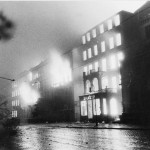
- The firestorm burning.
-
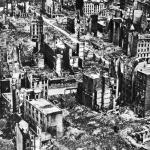
- Aerial shot showing the destruction of Hamburg.
-
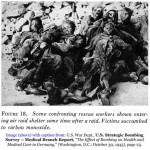
- Air Raid Shelter victims.
-
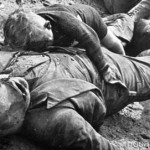
- A deceased fireman holding a small boy, killed during the firestorm.
And here’s a color film showing the destruction and aftermath:
[TUBE]https://www.youtube.com/watch?v=-tnQulHcWaI[/TUBE]