Today’s Photogenic Yet Truly Morbid Fact!
Harvey Murray Glatman (December 10, 1927 – September 18, 1959) was an American serial killer active during the late 1950s. He was known in the media as “The Lonely Hearts Killer.”
Born in the Bronx to a Jewish family and raised in Colorado, Glatman exhibited antisocial behavior and sadomasochistic sexual tendencies from an early age. At the age of 12, his parents noticed he had a red, swollen neck, and he described being in the bathtub, placing a rope around his neck, running it through the tub drain, and pulling it tight against his neck, “achieving some kind of sexual pleasure from this act.” His mother took him to the family physician and was told he “would grow out of it.” As a teenager, he would break into women’s apartments, where he tied them up, raped them and took pictures as souvenirs. He was caught in one such act in 1945 and charged with attempted burglary. Less than a month later, while still out on bail awaiting trial, he kidnapped another woman in Boulder, Colorado and raped her before letting her go. She went to the police, and Glatman went to prison for eight months.
Once out of prison, Glatman moved to Albany, New York, where he was eventually arrested in 1946 for a series of muggings. He served time at the New York State Reception Center at Elmira and then in the Sing Sing Correctional Facility, where prison psychiatrists diagnosed him as a psychopath. He was nevertheless a model prisoner and was paroled in 1951. He returned to Denver in 1951 and lived there until 1957. He worked as a TV repairman and hired young women to pose for him in bondage situations. He claimed that his photos would be published on the covers of detective magazines, but none were.
Glatman moved to Los Angeles, California in 1957 and started trolling around modeling agencies looking for potential victims. He would contact them with offers of work for pulp fiction magazines, take them back to his apartment, tie them up and sexually assault them, taking pictures all the while. He would then strangle them and dump the bodies in the desert. His two known model victims were Judith Dull and Ruth Mercado. A third victim, Shirley Ann Bridgeford, was met through a Lonely Hearts ad in the newspaper.
Glatman is also a suspect in the slaying of “Boulder Jane Doe”, a victim whose corpse was discovered by hikers near Boulder, Colorado in 1954. Her identity remained a mystery for 55 years. In October 2009, the Sheriff’s Office was notified by Dr. Terry Melton, of Mitotyping Technologies in State College, Pennsylvania, that her lab had made a match between “Jane Doe’s” DNA profile and that of a woman who thought the unidentified murder victim might be her long-lost sister. The positive identification of “Boulder Jane Doe” was an 18-year-old woman from Phoenix, Arizona, named Dorothy Gay Howard.
Glatman was in Colorado at the time and was driving a 1951 Dodge Coronet. The damage done to the body was consistent with being hit by the same car.
Glatman was arrested in 1958, caught in the act of kidnapping what would have been his fourth known murder victim, Lorraine Vigil. A patrolman saw him struggling with a woman at the side of the road, and arrested him. He willingly confessed to the other three murders and eventually led the police to a toolbox containing pictures of the victims which he had taken. He was found guilty of two counts of first degree murder and sentenced to death. He was executed in the gas chamber of San Quentin State Prison on September 18, 1959.
Culled from: Wikipedia
This is a chilling photo that Glatman took of Judy Dull shortly before her murder:

And here’s the prick himself. Too bad I don’t have a picture of him being executed to share.

Facing the Madness: Religious Melancholy
In the Library Eclectica, I have a book entitled The Faces of Madness: Hugh W. Diamond and the Origin of Psychiatric Photography (edited by Sander L. Gilman), 1977. It contains a wonderful collection of photographs of asylum inmates taken in the 1850’s by pioneering medical photographer and psychiatrist Dr. Hugh W. Diamond, along with engravings that were made of them and used in teaching. There are also several case studies by Dr. John Conolly (the leading British psychiatrist of the mid-nineteenth century) for some of the patients. The portraits are beautiful and sad and the text reveals the psychiatric thought processes of the mid-19th century. Great stuff – so, of course, I must share! Here’s the first case study – and it’s a beautiful one indeed.


“In this form of melancholy there is no mere worldly despondency, nor thought of common calamities or vulgar ruin; but a deeper horror: a fixed belief, against which all arguments are powerless, and all consolation vain; a belief of having displeased the Great Creator, and of being hopelessly shut out from mercy and from heaven…
“The subject of this photograph had left the Protestant faith, and become what is commonly called a Roman Catholic. Her education had not been such as to enable her to reason well on either side, and she became merely wavering and unsettled in her belief. Attention to ordinary matters was neglected; she sat in the attitude shown in the engraving for a long time together; she was negligent of her dress, and occasionally destructive of it. Often she cried out that she was a brute, and had no soul to be saved. Now and then she had a desire to see some minister of religion, either Catholic or Protestant; and soon afterward would refuse to see either, declaring that neither could be useful to her. All this seems to be expressed in the photograph. The medal she wears was given to her by a gentleman connected with the Catholic establishment.
“It is unnecessary to say that her case was managed in the asylum with the most prudent caution. She was encouraged to more bodily exertion; and her mental perplexities, not being aggravated by reasonings unadapted to her, gradually died away. She soon began to occupy herself, and became useful in the laundry of the establishment. She was strengthened by quinine. The inactivity of the digestive canal, so common, or so constant in cases of melancholia, was counteracted by combining the decoctum aloes compositum with a tonic; and shower-baths, of half a minute’s duration, contributed to restore general bodily energy. Such attacks never yield at once. They come on gradually, and depart slowly. After a residence of ten months in the asylum, this patient became well. It is gratifying to know that she remains well, having now left the institution seven months since.”
It’s good to know that asylum inmates occasionally were released, isn’t it?
Garretdom!
Another sad case of “insanity” occurred when unfortunate Miss Lydia Pickel was attacked on a stagecoach circa 1886.
December 23, 1886
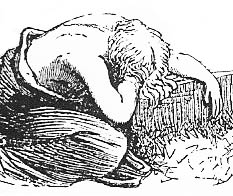
AT REST AT LAST.
The Closing Chapter of the Sad Story of Miss Pickel’s Life.
VINCENNES, Ind., Dec. 17 –A message was received from the Indiannapolis [sic] Insane Asylum at the home of Miss Lydia Pickel a day or two ago which reveals the last chapter of a sad story. The message was as follows: “Lydia Pickel is lying at the point of death. Come if you wish to see her alive.” The dying girl lived in Harrodsburg, Lawrence county. She was on [sic] of a numerous family. She accumulated a snug sum of money, which she was ambitious to invest to the best advantage. She learned that under the Homestead law she could secure a considerable tract of land with her little store of money, and with this thought in view she set out for the west.
On the way to her destination she had to travel a long way by stage coach. One night the coach was entered by several drunken cowboys. Seeing a defenceless [sic] woman was the only occupant of the coach save themselves, they attacked her. It will never perhaps be known what really took place in the stage coach on the lonely prairie that night. It is only known that the poor girl escaped from her persecutors by jumping from the coach.
Three or four days later a woman with most of her clothes torn from her person was found wandering aimlessly about on the open prairie. When captured she was found to be hopelessly insane. Fortunately a man from Lawrence county, Indiana, was present and he at once identified her as Miss Lydia Pickel, whom he had known from childhood. A guard was provided and the poor girl was sent home, and from there to the State Asylum for the Insane. Her case was beyond the power of human skill, her mental ailment being long since pronounced incurable. Her physical health had given out.
Culled from the collection of The Comtesse DeSpair: the 1886 Morbid Scrapbook.
More sad old stories can be read at Garretdom.