Today’s Icy Hot Yet Truly Morbid Fact!
In 1893, the city of Chicago hosted the World’s Columbian Exposition, a world’s fair belatedly commemorating the 400th anniversary of Christopher Columbus’s discovery of North America. The fairgrounds were situated on the city’s south side six miles south of the Loop and spread over a 700-acre tract of land abutting Lake Michigan in Jackson Park. Frederick Law Olmsted, one of America’s foremost landscape architects, transformed the sandy, swampy land into a wonderful setting of lagoons and gardens that would host exhibits from 60 countries and more than 200 buildings. The fair cost the city $30 million and drew 27 million visitors during its six-month run. It turned a 10% profit. Two prominent Chicago architects, John Wellborn Root and Daniel Burnham, were selected to design the fair’s buildings. After Root died of pneumonia in 1891, Burnham decided to emulate classical Greek and Roman styles in his designs. Each building was built of wood and covered with “staff,” a fibrous plaster substance that gave the look and feel of white marble. Thus the “White City” as it became known, appeared to be built of stone. The grand effect was further heightened at night when electric lights were played against the building’s exteriors, illuminating the “marble”.
In addition to the stately show buildings, the White City housed restaurants, cafes, and sanitation and support facilities. One of the largest of the utility buildings was the fair’s cold-storage warehouse. Dubbed the “greatest refrigerator on earth” because of its mammoth size, the six-story white terra cotta building at 64th Street and Stony Island Avenue had its own ice-skating rink and measured 130 feet wide by 255 feet long. And though not officially a part of the fair itself, the warehouse had been built specifically to store all perishable food items used by the fair’s food vendors and to manufacture ice.
The cold storage warehouse appeared to be a sturdy, well-built structure, but it did have one fatal design flaw. Its iron chimney, fitted at its base to a series of boilers, was 200 feet high, and because it was considered unsightly and clashed with the beauty of the surrounding buildings, a large wooden tower, topped with an ornate cupola, was built to enclose the chimney and hide it from view. Herein lay the problem. The cupola had been built several feet about the chimney opening creating a dangerous fire hazard. The chimney was insulated by firebrick for only the first 70 feet; the remaining 130 feet were left completely open and unprotected inside the tower. Though the architect’s plan had called for installation of a cast-iron thimble to extend the chimney above the cupola to protect it from the hot upward airflow, cost prevented it from being built.
This danger should have raised the concern of fire officials, especially after flames broke out inside the tower on June 17, although it was quickly put out by firefighters from the Columbian Exposition Fire Brigade. On July 10, the firefighters were called back to the cold storage building when another fire broke out inside the wooden tower. This time, however, the flames would not be so easily tamed. Led by their captain, James Fitzpatrick, more than 20 men rushed to the top, climbing interior stairs that took them to platforms above the hot metal smokestack. Using ropes, the men hauled up their equipment, including hose and a portable ladder. A crowd began to gather. Just then hot coals started falling onto a lower platform below the firefighters, sparking a secondary fire that quickly burned upward. When it burst through the tower it cut off escape for the firefighters above.

The flames traveled quickly up the wooden tower, directly toward the firefighters trapped 200 feet above the street. To compound the situation, the water pressure in the hose line was severely inadequate, the pumps below unable to overcome the extreme height of the tower.
The stranded firefighters were left with just one option: they could tie off their hoseline and try sliding down it to safety. Though burned in the process, two managed to escape this way, to the cheers of the crowds below. When a third man followed their lead, he plunged to his death after the hose burned in half. A few others slid down a rope to the ground, but several more were trapped above when the rope burned as well. The remaining firefighters opted for jumping or falling off the ledge. The more than 40,000 spectators watched in shocked disbelief as the firefighters fell to their deaths. It took two hours for the 30 responding fire companies to put out the warehouse fire. Another three days would pass before rescuers recovered the last of the 12 dead firefighters, including Captain Fitzpatrick, whose body had broken through the roof and was buried in the debris. Fitzpatrick had survived the fall but died a short time afterward. Five other firefighters were severely injured, and one was crippled for life. Of the dead, four were Chicago Fire Department members and eight were with the exposition’s fire brigade. Two cold storage employees and one electrician working in the building had also been killed.
The tragedy, of course, marred the world’s fair. Once again the Garden City was unable to protect itself from, or avoid being upstaged by, its greatest foe: fire.
Culled from: Great Chicago Fires: Historic Blazes That Shaped a City
Of course, I’m sure many of you know all about the Columbian Exposition by way of Erik Larson’s brilliant book The Devil in the White City. I decided to take a trip to Oak Woods Cemetery the other day to see the monument to the cold storage firefighters and take some photos of the remnants of the White City. Of course, as usual, I ended up getting quite sidetracked and I thought I’d share all the ways a Comtesse can get sidetracked whilst undertaking a simple task like photographing a couple of locations in Chicago. Now, here’s my day on the South Side…
Wretched Recommendation!
When I saw that Joe had sent me a note about a book with the word ‘Mütter’ in the title, I lazily thought to myself, “Been there, read that, got it on my bookshelf”. Luckily, I read his missive closer and realized that, no, this isn’t just another collection of photographs from the Mütter Museum (as glorious as those books always are); this is actually a book about the man behind the morbidly magnificent museum himself – Dr. Mütter! And judging by the reviews on Amazon, it looks to be an excellent book – and it’s going on my ‘To Read’ list immediately! Thank you, Joe!
Dr. Mutter’s Marvels: A True Tale of Intrigue and Innovation at the Dawn of Modern Medicine
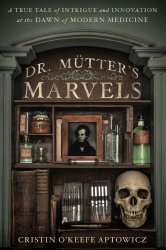
Here’s the Amazon blurb:
“A mesmerizing biography of the brilliant and eccentric medical innovator who revolutionized American surgery and founded the country’s most famous museum of medical oddities
“Imagine undergoing an operation without anesthesia performed by a surgeon who refuses to sterilize his tools—or even wash his hands. This was the world of medicine when Thomas Dent Mütter began his trailblazing career as a plastic surgeon in Philadelphia during the middle of the nineteenth century.
“Although he died at just forty-eight, Mütter was an audacious medical innovator who pioneered the use of ether as anesthesia, the sterilization of surgical tools, and a compassion-based vision for helping the severely deformed, which clashed spectacularly with the sentiments of his time.
“Brilliant, outspoken, and brazenly handsome, Mütter was flamboyant in every aspect of his life. He wore pink silk suits to perform surgery, added an umlaut to his last name just because he could, and amassed an immense collection of medical oddities that would later form the basis of Philadelphia’s Mütter Museum.
“Award-winning writer Cristin O’Keefe Aptowicz vividly chronicles how Mütter’s efforts helped establish Philadelphia as a global mecca for medical innovation—despite intense resistance from his numerous rivals. (Foremost among them: Charles D. Meigs, an influential obstetrician who loathed Mütter’s ‘overly’ modern medical opinions.) In the narrative spirit of The Devil in the White City, Dr. Mütter’s Marvels interweaves an eye-opening portrait of nineteenth-century medicine with the riveting biography of a man once described as the ‘P. T. Barnum of the surgery room.'”
More Monstrous Medical recommendations can be found at the Library Eclectica.
Fetus Du Jour!
Here’s another preserved 1930’s fetus that I photographed at the Museum of Science and Industry last week. You’ll note that as the fetuses get closer to birth, they start to look increasingly cynical. This one’s just picking its nose and watching its invisible watch. You think you’re bored NOW? Try staring at the same dark womb 24 hours a day – without a cell phone!
