Today’s All-Clear Yet Truly Morbid Fact!
In Hiroshima, Japan, at 7:09 a.m. on August 6, 1945, the civil defense control center called an air-raid alert when a single B-29 was detected in the area – it was Captain Eatherly in Straight Flush acting as a weather scout for the Enola Gay, the plane that would drop the atomic bomb. But as the plane departed, the alert was cancelled and the all clear announced. As a result, the citizens of the town left the relative safety of their air-raid shelters and resumed their tasks:
“The siren sounded the all-clear. You could say that it was the sound of this siren that killed the great majority of the citizens of Hiroshima.”
– Susumu Kimura, schoolgirl

Culled from: Eyewitness Hiroshima: First-Hand Accounts of the Atomic Terror That Changed the World

Ghastly!
Here’s a photo of a class, probably at Rush Medical College in Chicago, circa 1915. Bet that room smelled really nice.
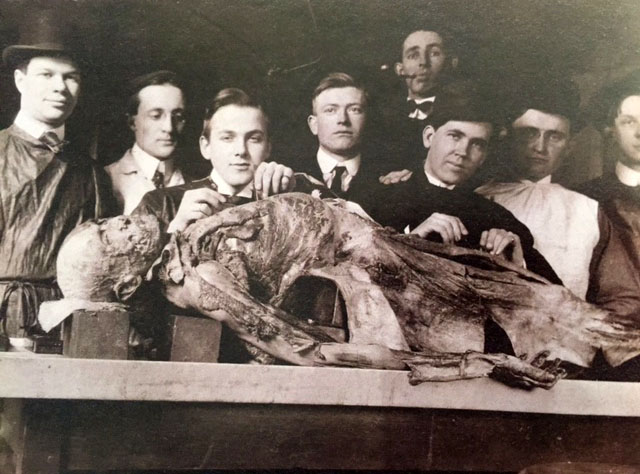
Culled from: Dissection: Photographs of a Rite of Passage in American Medicine 1880-1930

Arcane Excerpts!
Here’s another completely ridiculous case study of “menstruation” through the nipples from the marvelously strange Anomalies and Curiosities of Medicine (1896):
“Baker details in full the description of a case of vicarious menstruation from an ulcer on the right mamma of a woman of twenty. At the time he was called to see her she was suffering with what was called ‘green-sickness’. The girl had never menstruated regularly or freely. The right mamma was quite well developed, flaccid, the nipple prominent, and the superficial veins larger and more tortuous than usual. The patient stated that the right mamma had always been larger than the left. The areola was large and well marked, and 1/4 inch from its outer edge, immediately under the nipple, there was an ulcer with slightly elevated edges measuring about 1 1/4 inches across the base, and having an opening in its center 1/4 inch in diameter, covered with a thin scab. By removing the scab and making pressure at the base of the ulcer, drops of thick, mucopurulent matter were made to exude. This discharge, however, was not offensive to the smell. On March 17, 1846, the breast became much enlarged and congested, as portrayed in Plate 1 [below]. The ulcer was much inflamed and painful, the veins corded and deep colored, and there was a free discharge of sanguineous yellowish matter. When the girls’ general health improved and menstruation became more natural, the vicarious discharge diminished in proportion, and the ulcer healed shortly afterward. Every month this breast had enlarged, the ulcer became inflamed and discharged vicariously, continuing in this manner for a few days, with all the accompanying menstrual symptoms, and then dried up gradually. It was stated that the ulcer was the result of the girl’s stooping over some bushes to take an egg from a hen’s nest, when the point of a palmetto stuck in her breast and broke off. The ulcer subsequently formed, and ultimately discharged a piece of palmetto. This happened just at the time of the beginning of the menstrual epoch. The accompanying figures show the breast in the ordinary state and at the time of the anomalous discharge.”
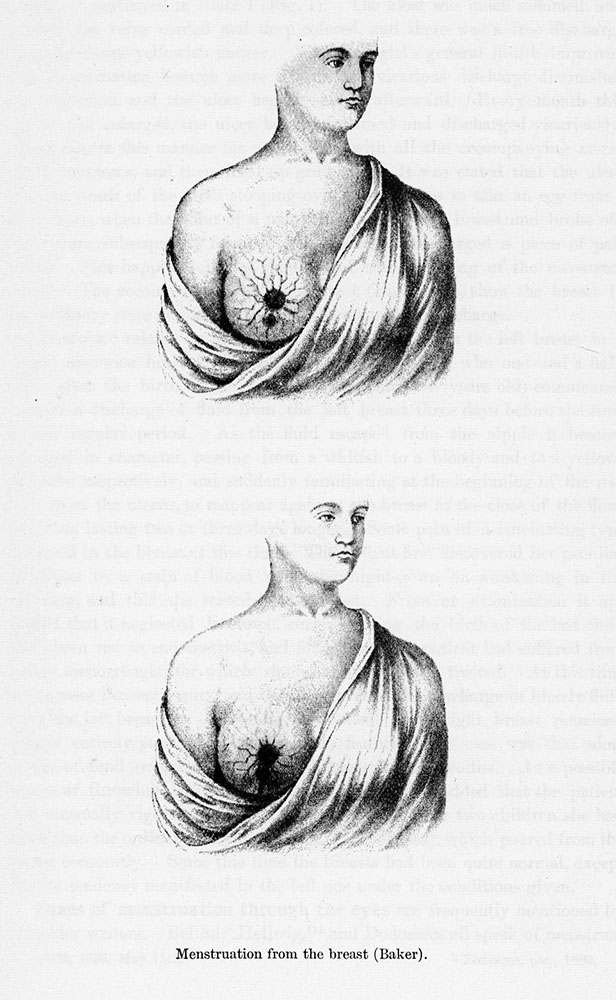
Yes. I’m sure that it was menstrual blood somehow moving from the uterus up and out the woman’s nipple. That’s far more likely than an abscess or tumor that leaked during the menses when the breasts became naturally enlarged. It’s scary to think that women had to be under the “care” of doctors so completely oblivious to how a woman’s body worked, isn’t it?
Ecch. Instead of the normal messiness and discomfort most women have to deal with monthly, that poor girl had that to look forward to as well.
Actually, menstrual discharge can occur in unusual places in the body if the endometrial tissue ends up somewhere where it shouldn’t. (Endometriosis anyone?) While we certainly don’t know if that was what was happening here, it isn’t unheard of.
True. But endometriosis makes sense – it affects the body cavity and organs immediately surrounding the uterus. How is that tissue gonna get up inside mammary glands?