And so we say goodbye to 2014 – a mixed bag of a year if ever there was one. On the good side, I finally got to achieve the dream of traveling to morbid Europe, and I had lots of great outings with friends throughout the year. (Yes, it’s hard to believe, but The Comtesse does have a few of those.) Also, I brought back the MFDJ newsletter and your feedback has made me extremely pleased that I did so!
On the other hand, there was also another inevitable break-up, another even-more-inevitable deep depression, and lots of mood stabilizing drugs. But I survived another trip around the sun and I suppose that’s worth celebrating. So let’s say goodbye to 2014 with…
Today’s Inhuman Yet Truly Morbid Fact!
When Sir Henry Morgan and his buccaneers captured the Spanish city of Panama in 1671, they took a large quantity of prisoners, as described in John Esquemeling’s Buccaneers of America (1684):
“One poor and miserable wretch was found in the house of a gentlemen of great quality, who had put on… a pair of taffety breeches belonging to his master with a little silver key hanging at the strings thereof. This being perceived by the Pirates, they immediately asked him where was the cabinet of the said key. His answer was: He knew not what was become of it, but only that, finding those breeches in his master’s house, he had made bold to wear them. Not being able to extort any other confession out of him, they first put him upon the rack, wherewith they inhumanly disjointed his arms. After this, they twisted a cord about his forehead, which they wrung so hard that his eyes appeared as big as eggs and were ready to fall out of his skull. But neither with these torments could they obtain any positive answer to their demands. Whereupon they soon after hung him up by the testicles, giving him infinite blows and stripes while he was under that intolerable pain and posture of body. Afterwards they cut off his nose and ears, and singed his face with burning straw, till he could speak nor lament his misery no longer. Then, losing all hopes of hearing any confession from this mouth, they commanded a negro to run him through with a lance, which put an end to his life and a period to their cruel and inhuman tortures.”
Culled from: The History of Torture
Ghastly!
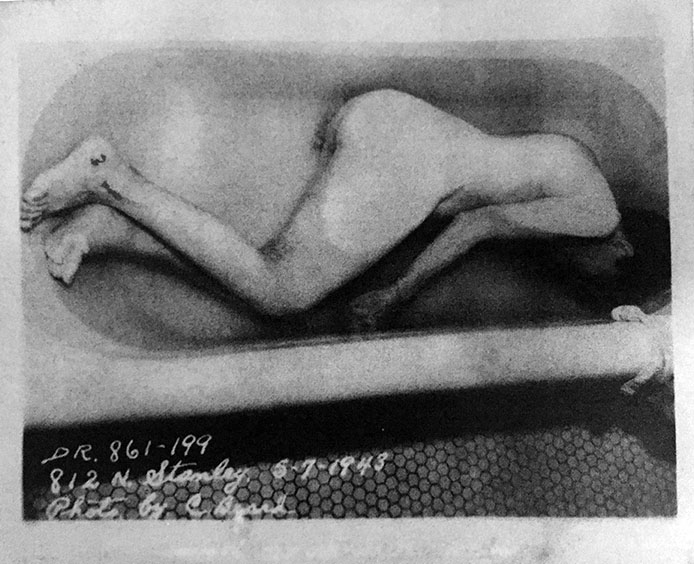
Here’s another photo, which doesn’t really have any explanation to it, from the delightfully grim book Death Scenes. The address shown is 812 N Stanley. I wonder if the people who live there right now know? I’ve often thought of dropping flyers detailing tragedies that occurred in locations on the doorstep of the houses to alert the inhabitants. Of course, I’d think it was fascinating, but normal people might not appreciate it so much. Which is all the more reason to do it, I suppose!
Wretched Recommendations!
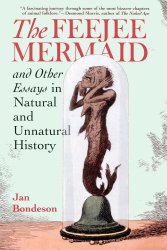
Recently I shared a morbid fact from a fantastic book called Buried Alive: The Terrifying History of Our Most Primal Fear by Jan Bondeson. Bruce writes to recommend another book by Jan:
“Jan Bondeson has written several other interesting and well-written books. I enjoyed his ‘The Feejee Mermaid and Other Essays in Natural and Unnatural History‘. He also appears in Fortean Times quite regularly.”
Here’s the Amazon blurb on The Feejee Mermaid:
“In his new collection of essays, Jan Bondeson tells ten fascinating stories of myths and hoaxes, beliefs and Ripley-like facts, concerning the animal kingdom. Throughout he recounts–and in some instances solves–mysteries of the natural world which have puzzled scientists for centuries.
“Heavily illustrated with photographs and drawings, the book presents astounding tales from across the rich folklore of animals: a learned pig more admired than Sir Isaac Newton by the English public, an elephant that Lord Byron wanted to employ as his butler, a dancing horse whose skills in mathematics were praised by William Shakespeare, and, of course, the extraordinary creature known as the Feejee Mermaid. This object became the foremost curiosity of London in the 1820s and later in the century toured the United States under the management of P. T. Barnum. Bearing a striking resemblance to a wizened and misshapen monkey with a fishtail, the mermaid was nonetheless proclaimed a genuine specimen by ‘experts.’
“Bondeson explores other zoological wonders: toads living for centuries encased in solid stone, little fishes raining down from the sky, and barnacle geese growing from trees until ready to fly. In two of his most fascinating chapters, he uncovers the origins of the basilisk, considered one of the most inexplicable mythical monsters, and of the Vegetable Lamb of Tartary. With the head and body of a rooster and the tail of a snake, the basilisk was said to be able to kill a person with its gaze. Bondeson demonstrates that belief in this fabulous creature resulted from misinterpretations of rare events in natural history. The vegetable lamb, a mainstay of museums in the seventeenth century, was allegedly half plant, half animal: it had the shape of a little lamb, but grew from a stem. After examining two vegetable lambs still in London today, Bondeson offers a new theory to explain this old fallacy.”