Today’s Infectious Yet Truly Morbid Fact!
Throughout the ages physicians have given their lives fighting infections, sometimes epidemic, that they neither understood nor could control. Though the general population, especially the wealthy, could flee the area under siege, physicians were expected to remain behind and treat the sick. Hundreds died doing this noble work.
This postmortem daguerreotype depicts such a hero, 22-year-old James Samuel Howe, who graduated from the medical college of the State University of Missouri in Saint Louis in 1849, just as cholera struck in one of the deadliest epidemics in the history of the United States. Photographs of its victims are very rare, as fear of contagion precluded close contact and the dead were quickly buried. This is the only known photograph of a physician who fell victim to this epidemic. Taken at the request of Howe’s father, who wanted it as a memorial, this image has become a visual legacy of the dedication and self-sacrifice of many physicians.
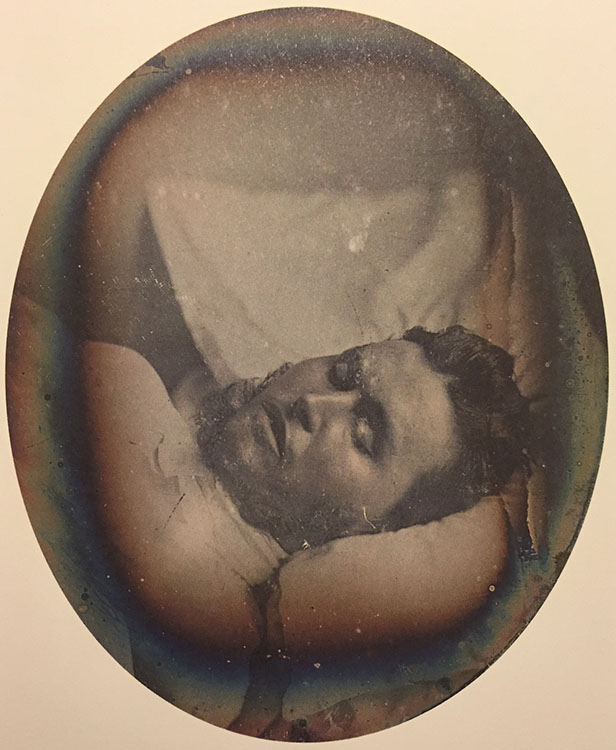
Cholera, an acute infectious intestinal disease, causes severe vomiting and diarrhea, and therefore dehydration. Soon,patients are wracked with abdominal pain, and experience unremitting muscle cramps all over their bodies. They often go into spasmodic asphyxia, which causes them to turn blue and die from lack of oxygen. Death can occur as quickly as a few hours after the onset of symptoms. In that era, the disease proved fatal to more than half of those who contracted it. Today, with proper treatment, the mortality rate is less than one percent.
As a fledgling physician, Dr. Howe was expected to earn his reputation dealing with the epidemic. However, according to his obituary, he died in the service of his patients soon after his graduation, “stricken down with the scourge now afflicting our city [as] he was engaged, with disinterestedness of purpose, in ameliorating such cases and presented themselves to his notice.”
Culled from: A Morning’s Work: Medical Photographs from The Burns Archive & Collection 1843-1939
Of course, our modern examples, as recognized by Time magazine as the “People of the Year”, are the brave physicians and nurses who fight Ebola and other epidemics around the world. True heroes.
Oh, also – you could graduate a doctor at age 22 once? Well, I guess they didn’t have as much to learn….
X-Ray Du Jour!
X-Ray of Swallowed Toy Battleship culled from Mütter Museum of the College of Physicians of Philadelphia by Gretchen Worden.
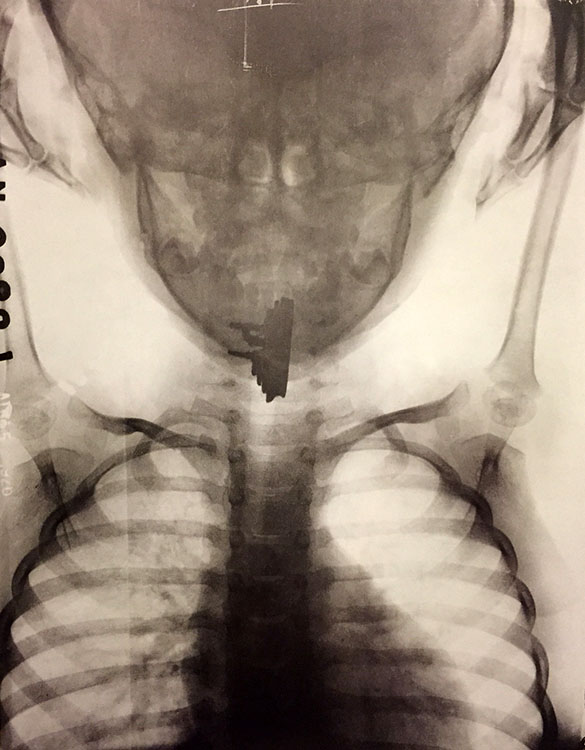
“Toy battleship caught in the esophagus of an infant. Radiograph from the Mutter Museum, taken for Dr. Chevalier Jackson (1865-1958) to locate the object before attempting removal. Dr. Jackson designed an array of specialized retrieval instruments for removing swallowed objects.”
Of course, nowadays we don’t have that problem because we have warning labels on our toys. Right?
Morbid Mirth Du Jour!

(Thanks to Katchaya for the image.)
There were some very young doctors in those days. John William Polidori, who wrote the first modern vampire story (“The Vampyre”), was a practicing physician at age 19. For a time, he was the personal doctor of Lord Byron, who provided him with a model for Lord Ruthven, his vampire protagonist. (Ruthven, in turn, was a model for Bram Stoker’s Count Dracula.) Like Dr. Howe, Polidori died very young: in 1821 he committed suicide at age 25.
In the US, the first medical school to require a college degree was Johns Hopkins in 1893. And even then, college graduates might be a year or two younger than today. In one of L. M. Alcott’s books, she has one (female!) character begin studying medicine at 16.
Fun fact: in addition to requiring a college degree, Johns Hopkins was also one of the first medical schools to admit women on an equal basis with men. The school’s early patrons, an assortment of well-to-do women, apparently insisted on it. Other medical schools were quick to adopt its BA requirement– but sadly they ignored the admitting-women innovation.