Today’s Dusty Yet Truly Morbid Fact!
The slaves were half-dressed, most of them, with rags tied around their heads and over their mouths. Their skins were white with dust. They dug, shoveled, and pushed under the watch of armed guards who clubbed or whipped them if they slowed. The sun through the dust was blinding. There were no trees to provide shade. There was only the smell, the heat, and everywhere the screaming of birds.
These were the Chinchas Islands, a sprinkling of rocks six miles off the coast of Pisco, Peru, which constituted, in 1850, acre for acre, the most valuable real estate on earth. The value came from the ground the workers and the birds walked on: ten stories of guano, the world’s best fertilizer.
The ground everywhere was springy to the step. Deep down, when the workers dug into it, it turned a rusty red. Some of the workers – about six hundred of them, all from China, coolies tricked or coerced into signing long-term labor contracts that made them virtual slaves – picked and shoveled the dusty guano into wheelbarrows. The others ran the wheelbarrows to the edge of the cliffs and dumped them into canvas chutes that funneled the guano directly into the holds of ships far below.
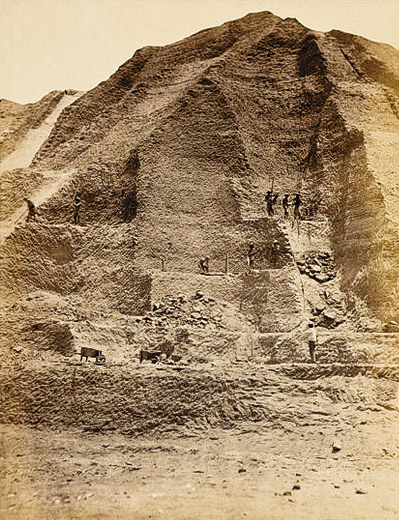
Visitors were appalled by what they found in the Chinchas. The coolies lived “almost naked, under the tropical sun… no days of rest,” one observer wrote, in huts made of reed, surviving on two small meals a day, usually maize or rice and a few bananas. On good days they might get a little meal. They worked up to twenty hours a day, six days a week, in intense heat and choking dust that never settled because here, along the same coast as the Tarapaca, it almost never rained. Up to a quarter of the workforce at a time would be too sick to work, from exhaustion, exposure, malnutrition, and something called “guano handling illness,” which included some combination of shortness of breath, coughing up blood, fainting, swollen legs, cramps, vomiting, and diarrhea. Scurvy was common. Sometimes a trench in the guano would cave in and a few would be buried alive. Any coolies who did not meet their quota of one hundred wheelbarrow loads a day had to make it up on Sunday, their only day of rest. If their hands were too sore and blistered to hold a shovel, they were yoked to the wheelbarrows like mules.
There was a prison ship off one of the islands where sailors loading guano could see eight or ten coolies at a time hanging on masts in the sun, without food or water, for infractions as minor as refusing an order. Others were punished by being tied to buoys where the sea washed over them all day or chained to small leaky boats and forced to bail to stay alive. An outraged British visitor wrote, “No hell has ever been conceived of by the Hebrews, the Irish, the Italian, or even the Scotch mind for appeasing the anger or satisfying the vengeance of their awful gods that can be equaled with the fierceness of the heat, the horror of the stink, and the damnation of those compelled to work there.”
Until their contracts were paid off, there was only one way out. Some coolies killed themselves with opium or drink – there was a thriving drug trade in the camps. Others threw themselves off cliffs or simply swam out in the sea. Dead coolies were “buried like dogs,” one visitor noted, in shallow graves scratched out of the guano. No one knows exactly how many died. Sometimes their bones were found strewn around the surface, dug up and scattered by guard dogs. For this the coolies were paid three reales (about a third of a peso) a day, two of which were withheld for meals. The contracts, held by Peruvian overseers, usually lasted five years. Guano was big money for Peru – for a few years, income from its sale supplied most of the Peruvian national budget – and few Peruvians would work on the islands, so they bought into the coolie trade, with a few wealthy families making money on contracts for the Chinese as well as the fertilizer.
Visiting ship captains and their crews hated the guano trade. At its height more than a hundred ships at a time might be waiting to load at one of the few places they could be at the two largest islands. When their turn finally came, the barrow loads of guano hurtling down into their holds raised clouds of dust so foul that most of the crew escaped by climbing into the rigging, coughing. The ships, mostly from England and the United States, were covered in yellow dust. Sailors unlucky enough to draw duty as a “trimmer” – leveling the deep piles of guano in the hold – could work no more than twenty minutes at a time, even with damp cloths tied around their mouths and noses, before clambering out, gasping for breath. Some got nosebleeds. Some were temporarily blinded. The guano ship crews drank heavily, brawled, and at the height of the trade threatened so much trouble that the U.S. Pacific Fleet was ordered to patrol the area “to maintain order among the unruly merchant seamen”.
Wretched Recommendations: Nitrogen-Rich Edition!
The Alchemy of Air: A Jewish Genius, a Doomed Tycoon, and the Scientific Discovery That Fed the World but Fueled the Rise of Hitler

by Thomas Hager
I just finished this fascinating book which is about Fritz Haber and Carl Bosch, two German men who together solved the most pressing issue of the early 20th century: how to capture the nitrogen in the air and use it to fertilize the world’s crops. It’s kind of amazing when you think about it, but nobody really knows that the human population faced world starvation just over a hundred years ago because fertile farmlands were being rapidly depleted of nutrients and the exploding human population was such that the traditional farming procedure of allowing fields to lie fallow for a number of years to allow the nutrients to be replenished was simply not feasible. Guano (bird poop) fields were being mined (and wars being fought over them) to supply fertilizer, but there was only a matter of time before they were gone… and then what? Crops would begin to falter and fail and mass starvation would quickly bring to an end the human population boom. (Yeah, I know – a totally mixed blessing.)
The solution was to figure out a way to capture the nitrogen that was floating about in the air and use it to fertilize the fields. This wasn’t an easy task and the man who finally figured out how to do it was Fritz Haber. Haber, however, only came up with a table-top working model that could produce a few drops of ammonia here and there. It took industrial genius Carl Bosch to take that model and turn it into an enormous factory. Voila! Humans were saved and the planet was doomed! Haber and Bosch both won Nobel Prizes for this landmark work.
Although the book spends a lot of time discussing the technical details of how they were both able to overcome their respective technological challenges, the most interesting part for me was the story of Fritz Haber, as complex a character as you’ll find in modern history. Haber, a Jew, was desperate to prove himself as a good, loyal German. To prove his worth, during World War I, he became the father of chemical warfare, inventing chlorine gas and other chemical weapons. He dressed in a military uniform and considered himself to have contributed heavily to the German war effort.
His young wife, Clara, herself a gifted scientist, plunged into despair through a combination of both a stifling life as a wife and mother to a cold husband, dashed career aspirations, and her horror at her husband’s evil doings with chemical weapons. Eventually she walks into the garden with a gun and ends her suffering.
Of course, Haber’s story gets really pathetic once Hitler comes into power and starts ridding Germany of all the Jewish scientists. Haber comes to realize his folly as a Jew trying to be an upstanding, loyal, German citizen. He was exiled out of Germany and died soon thereafter (in 1934). Ironically, the gas used to kill millions of Jews a few years later, Zyklon-B, was one of Haber’s company’s products. As darkly ironic a turn of events as you’ll see.
The story of Bosch and his attempts to keep his enormous factories running during the post-WWI years is also quite interesting, as France attempts to steal the technology as part of reparations. Bosch is revealed as an industrial genius, a visionary business man, and, ultimately, another tragic figure. Due to his criticisms of Nazism, he was removed from his position as the head of the huge chemical conglomerate IG Farben soon after Hitler’s rise to power, and fell into alcoholic despair. He died in 1940.
And the Haber-Bosch process which converts nitrogen in the air to ammonia? It’s part of us all. It’s estimated that half of the protein within each of us is made of nitrogen that was originally fixed using this process. And that’s something well worth reading about.