Today’s Tough-Minded Yet Truly Morbid Fact!
Labor demonstrations began in the nitrate (fertilizer) fields of Chile around 1903, tied to the growth of anarcho-syndicalist resistance societies across all of Chile for all sorts of laborers. Small strikes were used in the beginning, perhaps a day long work stoppage at a mill when the men and their families would gather to hear speeches in the plaza. Almost always the mill owners would refuse to bargain, and the government would step in and get the laborers back to work.
The 1907 march started the same way, with workers at a nitrate mill near Iquique laying down their tools. This time, instead of staying at the mill, they decided to take their protest into town. At first it was peaceful. It is difficult to know exactly what happened next, because eyewitness accounts differed dramatically. It is known that around 1900 the total population of Iquique was about 16,000. After a few days, the number of protesters around the Santa Maria schoolyard grew to somewhere between 6,000-20,000 workers and family members. It appears they were entirely peaceful. For a few days there was an optimistic sense that the sheer presence of so many workers, plus a firm refusal to leave Iquique until they were heard, would result, finally, in the elimination of the fichas system (payment only in company-issued currency that could only be redeemed at company stores), better wages and improved work conditions.
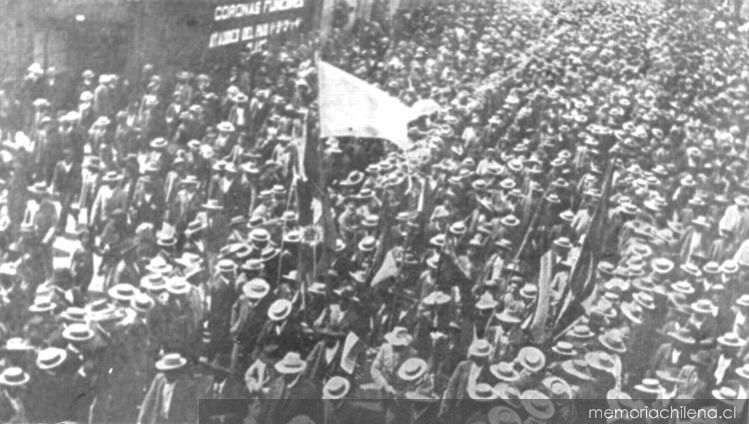
Iquique town officials notified the government in Santiago, requested help to maintain order, and tried to mediate agreements between the management and the workers. But talks fell through after the mill owners flatly refused all demands.
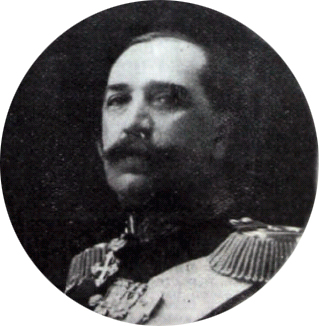
Two Chilean ships arrived carrying a military force under the command of a tough-minded general, Roberto Silva Reynard. General Silva was ordered to end the strike. Silva had machine guns from the ships set up at the schoolyard. Soldiers surrounded the workers. Martial law was declared.
On the afternoon of December 21, 1907, the longest day of the year in Iquique, Silva gave the strikers a deadline to disperse. Instead of leaving, the strike committee called a meeting on a school balcony under the flag of Chile. The workers in the schoolyard stayed with them. The generals’ deadline passed. Then, shortly afterward, the soldiers surrounding the schoolyard were ordered to ready their arms. Some of the soldiers, especially some who had grown up in Iquique, refused to raise their guns. Silva turned to men from the ships, men who came from other parts of Chile, the sailors manning the machine guns. They were ordered to fire.
The strike leaders under the flag were shot first. “As though struck by lightning they fell,” wrote a witness. The crowd panicked. It was reported that some of the strikers had weapons and might have tried to use them. The machine gunners strafed the schoolyard, firing for what seemed like a few minutes, no one was quite sure. There were cries and screams, there were many women and children. The crowd broke and ran; the schoolyard emptied. Only bodies were left behind. Iquique officials claimed that 126 strikers died; the British minister in Santiago estimated somewhere around 500. Historians now believe that somewhere between 1,000 and 3,000 workers, spouses, and children were killed. There were no reports of any military casualties.
It was the deadliest incident in world labor history. The Iquique Massacre, as it became known, broke the back of organized labor in the nitrate fields. Eventually the owners finally abandoned the ficha system, but at their own speed, in their own time. The Chilean military changed its rules so that soldiers would no longer be given active duty in their hometowns. Years later General Silva, the man who gave the order to fire, was attacked with a dagger by a relative of one of the Iquique dead. Silva survived the attack but suffered permanent effects from the injuries: he lost all movement on half of his face, became blind, and was mostly an invalid until his death in 1920. His attacker was sentenced to 5 years in prison.

Here’s that bastard Renaud:
Arcane Excerpts!
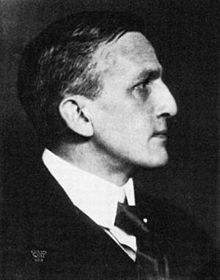
I just stumbled across one of the most twisted anti-war arguments I’ve ever seen, by German physician and physiologist Georg Friedrich Nicolai (1874-1964). Georg refused to serve in uniform during World War I and fled Germany. After the war he tried to resume his academic career in the Weimar Republic, but was prevented by the resistance of nationalist students. A committed “pacifist,” he left Germany forever in 1922. The following quotation is taken from his book The Biology of War, which drew on a series of lectures held during World War I.
“War protects the blind, the deaf mutes, the hunchbacked, the scrofulous, the imbeciles, the impotent, the paralysed, the epileptics, the dwarfs, the freaks. – All these dross and scum of the human race rest easy, for no bullets whistle towards them… For them, war is practically life insurance.”
Sweet guy, huh? I’m surprised he didn’t include “the female” in his list.
Psychiatric Patient Du Jour!
Before-and-after photograph from the German slide series “Caring for the Insane, Then and Now” (1924-25) attesting to successful treatment. The lecture text contrasts them: “a patient exhausted by severe states of anxious excitement” and “the same patient after appropriate hospital treatment has not only improved her mental health, but also transformed her physical appearance.”
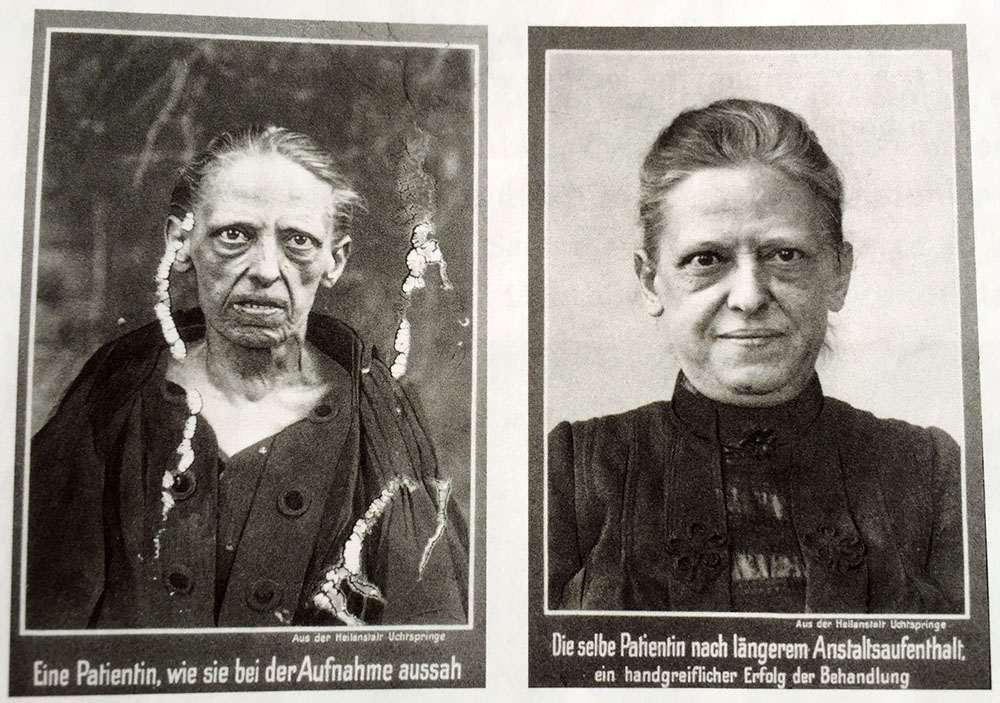

(Of course, I was thinking the ‘After’ picture looks like me on Monday and the ‘Before’ pic looks like me on Friday, but hey…)
Quote:
(Of course, I was thinking the ‘After’ picture looks like me on Monday and the ‘Before’ pic looks like me on Friday, but hey…)
———–
SO true! I got a good laugh out of that, thank you!