Today’s Yellow-Gray Yet Truly Morbid Fact!
German chemist Fritz Haber showed his patriotism during World War I by creating chlorine gas which could be utilized against vulnerable troops huddled in trenches because it was heavier than air and highly toxic. He came up with a plan for deploying canisters along a fifteen-mile stretch of the front, tended by specially trained troops who would release the gas in precise synchrony when the wind was right. The demoralized enemy would break and run. Behind the toxic cloud would march thousands of German soldiers wearing gas masks, sweeping through the enemy lines to victory. Hardly a shot would be fired. Haber’s gas would open the door to Paris and victory. When one of his colleagues expressed reluctance about gas warfare’s seeming violation of international accords, Haber reminded him that the French had already used gas. In any case, he argued, if the chlorine attack worked, the war would end more quickly and “countless lives would be saved”. (Hmmmm, seems like I’ve heard that atomic argument before? – DeSpair)
In March 1915 Haber’s gas troops began placing their canisters along the lines at Ypres, burying them in the soil under cover of night to avoid tipping-off the enemy. Haber hid his canisters and waited for the wind to shift. For weeks gas attacks were planned and men gathered, then dismissed as the weather conditions refused to cooperate.
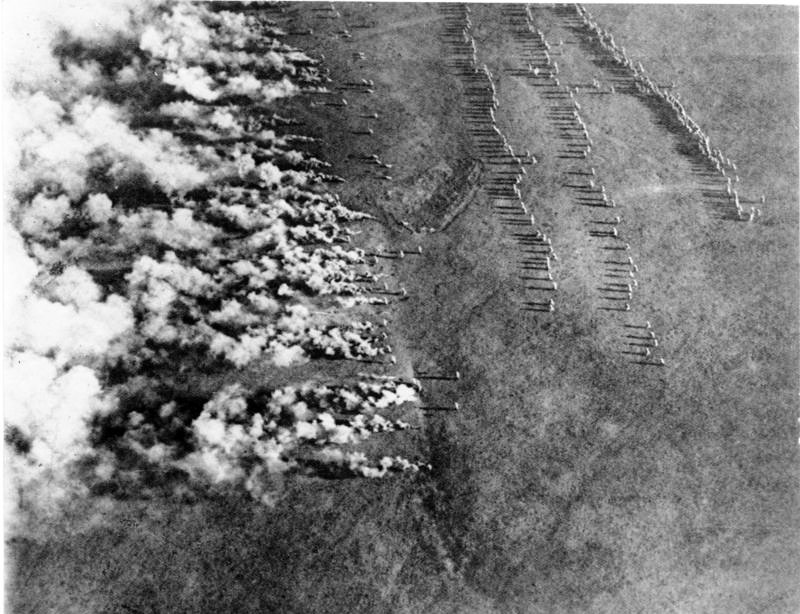
The offensive was reset for the morning of April 22, 1915. Thousands of German troops were again gathered. At first the wind refused to cooperate but late in the day it finally reversed, and at long last the order came to release the gas. About 5:00 p.m., with perfect precision, Haber’s gas troops opened their canisters. A wall of chlorine gas four miles long began slowly advancing toward the French.
It worked just as Haber had predicted. The gas caused a panic. A British soldier stationed several miles from the attack remembered the scene, with a strange cloud of yellow-gray gas moving forward, a strange tang in the air, and then, “Suddenly down the road from the Yser Canal came a galloping team of horses, the riders goading their mounts in a frenzied way; then another and another, till the road became a seething mass with a pall of dust over all.” The horses were throwing froth, the riders wild-eyed, sometimes two or three to a horse. They were followed by thousands of troops on foot, many of them French colonial soldiers from Algeria, mobs of men running as fast and as far as they could, throwing away their rifles and packs, even their tunics.
As Haber had hoped, the attack opened a huge gap in the Allied lines. But the Germans squandered their opportunity. German soldiers, unsure about the remaining gas, moved forward tentatively. For an hour in the dusk they probed their way into an eerily deserted landscape. There was no major resistance. But they were too slow. As they felt their way forward, Canadians stationed to the sides of the gas attack held their line and began pouring flanking fire into the advancing Germans. As darkness fell, the Germans stopped. The reserve troops needed to complete the breakthrough had been sent away. That night the Allies marched in more troops to seal the gap. Although the Germans conquered a sizable chunk of the area, they lost their chance to win the war.
The Allies recovered from their surprise, educated their troops, and gave their men improvised respirators made from wetted handkerchiefs. When the Germans tried another, smaller, chlorine release two days later, the Canadians under attack were pushed back a bit but not crushed. Then the Allies began planning their own gas attacks. The first British attempt made at Loos five months later, using chlorine release from canisters, failed when the wind shifted, blowing gas back into their faces. It is estimated that as many British soldiers as Germans died that day from the gas. Then both sides went on to develop more, better, deadlier poison gases.
It’s a sick irony that Haber was Jewish and one of his company’s other creations, Zyklon-B, would later be used to execute Jews in the World War II concentration camps. Haber was dead by then though – a broken man after he, the ideal German, was persecuted and had to flee the country in the early 30’s.
And, of course, I keep thinking of all the innocent victims of these attacks like the birds. 🙁
Here’s what a World War I German gas attack looked like to the high-flying birds:
In Praise Of Gas Masks
And one thing we can thank Fritz Haber and his chemical weapons for: creepy gas mask photographs. There are quite a few to enjoy on Pinterest.
