Today’s Subatomic Yet Truly Morbid Fact!
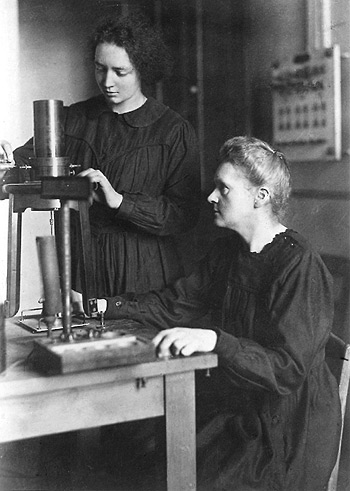
Irène Joliot-Curie was Marie Curie’s slender, sad-eyed daughter. A birlliant scientist herself, Irène and her husband, Frédéric Joliot-Curie, picked up on Marie’s work and soon one-upped her. Rather than just finding radioactive elements, Irene figured out a method for converting tame elements into artificially radioactive atoms by bombarding them with subatomic particles. This work led to her own Nobel Prize in 1935. Unfortunately, Joliot-Curie relied on polonium as her atomic bombardier. And one day in 1946, not long after Poland had been wrested from Nazi Germany, only to be taken over as a puppet of the Soviet Union, a capsule of polonium exploded in her laboratory, and she inhaled Marie’s beloved element. Joliot-Curie died of leukemia in 1956, just as her mother had twenty-two years before.
Marie Curie and her daughter Irène in the lab:
Weegee Photo Du Jour
Weegee was the pseudonym of Arthur Fellig (June 12, 1899 – December 26, 1968), a photographer and photojournalist, known for his stark black and white street photography. Weegee worked in Manhattan, New York City’s Lower East Side as a press photographer during the 1930s and ’40s, and he developed his signature style by following the city’s emergency services and documenting their activity. Much of his work depicted unflinchingly realistic scenes of urban life, crime, injury and death.
Here’s a photo from the book Weegee’s New York: Photographs, 1935-1960
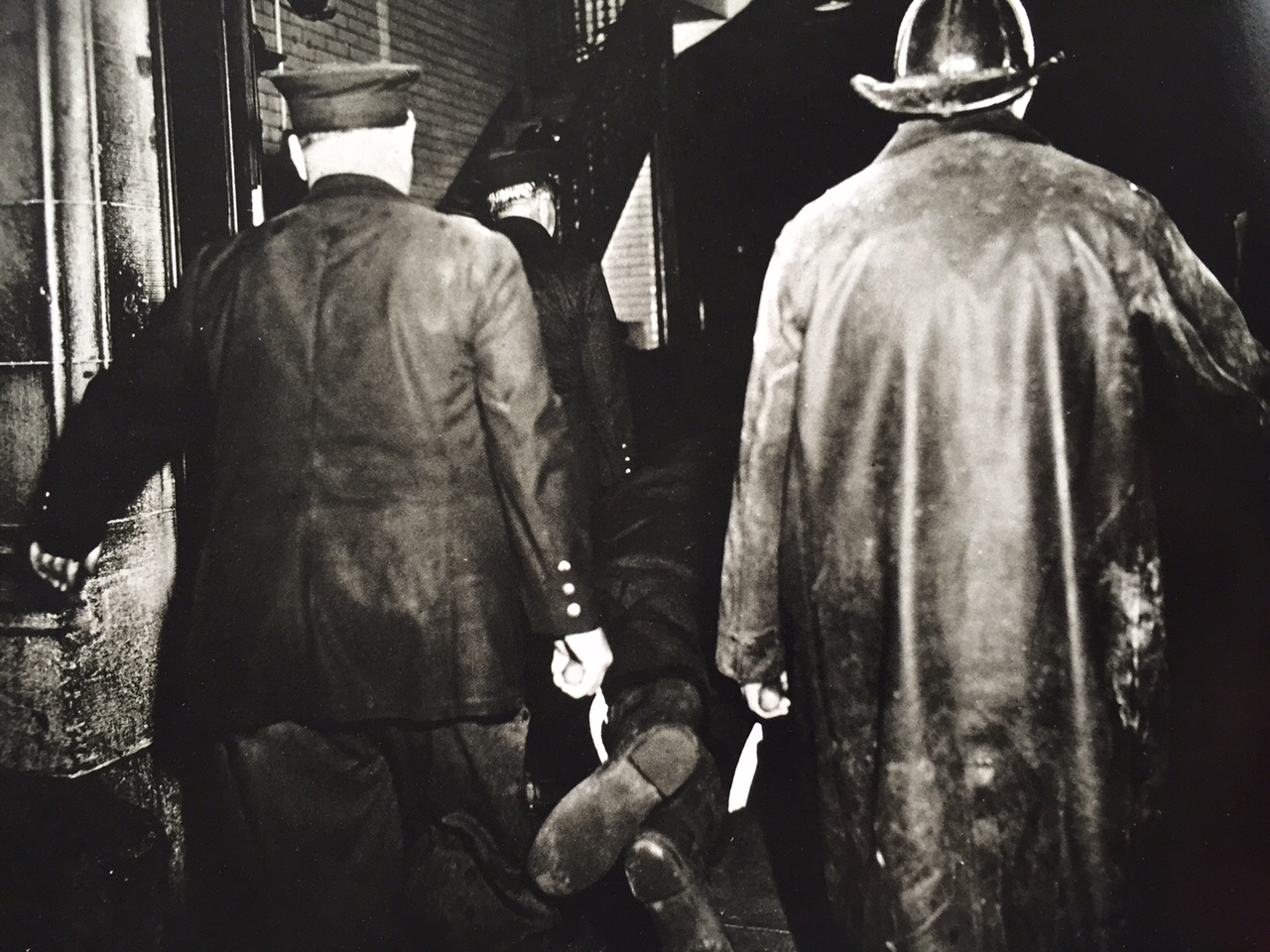
Firefighters carrying a body to the morgue.