Today’s Subservient Yet Truly Morbid Fact!
Clara Immerwahr (June 21, 1870 – May 2, 1915) was a German chemist. She was the first woman to be awarded a doctorate in chemistry in Germany. She was also an active women’s rights activist.
Immerwahr studied at the University of Breslau, in 1900 attaining her degree and a Ph.D in chemistry under Richard Abegg. Her dissertation was entitled Contributions to the Solubility of Slightly Soluble Salts of Mercury, Copper, Lead, Cadmium, and Zinc. She was the first woman Ph.D. at the University of Breslau and received the designation magna cum laude.
Immerwahr married Fritz Haber in 1901. She was from a Jewish family, and had converted to Christianity in 1897. Due to societal expectations that a married woman’s place was in the home, her ability to conduct research was limited. She instead contributed to her husband’s work without recognition, translating his works into English. In 1902 she gave birth to Hermann Haber (1902–1946) the only child of that marriage.
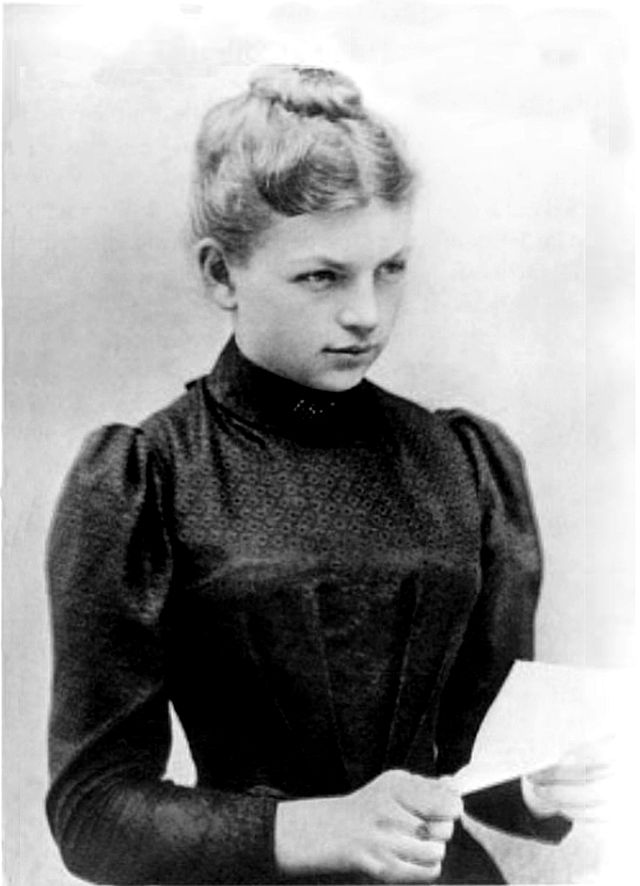
Confiding in a friend, Immerwahr bemoaned her subservient role:
It has always been my attitude that a life has only been worth living if one has made full use of all one’s abilities and tried to live out every kind of experience human life has to offer. It was under that impulse, among other things, that I decided to get married at that time… The life I got from it was very brief…and the main reasons for that was Fritz’s oppressive way of putting himself first in our home and marriage, so that a less ruthlessly self-assertive personality was simply destroyed.
During World War I, Fritz Haber became a staunch supporter of the German military effort and played an important role in the development of chemical weapons (particularly poison gases). His efforts would culminate in his supervision of the first successful deployment of a weapon of mass destruction in military history, in Flanders, Belgium on April 22, 1915.
Clara, waiting at home, told a friend that she was in despair. The news from the front was all too horrible, chemicals being used as weapons. She had been shocked just a few months before when a friend working at Haber’s institute had been killed in a chemical explosion, a lab accident, and now her husband was masterminding the murder of thousands. She loved chemistry. This was a perversion.
After his limited success at Ypres, Fritz Haber returned to Berlin, where he was feted, honored, and ordered to the eastern front to prepare gas attacks against the Russians. Before he left, Haber threw a party at his home. It was said later that the guests included Charlotte Nathan, the vivacious young business manager of Haber’s Berlin club.
Later that night, Clara, according to her biographer, spent hours writing several letters. Then she went to the villa’s garden, carrying her husband’s service revolver. Her son Hermann, then twelve years old, heard two shots. He ran to the garden and found her. She had aimed for her heart and was bleeding badly, but she was still alive. Hermann called his father, who had, it was said, taken sleeping pills. By the time Fritz got to her it was too late.
It was assumed that the first of the two shots was Clara testing the gun. None of her final letters survived.
Fritz Haber, a few days later, boarded a train for the eastern front.
Culled from: Wikipedia and The Alchemy of Air: A Jewish Genius, a Doomed Tycoon, and the Scientific Discovery That Fed the World but Fueled the Rise of Hitler
Stories like Clara’s break my heart; so many brilliant women who were made to suffer at the hands of patriarchy. So many stifled dreams, frustrated desires, desperate lives. 🙁
Clot Du Jour!
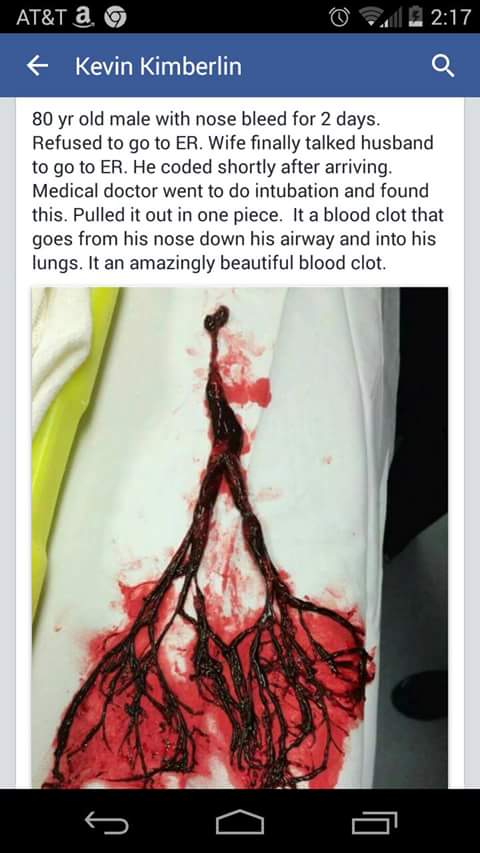
The human body can be a work of art. For example, take this lovely clot that that was removed from an unfortunate old man. Isn’t it something? (Thanks to Tracy for sharing.)
marie Curie is not impressed with Clara.
Pierre Curie is not impressed with Fritz.
(There was a guy on “Jeopardy! just the other night named Fritz.)
Makes you wonder why Clara married Fritz at all, they didn’t seem to have anything in common beyond a basic interest in chemistry.