Today’s Phony Yet Truly Morbid Fact!
At around 6 a.m. on March 22, 1915, Charles Stielow, a German immigrant of massive strength and feeble intellect, awoke at the farm where he worked in West Shelby, New York. Walking to the barn to begin his day’s work, he discovered the body of Margaret Wolcott, the farm housekeeper. She had been shot to death. A trail of blood led Stielow to the farmhouse, where he found his employer, Charles Phelps, unconscious on the floor. Although still alive, Phelps would not survive the morning. Autopsies revealed that both victims had died form .22 caliber gunshot wounds. Because the farmhouse had been ransacked and two hundred dollars stolen, police ascribed the murders to a bungled robbery.
At an inquest on March 26, Stielow, whose grasp on events was childlike at best, denied owning any .22 caliber weapons. But his brother-in-law, Chester Green, who as if anything even more retarded than Stielow, admitted to police that he had hidden no fewer than three weapons – all .22 caliber and all belonging to Stielow. He claimed to have acted on his brother-in-law’s instructions. After a brutal interrogation, Green confessed that he and Stielow had committed the murders.
Stielow was arrested and held at the local jail for two days without either food or sleep. After being questioned around the clock, he admitted to owning the three weapons but said he had told Green to hide them only because he knew that a search was on for all .22 caliber firearms. Promised that if he confessed to the murders he would be allowed to go home to his wife, Stielow did so. However, despite making the confession, Stielow resolutely refused to sign a statement to that effect.
At this point, one of the shadiest characters in the history of American jurisprudence entered the proceedings. Using the title of doctor – a qualification that existed only in his fertile imagination – Albert Hamilton had been hoodwinking juries for years, most often on behalf of unscrupulous prosecutors and always at a considerable profit to himself. A shameless self-promoter, Hamilton exuded an air of immense authority on a wide variety of subjects. Unfortunately for Stielow and Green, one of those pseudo-specialties was firearms.
Despite numerous holes in his testimony, the jury believed Hamilton’s bogus assertions that the bullet had to have been fired from Stielow’s gun and Stielow was found guilty and condemned to death. (Earlier, in a separate trial, Chester Green had pleaded guilty and was sentenced to life imprisonment.)
On death row, Stielow came to the attention of Spencer Miller, Sing Sing Prison’s deputy warden. In conversation with the simpleminded laborer, he became convinced of Stielow’s innocence and referred the case to a group of New York ladies, known as the Humanitarian Cult, who were dedicated to the abolition of capital punishment. Their efforts on Stielow’s behalf were tireless and at times nerve-wracking. Three appointments with the executioner were halted only at the final hour; the closest call was in 1916, when Stielow came within forty minutes of begin strapped into the electric chair before a stay of execution was phoned through.
Investigators hired by the Humanitarian Cult learned that two drifters named Erwin King and Clarence O’Connell, then serving sentences for robbery, were known to have been in West Shelby on the night of the murder and had been heard discussing the crime the next morning. Urged by the ladies to clear his conscience, King finally confessed that he and O’Connell had committed the dual murder.
The case was reopened and Hamilton’s ballistics “evidence” was re-examined. It was found that the bullets could NOT have been fired from Stielow’s gun based upon the groove patterns. On May 9, 1918, Charles Stielow and Chester Green walked out of Sing Sing prison as free men.
Culled from: The Casebook of Forensic Detection
Talk about a case that illustrates the best (Humanitarian Cult) and worst (Albert Hamilton) of human nature in one fell swoop.
Car Crash Du Jour!
One of my favorite books is Car Crashes and Other Sad Stories by Anaheim photographer Mell Kilpatrick. It’s a collection of car crash photos from the 40’s and 50’s, often with corpses still strewn across the enormous interior (or out of it, since there were no seat belts in those days). It combines my love of old cars with my love of morbidity and is the perfect ambulance chaser book!
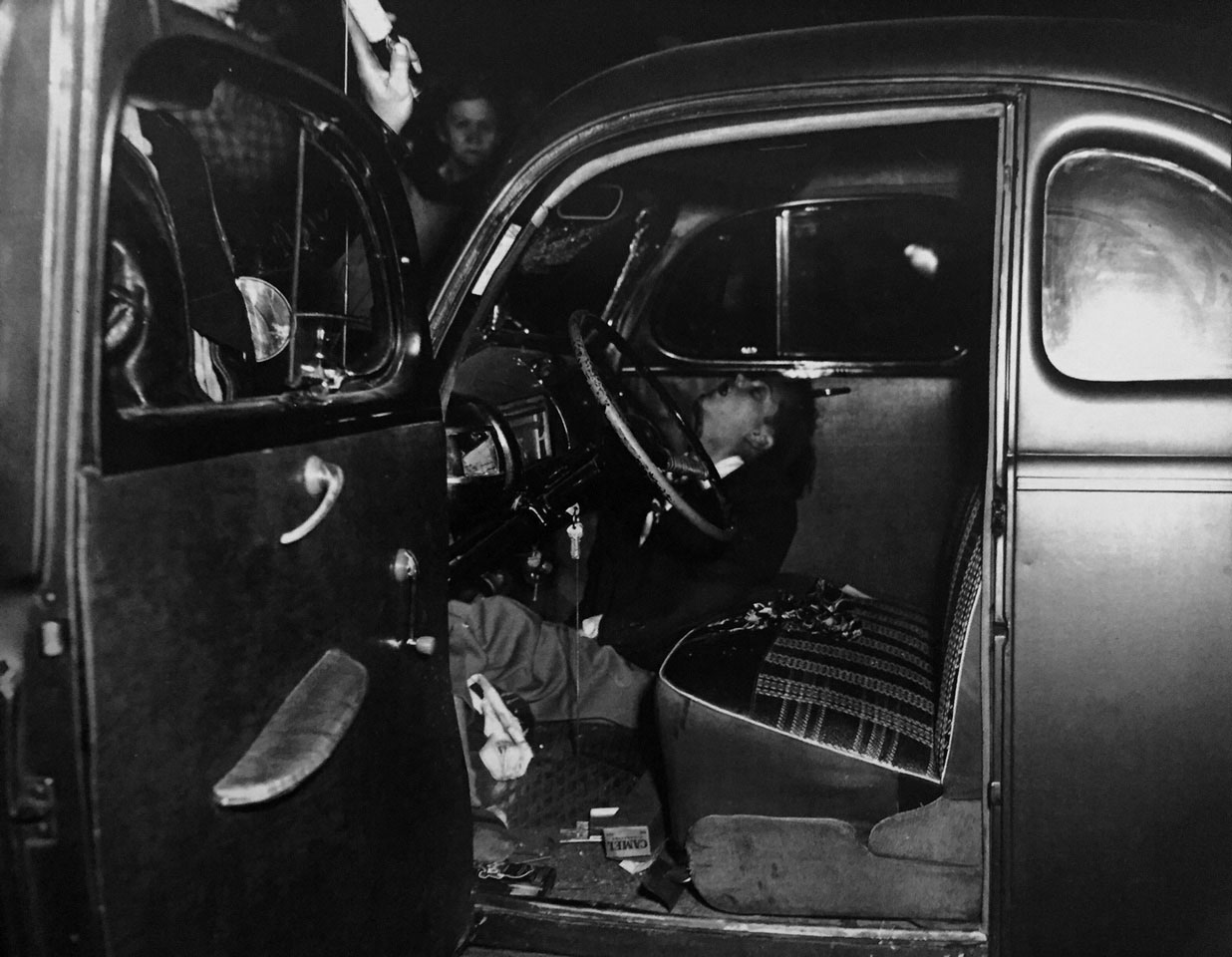
17th and South Main, Los Angeles.
I love the open bottle of alcohol and the box of cigarettes on the floor. Ah, the good old days! When ashtrays were for ashes, seatbelts were non-existent, and drunks barreled along the roads in hulking steel coffins! *sniffle* I’m getting all nostalgic for standing on the seats in my Mom’s station wagon (Betsy) when I was a toddler.
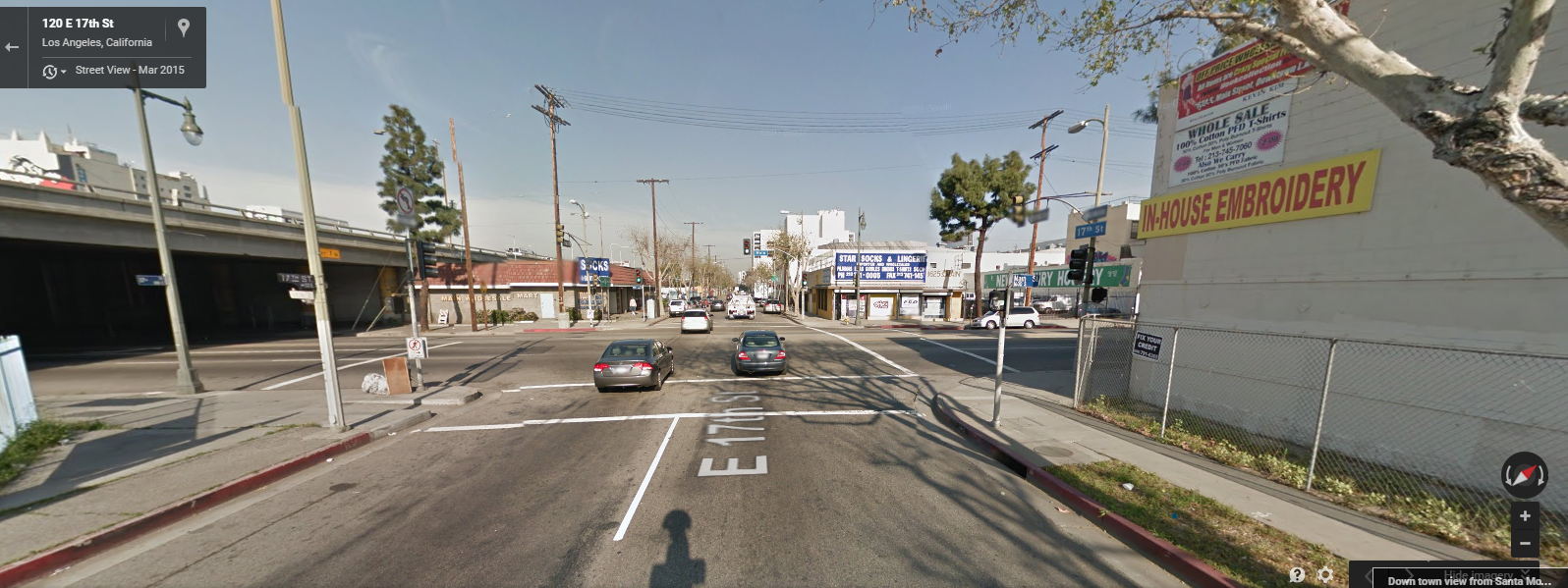
And through the miracle that is Google Maps I went and took a look at the intersection where this guy met his untimely demise. I find the most boring things interesting, don’t I?
ZOMG! My Mama had a station wagon named “Betsy”! I forget the make but it was blue and had red interior and the passenger window was cracked.
Daddy’s cars were called “Matilda”.
I was in high school back in the late 1970s when driver’s ed was still part of the curriculum. I remember those old gross-out films such as “Highways of Agony” and so on. Fun, morbid times.