Today’s Addicted Yet Truly Morbid Fact!
Charles Pierre Baudelaire (1821-1867) was a French poet who also produced notable work as an essayist, art critic, and pioneering translator of Edgar Allan Poe. While living in Paris’s Latin Quarter in the 1840’s, he met the Haitian actress and prostitute Jeanne Duval. She became his inspiration, “The Black Venus,” his “mistress of mistresses,” and his unattainable love for nearly the remainder of his life.
Craft-wise, Baudelaire worked slowly, primarily because of his opium addiction, and it wasn’t until 1857, when he was in his mid-thirties, that he saw his first volume of poetry, The Flowers of Evil, in print. His themes of sex and death caused a moral outrage from the outset, setting off a tedious path of legal prosecution for publisher and writer, both eventually being convicted of blasphemy, obscenity, and corrupting the morals of society. Although writers such as Flaubert praised his subject matter and noted, “It maybe a perverted taste, but I love prostitution,” Baudelaire was held up as a poète maudit, a cursed poet without class. This ostracizing and persecution only made him fall deeper into addiction, and he surrendered hopelessly to the true mistress of his life – opium.
Baudelaire never married, and preferred to pay for sex, going back again and again to Duval. He usually asked Duval to do no more than the equivalent of a Victorian lap dance, wearing the cheap jewelry he provided her as gifts. Yet it was basically a one-sided love affair. Duval, herself an addict, couldn’t care less, like any good hooker, obliging when Baudelaire had money and infuriatingly aloof when he had none. Nevertheless, his fantasy image of her became the genesis for some of his best love poems. He imagined taking Duval back to Haiti, where he promised: “I’ll love you to death.”
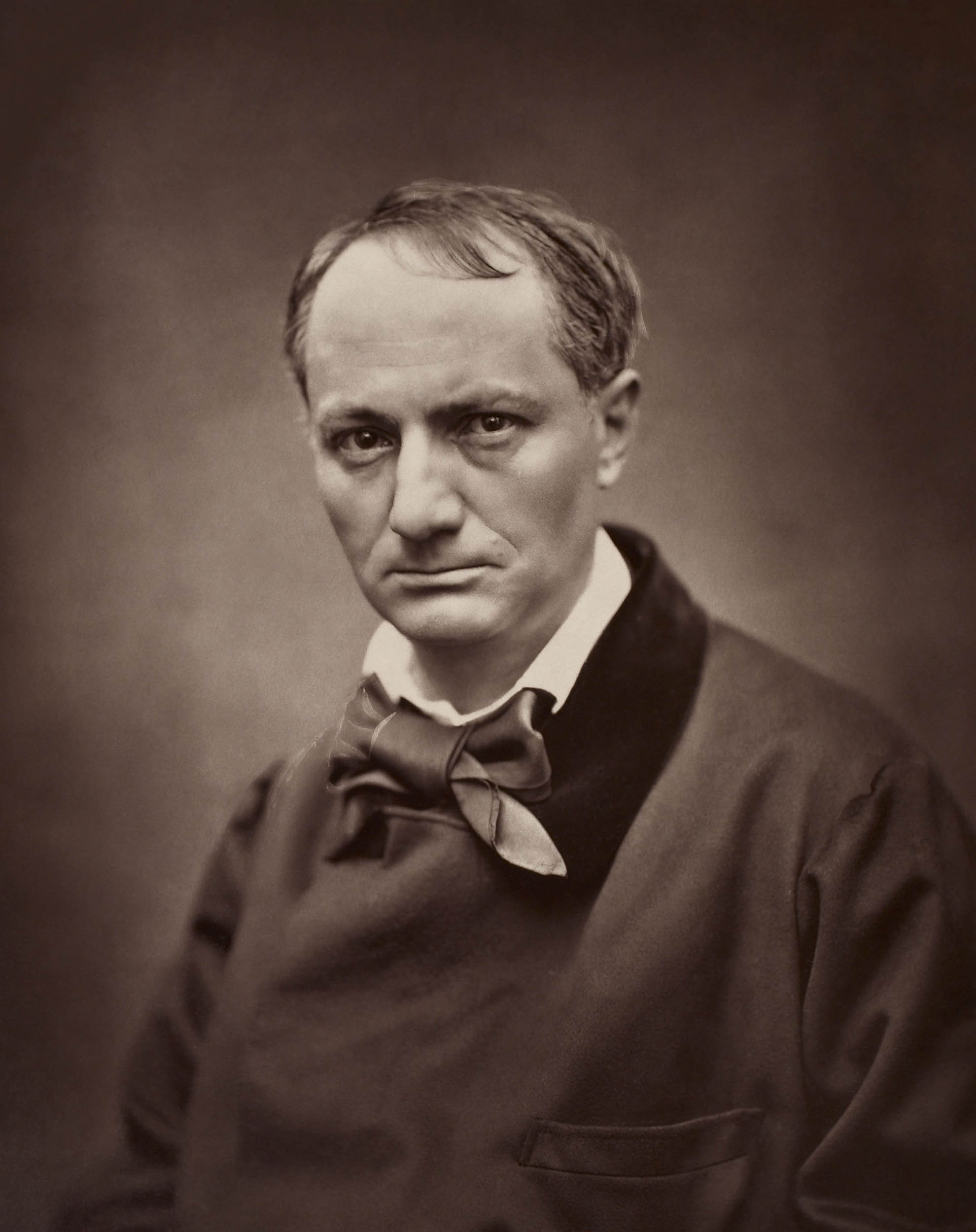
As his notoriety grew, among writers, at least, so did Baudelaire’s impotence, nagging abdominal pains, constipation, and general ill health. He blamed his depression and miserable life as a result of his unappreciated genius, and refused to view his sordid affairs as side effects of opium use. Even his crippling financial indebtedness, as he borrowed from whomever he could without intention to repay, was – and still is – another typical trait of anyone as wrapped up as he was in his addiction. Baudelaire found relief only when high, noting, “Common sense tells us that the things of the earth exist only a little, and that true reality is only in dreams.” He was convinced that nothing ignited overlapping dream images better than opium.
Although it was once believed Baudelaire died of syphilis, many of his ailments were not entirely consistent with the end stage of that disease, and the decline of his health seems more likely attributable to the decaying body of a junkie. As so many did when opium no longer worked, Baudelaire made a last-ditch attempt to get off the stuff and tried what is now called a “geographical cure” by fleeing Paris for Brussels. There he battered his already damaged liver by resorting to drink in vast quantities and soon suffered a stroke that resulted in hemiplegia, a condition where paralysis affects one half of the body. He was transported to a clinic in Paris. His condition worsened, his brain starved of oxygen, until suffering aphemia, a loss of the ability to produce and possibly comprehend language. He died in 1867 at age forty-seven, unable to speak, cradled by his mother, by whom he had always felt betrayed.
“How little remains of the man I once was, save the memory of him! But remembering is only a new form of suffering.” – Charles Baudelaire
Culled from: Genius and Heroin: The Illustrated Catalogue of Creativity, Obsession, and Reckless Abandon Through the Ages
And Regarding Jeanne Duval…
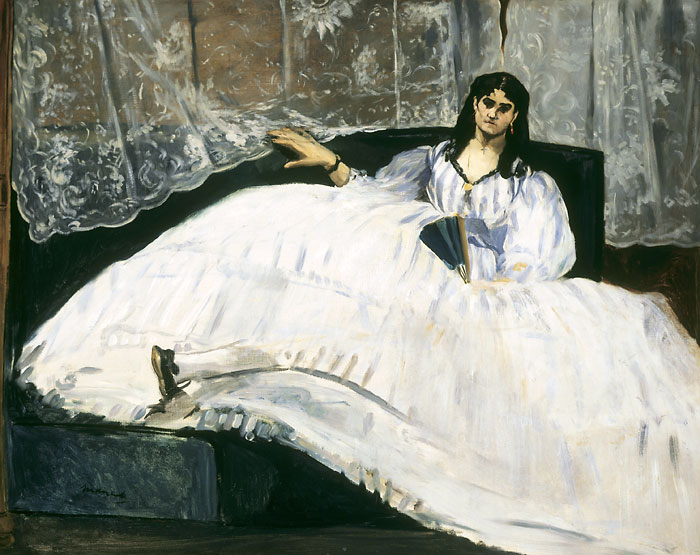
In 1862 French painter Édouard Manet painted “Baudelaire’s Mistress Reclining,” at a point when the poet had finally ended relations with the prostitute. Five months after sitting for this bizarre and unflattering portrait, in which her right hand looks the size of a lumberjack’s, Jeanne Duval went blind and soon after died of syphilis, at age forty-two.
I’m reminded of a Smiths lyric – which might well have been written by Baudelaire himself:
Jeane, the low-life has lost its appeal
And I’m tired of walking these streets
To a room with its cupboard bare
Jeane, I’m not sure what happiness means
But I look in your eyes and I know
That it isn’t there
Oh, we tried and we failed…
Jeane, there’s ice on the sink where we bathe
So how can you call this a home
When you know it’s a grave?
But you still hold the reedy grace
As you tidy the place
But it will never be clean Jeane.
Oh, we tried and we failed…
Cash on the nail
It’s just a fairy tale
And I don’t believe in magic anymore, Jeanne.
No heavenly choirs
Not for me and not for you
Because I think that you know
I really think that you know
I think you know the truth, Jeane
That we tried and we failed.
Not to be a nitpicking jerk, but I think you have the dates of Baudelaire’s birth and death wrong. Wikipedia says he lived from 1821 to 1867.