Today’s Chaotic Yet Truly Morbid Fact!
June 4, 1968: Democratic Senator Robert Kennedy eased past Eugene McCarthy to win the California Primary, and it seemed certain he would be nominated by his party at the upcoming national convention in Chicago. Kennedy delivered a victory speech in the early hours of June 5, in the ballroom of Los Angeles’s Ambassador Hotel, and then prepared to leave for another celebration in another part of the hotel. However, because reporters were nearing deadlines, it was decided at the last minute that Kennedy would forgo the party and instead go through the hotel kitchen to a press area.
At that time, presidential candidates didn’t receive Secret Service coverage, so Kennedy was protected by ex-FBI agent William Barry and two professional athletes, football player Rosey Grier and Olympic decathlete Rafer Johnson.
As the senator finished his speech, his press secretary and Barry attempted to clear a path for him through the kitchen corridor, but Kennedy was hemmed in by well-wishers and ended up accompanying maitre d’ Karl Uecker through a back entrance to the kitchen. In a narrow hallway, dominated by a steam table on one side and an ice machine on the other, Uecker escorted Kennedy, holding his right wrist, which he released whenever Kennedy stopped to shake hands. As Kennedy stopped to shake the hand of busboy Juan Romero, 25-year-old Palestinian national Sirhan Bishara Sirhan stepped down from a low tray-stacker next to the ice machine, pulled out a .22-caliber Iver Johnson revolver, and fired, striking Kennedy in the head and chest.
The scene erupted in chaos, as Sirhan was thrown against the steam table, firing wildly even as his gun was being wrestled from him. Five other people were injured: two newsmen, a campaign staffer, a party activist, and a UAW leader. Meanwhile, Kennedy slid to the floor, and Barry, who recognized the low-caliber weapon, at first had reason to hope the injuries were not serious. But once he got a look at the wound in Kennedy’s head, he knew his hopes were in vain.
Juan Romero, 17 years old, who had just shaken hands with Kennedy, now knelt by the stricken man’s side, cradling his head and giving him his own rosary to hold. Kennedy asked “Is everybody safe? Okay?” and Romero reassured him “Yes, yes, everything is going to be okay.. An L.A. Times photographer captured the moment with his camera, and the image of the young man comforting the injured candidate became the most iconic image of the assassination.
Police and paramedics were on the scene quickly and Kennedy was placed on a stretcher. He whispered “Don’t lift me” and then lost consciousness; those would be his final words. He was taken to Receiving Hospital, where his heartbeat was stabilized, and then transferred to the Good Samaritans Hospital for a nearly four-hour surgery. Doctors attempted to remove bullet fragments and pieces of shattered skull from his brain, but his condition continued to deteriorate. He never regained consciousness and was pronounced dead at 1:44 AM on June 6, about thirteen hours after he’d been shot. He was just 42 years old.
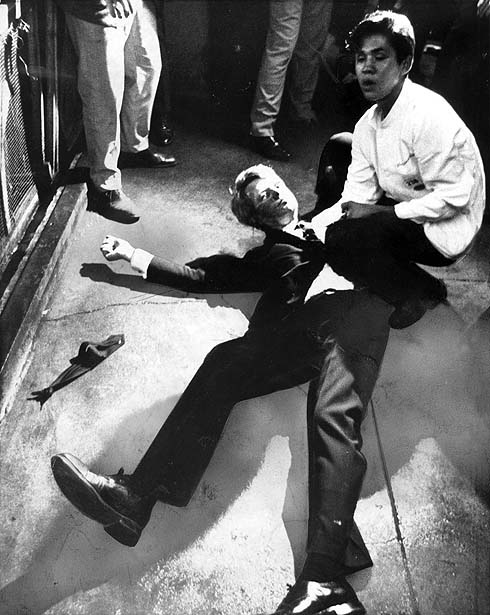
Busboy Juan Romero, 17, comforts Sen. Robert F. Kennedy moments after Kennedy was shot at the Ambassador Hotel on June 5, 1968.
Culled from: Wikipedia
Submitted by: Aimee
Here’s some footage for you. The frantic reporter is Los Angeles radio newsman Andrew West, who had just spoken briefly with Kennedy a few moments before he was murdered. – Aimee
The Assassination of RFK – ABC News
Ghastly! – French Edition
Here’s a ghastly image of a murder victim and her murderer from a French crime scrapbook used as the basis of fictional tales in the book Crime Album Stories. (The poor quality is in the source material.)
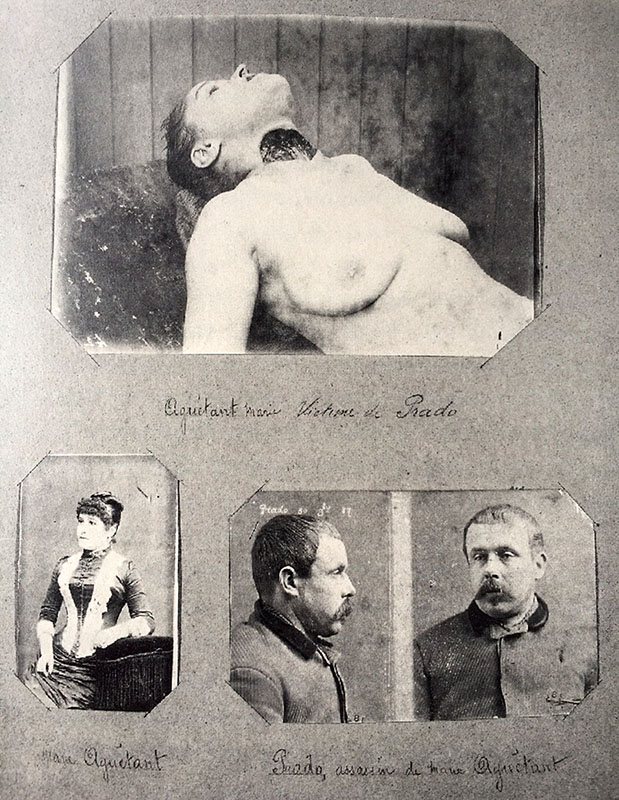
And here’s the story from the December 31, 1888 issue of the Montreal Herald:
GUILLOTINED.
Prado, the Paris Murderer, Executed on Friday.
A Howling Mob Surrounds the Jail All Night Long.
PARIS, Dec. 28. — Prado, the murderer of Marie Aquetant, a prominent member of the demi-monde of Paris, was guillotined at daybreak to-day in the yard of the Roquette Prison.
The execution was attended only by a few correspondents of the gensdarmerie and two chaplains, whose services the murderer declined with the suavity of a courtier who is about to be decorated.
INDIFFERENT THROUGHOUT.
The culprit was as unconcerned throughout as if he were simply an onlooker and not the chief actor in the horrible execution. He made no confession and smiled blandly when his arms and legs were pinioned behind him. He looked about him in an unconcerned way, muttered a few unintelligible words and then bowed his head ready for the fatal stroke of the gleaming axe.
Down it came with a whizz, and Prado’s head rolled from the block to the ground.
CROWDS OUTSIDE.
All night long there was a great howling mob outside the prison. They came from everywhere; Bohemians from the Quarter Latin; roues and loungers from the avenues; workmen in blouses, and women with children in their arms. They could see nothing, but still they remained, jostling, crowding, hooting and shrieking.
As is usual when a man is executed there are numerous accidents. Women fainted and in many cases had to be carried away by the gensdarmes.
Many had rented rooms a week before in the immediate vicinity of Roquette merely for the purpose of gratifying their morbid curiosity.
After the execution the crowd dispersed in an orderly manner.
PRADO’S CRIME.
Pardo’s career of infamy brands him as the most remarkable criminal in the recent history of France. His victim, Marie Aquetant, was a young and beautiful woman of the fallen class, and was known as “La Dame aux Diamants,” from the splendour of a noted necklace she wore in public.
It was on the evening of January 14, 1886, that a small, unimportant looking man addressed Marie in the corridor of the Eden Theatre during a lull in the performance, and together they proceeded hastily to Marie’s apartments in a fashionable quarter of the town. She was the mistress of a prominent man in club circles, M. Bleg.
At two o’clock in the morning, the accepted lover reached the apartments and found Marie lying near the fireplace with her throat cut. The leather bag in which she had kept her treasures had been slit as dexterously as had been the murdered woman’s throat. No trace could at first be found of Marie’s companion.
Then began a detective hunt through Paris and all the rest of France, but for a long time no clue was found. Long afterward a man was surprised while attempting to make off with a casket of jewels from a private house. He was pursued by a policeman. Seeing himself overtaken, the man turned and sent a pistol ball through the policeman’s jaw. The policeman did not give up his hold. The man was caught and when arraigned for trial he gave the name of Prado.
About the time Eugenie Forestier, a demi-mondaine of Paris, and Mauricette Courouneau, a young married woman of Bordeaux, were arrested on the charge of receiving stolen goods.
The thief was Prado; Eugenie was his mistress, and Mauricette was the woman whom he had promised to make his wife. Eugenie finally consented to tell what she had learned from Prado of his origin and life. He was born in Mexico, he said, and when a youth discovered some fearful secret about his birth.
His life had been crowded with adventure of every kind. He had travelled in Hayti [sic], China, the United States and the Holy Land, nursed when sick in Jerusalem by an English lady of birth, who gave up her vows as a Sister of Charity to follow Prado to Italy.
When he had killed Marie he confided his secret to his mistress, Eugenie Forester, with whom he was then living. She promised to keep his secret, and they fled to Bordeaux. He might have remained undiscovered, had he not been faithless to Eugenie. When she learned he was living with Mauricette Courouneau she wanted revenge.
Eugenie told Mauricette of Prado’s crime. Mauricette, a girl of twenty who had become a mother, told her confessor. The priest insisted that Eugenie should make her statement public. At last she consented. Prado was arrested and the mystery of Marie Aquetant’s murder was solved.
The trial was the talk of all Paris. A new victim of the the adventurer then appeared. It was his legal wife, Dolores Garces, of Marcilla, with whom he had at one time lived in luxury in Madrid. She still retained her affection for Prado. The jewels of Marie were all traced, together with others he stole in Spain and distributed among his mistresses.
When on trial he was insolent to both Judge and witnesses and absolutely laughed at the avalanche of proof that fell upon him.
His Spanish wife was divorced, and the other women connected with the sensational case have become notorious and had many offers of marriage. Nothing was confessed by Prado of the mystery of his birth. He died as he had lived, cool, merciless and unconcerned.
THIS was “the most remarkable criminal in the recent history of France”? Sheesh… I am not impressed, France!