Today’s Plunging Yet Truly Morbid Fact!
On June 29, 1929, a twelve-year-old boy from Burlingame was enthralled by the spectacular view of Vernal Fall in Yosemite National Park while standing in the middle of the Merced River. Forest Case and his friend Edward Shoemaker had hiked up to the Mist Trail to the top of the falls. Case stepped about twenty feet into the river after getting a drink of water. He shouted to Shoemaker, “Look at those mountains up there, with the white clouds floating around them!” Those were his last words as he lost his footing and fell into the swift current.
Shoemaker ran to help his struggling friend and got as close as grabbing Case’s hand, but the river tore their death grip apart and Case went screaming over the falls in front of dozens of witnesses. Three female witnesses fainted at the sight of the boy falling over the ledge. Case’s body was never found.

Culled from: Death in California: The Bizarre, Freakish and Just Curious Ways People Die in the Golden State

Incidentally, the author of Death In California, my friend David Kulczyk, is currently running a GoFundMe campaign to pay for an illustrator for his next book. Please consider supporting a worthy morbid cause!
Raising Money For An Illustrator
Ghastly: Nipply Edition
Here’s another wax model image from the 1910 medical textbook Dermochromes – III.
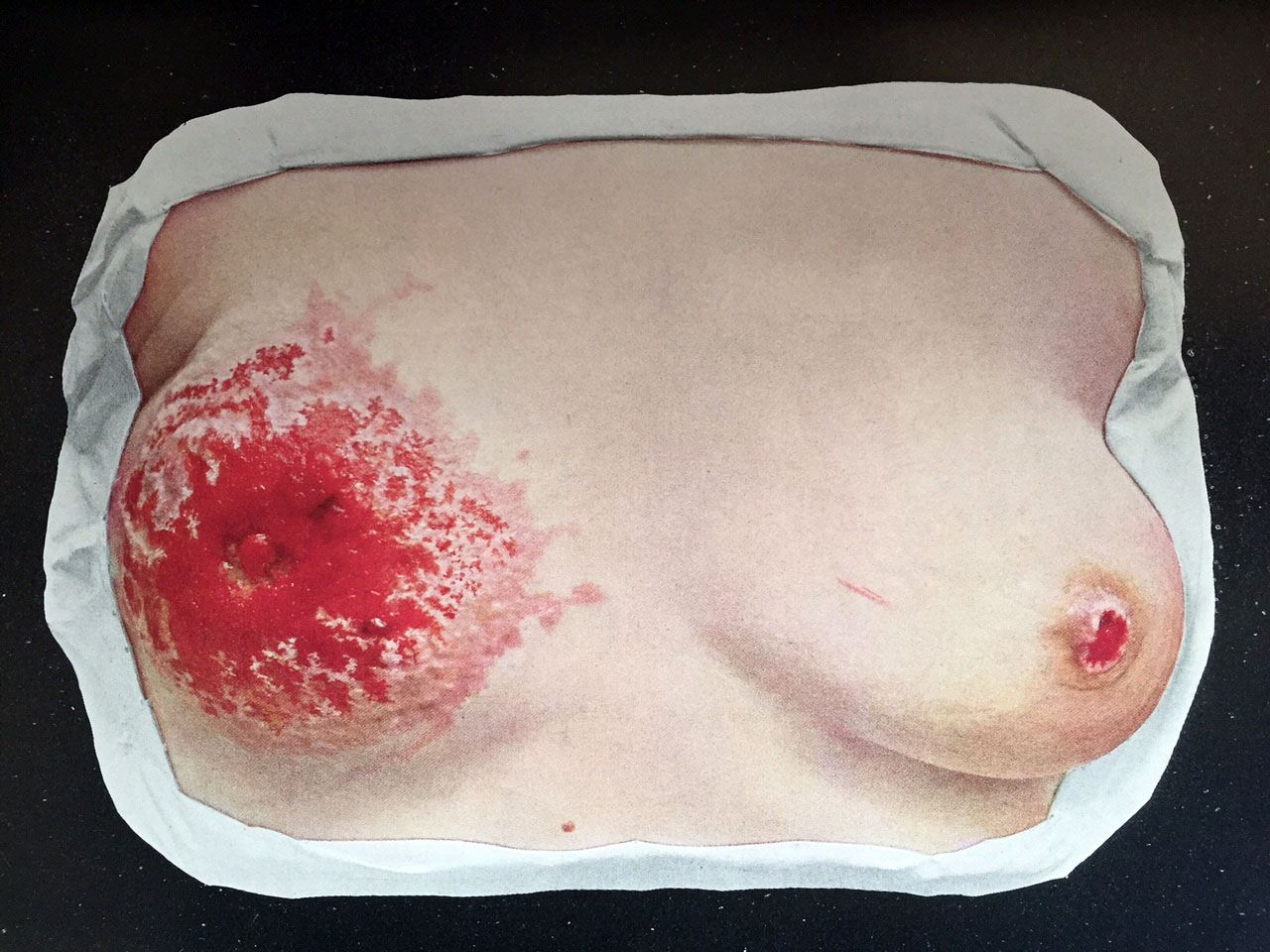
Paget’s Disease.
Paget’s disease of the breast usually begins as an obstinate, moist, eczematous condition on and around the nipple, in women about the climacteric [menopause – DeSpair]. The disease very seldom occurs in other parts of the body, e.g. – the anal region. The weeping spot is at first small, excoriated, covered in places with papillary, horny growths, and has a very sharply defined line of demarcation. After some time the affected area becomes flat, with parchment-like induration, and the disease may attain considerable dimensions, while regressive changes, with shrinkage and retraction of the nipple, result. Ultimately carcinoma of the neighbouring lymphatic glands or of the mamma usually complicates the process.
The Diagnosis of Paget’s disease from chronic eczema must first be established. In eczema the margin is not so sharply defined; subsequently the long duration of the malady, the parchment-like hardness and, in doubtful cases, the microscopic examination of a portion of excised tissue, will decide the diagnosis.
The Prognosis is invariably dubious.
The Treatment is purely surgical and consists in removal of the entire breast.
(Model in Clinic of Dr. Pospelow in Moscow)
*************************
I had to do a little additional research on this condition – it’s basically a type of breast cancer:
Paget disease of the breast (also known as Paget disease of the nipple and mammary Paget disease) is a rare type of cancer involving the skin of the nipple and, usually, the darker circle of skin around it, which is called the areola. Most people with Paget disease of the breast also have one or more tumors inside the same breast. Paget disease of the breast is named after the 19th century British doctor Sir James Paget, who, in 1874, noted a relationship between changes in the nipple and breast cancer.
And yes – it really does get as bad as that wax model implies!