Today’s Pustular Yet Truly Morbid Fact!
The Roman plague of Antoninus is sometimes known as the plague of the physician Galen. The story is better documented than that of previous outbreaks. Disease started among the troops of the co-emperor Lucius Verus on the eastern borders of the empire. It was confined to the east for the two years 164-6 and caused great mortality among the legions under the command of Avidius Claudius, who had been sent to repress a revolt in Syria. The plague accompanied this army homewards, spreading throughout the countryside and reaching Rome in A.D. 166. It rapidly extended into all parts of the known world, causing so many deaths that loads of corpses were carried away from Rome and other cities in carts and wagons.
The plague of Antoninus or Galen is notable because it caused the first crack in the Roman defense lines. Until A.D. 161 the empire continually expanded and maintained its frontiers. In that year a Germanic barbarian horde, the Marcomanni from Bohemia and the Quadi from Moravia, forced the north-eastern barrier of Italy. Owing to the fear and disorganization produced by the plague, full-scale retaliation could not be undertaken; not until A.D. 169 was the whole weight of Roman arms thrown against the Marcomanni. Possibly the failure of this invasion was as much due to the legions carrying plague with them as to their fighting prowess, for many Germans were found lying dead on the battlefield without sign of wounding. The pestilence raged until A.D. 180; one of the last victims was the noblest of Roman emperors, Marcus Aurelius. He died on the seventh day of his illness and is said to have refused to see his son at the last, fearing lest he, too, should succumb. After A.D. 180 there came a short respite followed by a return in 189. The spread of this second epidemic seems to have been less wide, but mortality in Rome was ghastly; as many as 2,000 sometimes died in a single day.
The name of the physician Galen is attached to the plague of A.D. 164-89 not only because he fled from it, but because he left a description of the disease. Initial symptoms were high fever, inflammation of the mouth and throat, parching thirst and diarrhea. Galen described a skin eruption, appearing about the ninth day, sometimes dry and sometimes pustular. He implies that many patients died before the eruption appeared. There is here some resemblance to the Athenian plague, but the undoubted Eastern origin and the mention of pustules have led many historians to assert that this was the first instance of a smallpox epidemic.
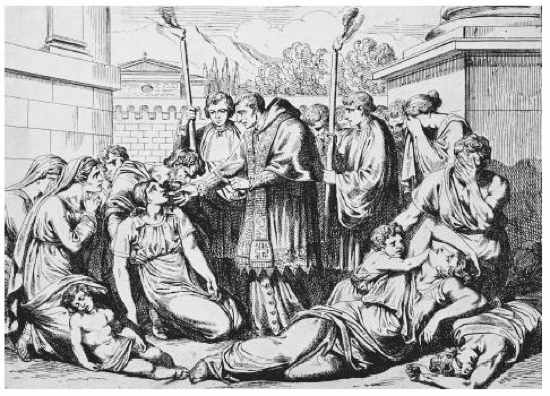
Culled from: Disease and History
Arcane Excerpts!
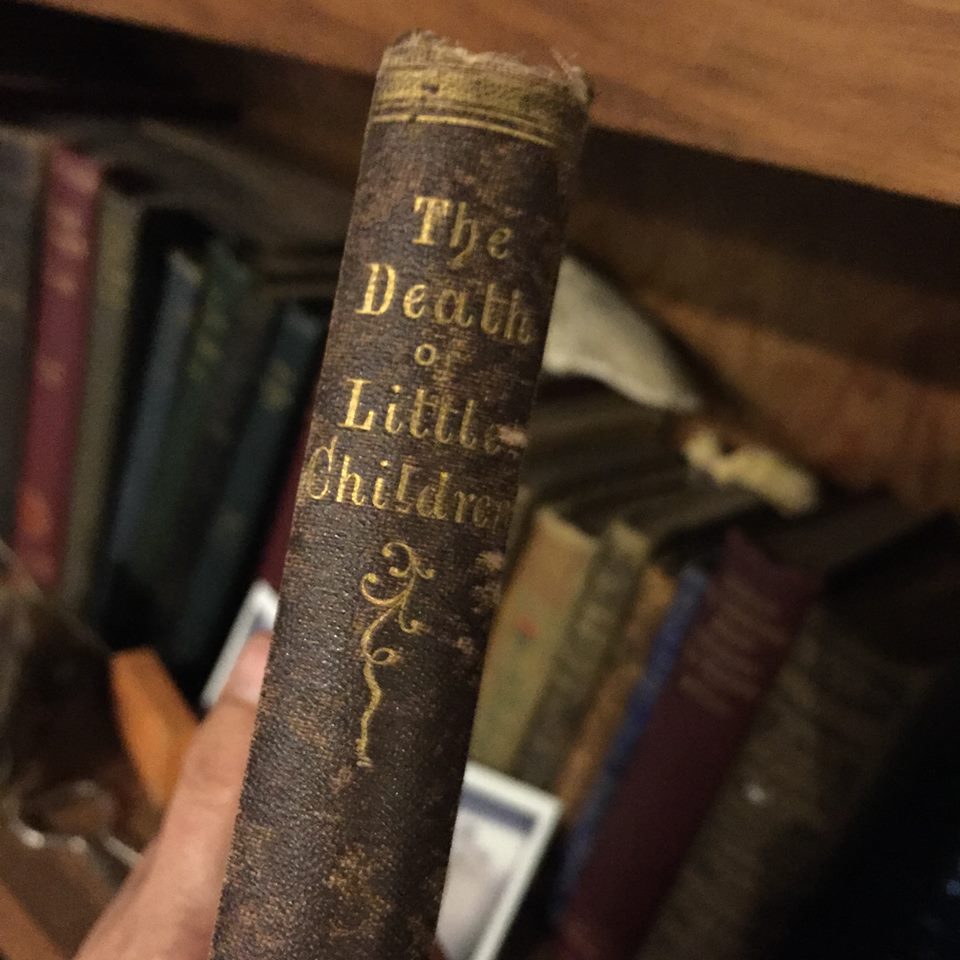
One of my beloved vintage books is entitled Thoughts on the Death of Little Children by Samuel Irenaeus Prime (1869, though I believe it was originally published in 1852). It’s exactly what it says it is: a collection of thoughts on the death of little children, with religious overtones in much of it, designed for an era where little children died regularly. My favorite part is the beginning of Chapter 1. Although it’s a little lengthy, I thought I’d share so that you, too, can see why.
The Child Is Dead
It is hard to believe it: that we shall no more hear the glad voice, nor meet the merry laugh that burst so often from its glad heart.
Child as it was, it was a pleasant child, and to the partial parent there are traits of loveliness that no other eye may see. It was a wise ordering of Providence that we should love our own children as no one else loves them, and as we love the children of none besides. And ours was a lovely child.
But the child is dead. You may put away its playthings. Put them where they will be safe. I would not like to have them broken or lost; and you need not lend them to other children when they come to see us. It would pain me to see them in other hands, much as I love to see children happy with their toys.
Its clothes you may lay aside; I shall often look them over, and each of the colors that he wore will remind me of him as he looked when he was here. I shall weep often when I think of him; but there is a luxury in thinking of the one that is gone, which I would not part with for the world. I think of my child now, a child always, though an angel among angels.
The child is dead. The eye has lost its lustre. The hand is still and cold. Its little heart is not beating now. How pale it looks! Yet the very form is dear to me. Every lock of its hair, every feature of the face, is a treasure that I shall prize the more, as the months of my sorrow come and go.
Lay the little one in his coffin. He was never in so cold and hard a bed, but he will feel it not. He would not know it, if he had been laid in his cradle, or in his mother’s arms. Throw a flower or two by his side: like them he withered.
Carry him out to the grave. Gently. It is a hard road this to the grave. Every jar seems to disturb the infant sleeper. Here we are, at the brink of the sepulchre. Oh, how damp, and dark, and cold! But the dead do not feel it. There is no pain, no fear, no weeping there. Sleep on now, and take your rest!
Fill it up! Ashes to ashes, dust to dust! Every clod seems to fall on my heart. Every smothered sound from the grave is saying, Gone, gone, gone! It is full now. Lay the turf gently over the dear child. Plant a myrtle among the sods, and let the little one sleep among the trees and flowers. Our child is not there. His dust, precious dust, indeed, is there, but our child is in heaven. He is not here; he is risen.
I shall think of the form that is mouldering here among the dead; and it will be a mournful comfort to come at times, and think of the child that was once the light of our house, and the idol – ah! that I must own the secret of this sorrow – the idol of my heart.
And it is beyond all language to express the joy, in the midst of tears, I feel, that my sin, in making an idol of the child, has not made that infant less dear to Jesus. Nay, there is even something that tells me the Saviour called the darling from me, that I might love the Saviour more when I had one child less to love. He knoweth our frame; he knows the way to win and bind us. Dear Saviour, as thou hast my lamb, give me too a place in thy bosom. Set me as a seal on thy heart.
And now let us go back to the house. It is strangely changed. It is silent and cheerless, gloomy even. When did I enter this door without the greeting of those lips and eyes, that I shall greet no more? Can the absence of but one produce so great a change so soon? When one of the children was away on a visit, we did not feel the absence as we do now. That was for a time; this is for ever. He will not return. Hark! I thought for a moment it was the child, but it was only my own heart’s yearning for the lost. He will not come again.