Today’s Electrocuted Yet Truly Morbid Fact!
President McKinley’s assassin, Leon Czolgosz, was sentenced to die in the electric chair at Auburn State Prison. The nation’s first-ever execution by electricity, in 1890, had also taken place at Auburn – and had been overseen by Edward Charles Spitzka, the alienist who’d insisted that President Garfield’s executioner Charles Guiteau was crazy. Things had not gone well. The prisoner fried but refused to die, and his burning hair and flesh stunk up the tiny execution room. Spitzka screamed to flip the switch again, but the electricians had to wait two whole minutes for the generator to recharge (In their defense, earlier tests that involved electrocuting a horse had gone much smoother.)
By 1901 Auburn had worked out the kinks. Guards awoke Czolgosz around 5 a.m. on October 29 and gave him dark trousers slit up the side. Inside the death chamber, an electrician wired up a string of twenty two light bulbs to test the current; when they began beaming, he pronounced the chair ready. Czolgosz entered at 7:06 a.m. and took a seat on “old Sparky,” a rough-hewn wooden throne sitting on a rubber mat. He promptly condemned the government again. Meantime, guards plopped a sponge soaked with conducive salt water onto his head. Next came the metal helmet, then another electrode clamped onto his calf beneath the slit in his pants. Last came the leather mask which kept his face in place. It also muffled his final words: “I am awfully sorry because I did not see my father [again].” The electrician waited until Czolgosz exhaled – gases expand when heated, and the less air in the lungs, the less unsightly moaning during the death throes – and snapped the switch. Czolgosz jerked, cracking his restraints. After a few pulses at 1,700 volts a doctor could find no pulse in Czolgosz. Time of death, 7:15 a.m.
His hair still wet, his lips still curled form the shock of the shock, Czolgosz was laid out on a nearby table for the autopsy. One doctor dissected the body, while the all-important brain autopsy, including the determination of sanity, fell to a second doctor – or rather, a wannabe doctor, a twenty-five year old medical student at Columbia University.
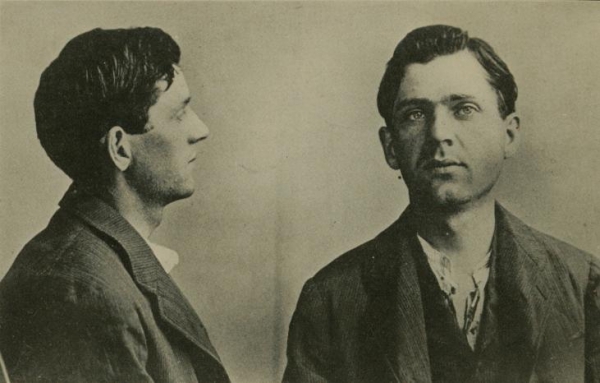
Why entrust this job to someone with no medical license? Well, he’d already published scores of articles about the brain, including work on whether high doses of electricity damaged brain tissue or altered its appearance, an important consideration here. He also claimed phrenological expertise, including the ability to link mental deficiencies with unusual anatomical features. What clinched the selection was his pedigree – for this was Edward Anthony Spitzka, son of the Edward Charles Spitzka who’d defended Guiteau. No other father and son doctors can boast of involvement in two such historic cases. And whereas Spitzka père had failed to convince the world of Guiteau’s insanity, Spitzka fils could still perhaps grant Czolgosz a posthumous scientific pardon.
He never got the chance. Spitzka removed the brain at 9:45 a.m., noting its warmth – the body can reach 130° F during electrical execution. He sketched it while it cooled , then began to investigate every fold and fissure. As with Guiteau, the brain looked normal, unnervingly normal, on a gross scale. But before Spitzka could examine it microscopically, the prison warden stepped in. The warden had already received offers of $5000 for Czolgosz’s skull, and rather than risk making Czolgosz a martyr, he was determined to destroy every last scrap of him. Cruelly, spitefully, he refused Spitzka’s plea for even a tiny slice of brain to examine later. Instead, the warden ordered the body sewn up at noon. He salted Czolgosz’s corpse with barrels of quicklime, then poured in gallons of sulfuric acid. Based on experiements he’d been conducting with shanks of meat, he figured Czolgosz would liquefy in twelve hours. By midnight Leon Czolgosz’s troubled brain was no more.
What a bastard that warden was, huh? Interfering with science!
Morbid Sightseeing Alert!
When I was dating the girl in DC earlier this year, I made a trip to the National Museum of Crime and Punishment. Was it a rip-off at $21.95 compared to the great low cost (free!) of the Smithsonian museums? Certainly it was. But were there interesting things on display here? Yes, there certainly are, including Gacy’s Pogo the Clown outfit. So then isn’t it worth it? Well, kind of, I suppose.
But the point is: It’s closing at the end of the month! So, get out there now or wonder if it will ever open anywhere else for the rest of your life!
I’ll hurry up and put out my travelogue this week (if work allows) so that you can see what you’re missing if you choose not to make a trip.
Crime Museum Is Closing At The End of September
(Thanks to Ear for the heads up!)