The facts have been erratic lately due to some issues I’ve had with my hands resulting from reactions to a medication. But I’m off the medication now and starting to improve so I’ll try to get back to the facts. The Iroquois Theater fire is one of Chicago’s most impressively terrible tragedies. I thought I’d do a three-part fact on it because it’s a fascinating bit of morbidology that I think everyone should experience. And I hate losing all the detail by paring it down. So let’s get started with…
Today’s Absolutely Fireproof Yet Truly Morbid Fact!
“Absolutely fireproof.”
That was how the Iroquois Theater, Chicago’s newest and most beautiful show palace, was introduced to the public in late 1903. By all appearances, the Iroquois was indeed a bright and modern example of fire-resistant construction, a building the Chicago Tribune called a “virtual temple of beauty.” But just five weeks after opening its doors, the Iroquois turned into a flaming death trap, killing 602 people, mostly women and children.
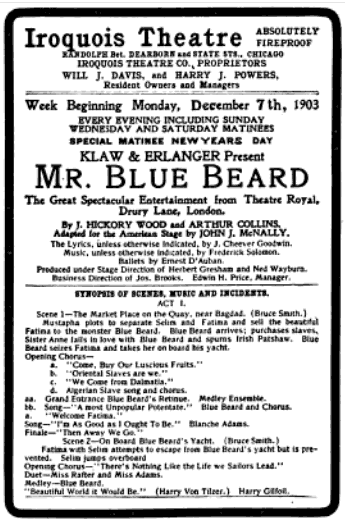
To assure the public, architect Benjamin H. Marshall had studied prior theater fires, including the tragic Brooklyn Theater fire of 1876 in which 276 died, and made every effort to establish safety at the Iroquois.The new theater had 25 exits that, it was claimed, could empty the entire building in less than five minutes. In the event of a fire on stage or in the loft above it, an asbestos curtain could be quickly lowered to protect the audience. As an added measure, the Iroquois’ management hired off-duty firefighters to be on hand during performances and provided them hand-operated fire extinguishers.
It all sounded impressive, but on the afternoon of December 30, 1903, the reality was troubling. Seats in the “fireproof” theater were wooden and stuffed with hemp, and much of the advertised precautionary fire equipment employed “just in case” a fire should break out had not been installed at all. The theater had no fire alarm, and there was no fire alarm box outside its front doors. In the rush to open the theater on time, several other key safety factors had either been overlooked or ignored completely. It was against this backdrop of greed and careless haste that tragedy struck.
At 3:20 p.m., at the beginning of Act II, the curtain went up and the house lights were darkened. Powerful spotlights created a soft midnight scene, bathing the stage in bluish-green hues as a bright harvest moon, projected against the scenery by another spotlight, started rising in the background. Suddenly, a bright flash was seen near one of the floodlights over the right side of the stage. It was never known for sure whether the light came into contact with a piece of red velvet curtain hanging next to it, or if the light’s wires overheated and arced. Regardless of its source, heat generated by the flash produced a finger of fire six inches long and two inches wide. At first the small flame traveled spiderlike across the edge of the drape, the fourth one back from the stage, then spread upwards, catching onto the oil-painted and highly flammable canvas, paper, and wood backdrops hanging by oiled manila ropes in the loft above.
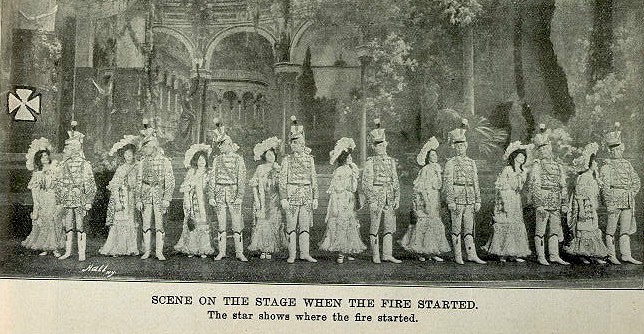
Two stagehands working below saw the flame and reacted quickly. One found a long stick used to change scenery sets and tried beating it out. When bits of flaming curtain and scenery started falling to the wooden floor, an off-duty firefighter and another stage worker ran up and emptied two small Kilfyre chemical fire extinguishers on them. Other stagehands tried and failed to stomp the fire out. Burning debris continued to fall throughout the concealed backstage area, sparking numerous spot fires. In seconds, the small loft fire spread rapidly to the unprotected upper curtains and heavy combustible sets hanging directly above the stage. From this point conditions inside the “fireproof ” theater deteriorated quickly as its auditorium began filling with smoke.The audience became aware that something was wrong when a flaming piece of drapery swung across the stage, causing the cast and several members of the orchestra to look up. But when smoke began filling the auditorium and large pieces of burning scenery dropped on the stage, the orchestra and the play goers began abandoning their seats.
To Be Continued…
Culled from: Great Chicago Fires: Historic Blazes That Shaped a City
“A little fire is quickly trodden out;
Which, being suffered, rivers cannot quench.”
— Shakespeare, King Henry VI Part 3