Today’s Shoulder Warming Yet Truly Morbid Fact!
The Whipping Act was added to the English state book during the reign of Henry VIII in 1530. It was designed specifically to put down vagrancy, and it provided that any vagrant detected in the act should be haled to the nearest town possessing a market-place “and there tied to the end of a cart naked, and beaten with whips throughout each market town, or other place, till the body shall be bloody by reason of such whipping.”
Men and women were whipped unmercifully for such trivial offenses as peddling, being drunk on a Sunday, and participating in a riot.A search of historical records reveals that in 1641, at Ecclesfield, the sum of fourpence was paid to a woman for whipping one Ellen Shaw, accused of felony; in 1680, a woman was whipped at Worcester; in 1690, at Durham, Eleanor Wilson, for being drunk on a Sunday, “was publicly whipped in the market-place, between the hours of eleven and twelve o’clock”; in 1759, according to the Worcester Corporation records, a fee of 2s. 6d. was paid for whipping Elizabeth Bradbury, but, says a correspondent in Notes and Queries (October 30th, 1852), this sum probably included “the cost of the hire of the cart, which was usually charged 1s. 6d. separately”; in 1699, there is an entry in the Burnham Church register which records the whipping of “Benjamin Smat, and his wife and three children, vagrant beggars”. According to the writer of the article on “Whipping” in the Encyclopaedia Britannica (eleventh edition) “at the quarter sessions in Devonshire at Easter 1598 it was ordered that the mothers of bastard children should be whipped, the reputed fathers suffering a like punishment.” On the occasion of the trial of Lady Alice Kyteler for witchcraft, in 1325, one of her associates was whipped until she made a confession involving Lady Alice as well as herself, The town council of Great Staughton, Huntingdonshire, in 1690, authorized payment of the sum of 8s. 6d. for guarding and whipping a female lunatic; and in this same town’s records some twenty years later appears the entry of a payment of 8d to one Thomas Hawkins, “for whipping two people yt the smallpox.” There is an element of humor, grim though it be, in this apparent belief in whipping as a universal panacea for ailments as well as misdemeanors; but there is no grain of humor discernible in the brutal directions issued by the notorious Judge Jeffreys to the executioner charged with the whipping of a woman upon whom this monster in human form had passed sentence:
“Hangman I charge you to pay particular attention to this lady. Scourge her soundly, man; scourge her till her blood runs down! It is Christmas, a cold time for madam to strip. See that you warm her shoulders thoroughly.”
Culled from: The History of Corporal Punishment
Halloween Cometh!
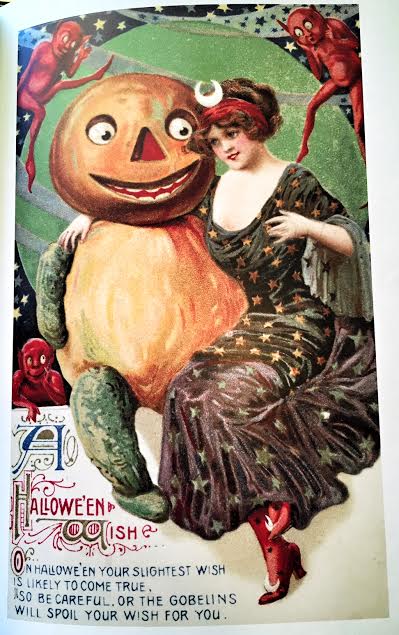
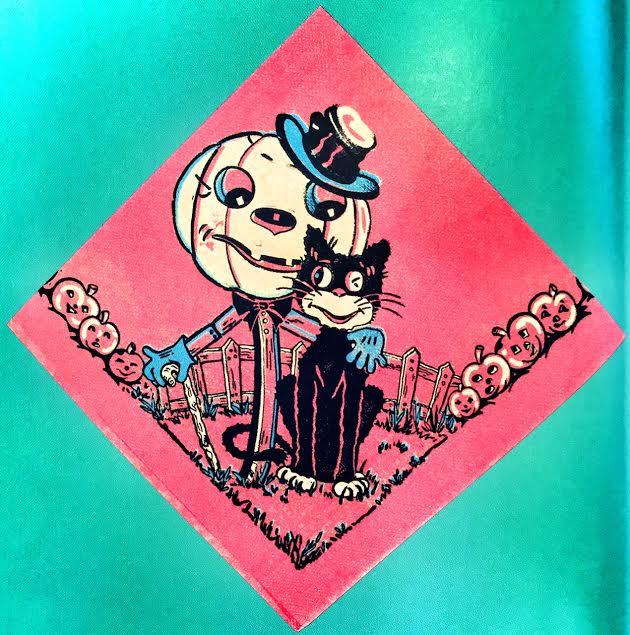
We’re a few weeks away from the greatest of all holidays, so I thought I’d start sharing some vintage Halloween pics with the newsletter. (Culled from Halloween: Vintage Holiday Graphics.) Enjoy!

Arcane Excerpts: Indian Liver Edition!
Have you ever heard of “tropical liver”? Neither had I, until I started reading a 1924 book entitled Health Knowledge: A Thorough and Concise Knowledge of the Prevention, Causes and Treatments of Disease, Simplified for Home Use by J.L. Corish, M.D. Here, let’s learn all about this affliction!
INFLAMMATION OF THE LIVER
This is not a common condition in temperate climates, but in hot countries, and particularly in India, it gives rise to the condition popularly known as “tropical liver,” which is of great importance because of the frequency with which Europeans, who have been resident in that country, are affected by it.
Causes. – The cause which renders white people in India so specially liable to inflammation of the liver, is the failure to adapt their habits as to food, drink, and exercise to the new conditions under which they live. Persons who eat the same rich food that can be tolerated or is necessary in a cold climate, and, above all, those who drink strong alcoholic liquors in large quantity, are prone to suffer. Two diseases also lead very specially to inflammation of the liver, viz., malaria and dysentery, the latter of which not infrequently produces abscess. It is said that inflammation of the liver was three times as frequent twenty years ago as it is to-day in India, and this is attributed partly, no doubt, to better modern hygienic conditions and largely to the fact that the heavier wines and stronger spirits are less indulged in now than formerly.
So what is the treatment for this dreadful condition? Hee hee, let’s find out!
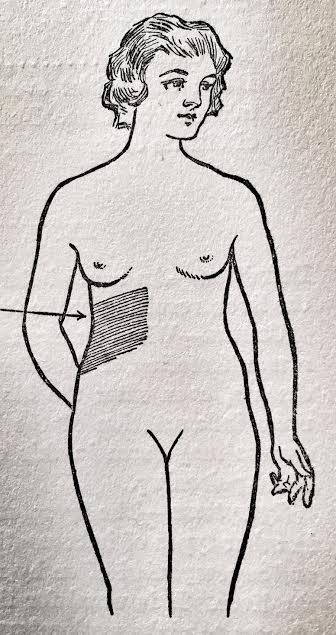
Treatment. – In the acute attacks, rest in bed, a very simple diet, and avoidance of all alcoholic liquors are the essentials. Counter-irritation over the liver by a mustard plaster applied over the area as designated by the accompanying figure, or painting the space with iodine, gives great relief. A smart saline purge of phosphate of soda or some aperient water in the morning, or a blue pill at night is also of importance, and, as the condition is passing off, various tonics of quinine and iron are prescribed.
In the case of chronic inflammation of the liver, the patient must be careful as to the mode of living. Overeating and the drinking of heavy wines and strong spirits must be abandoned. In fact, persons suffering from this complaint would do well to become total abstainers from alcohol, and to eat only the simplest foods. The drugs which have been specially advocated for this condition are chloride of ammonium and nitrohydrochloric acid.
Do you really think that applying a plaster to the skin over the liver is going to help? But it does allow us to admire this lovely drawing, and I know that certain helps my health!