Today’s Scheming Yet Truly Morbid Fact!
The Bannister family lived in abject poverty in the tiny town of Berry Mills, New Brunswick. Mr. Bannister was long gone and hard to find, but his wife May, 43, lived in their shack, together with her sons, Daniel, 20, and Arthur, 19, and her daughters, Frances, 15, and Marie, 13. May and the girls worked picking blueberries, and the boys cut firewood to sell and trapped whatever they could for food and fur. All were illiterate, and the boys were said to be intellectually subnormal.
May also made a little extra money doing chores and providing “companionship” to two local men, neither of whom knew about the other. In 1935, May hit upon a scheme to earn herself a bit more money from her two male friends: she told each that she was pregnant, and they upped her payments accordingly.
When a suitable length of time had passed, May announced to the two “fathers” that she had given birth to a baby girl, whom she called Thyra. She borrowed her daughter Marie’s doll, bundled it in blankets in a baby carriage, and wheeled it past each man’s home in turn, allowing them to catch a glimpse of an apparently sleeping little face surrounded by the blankets. The increased payments continued, but then both men, still unaware of each other’s involvement with May, wanted more contact with the little girl.
Meanwhile, in the neighboring town of Pacific Junction, near the railroad tracks, the Lake family lived in much the same conditions as the Bannisters. Phil Lake was also a lumberman and trapper, and he and his common-law wife Bertha struggled to raise two small children. But to May Bannister, the Lakes had one thing of value: they had a four-month-old daughter named Betty.
On the night of January 5, 1936, Daniel and Arthur Bannister paid a visit to the Lake’s two-room shack. Phil was cleaning his traps and Bertha and the two children were asleep. Arthur shot Phil Lake at point-blank range in the back of the head, and Bertha, awakened by the noise, tried to flee. Barely dressed, carrying her 20-month-old son Jackie, Bertha ran from the house into a snowstorm, chased by the Bannisters, who eventually caught up to her and killed her with blows to the head. They left her body in the snow, and abandoned Jackie with her to freeze to death. Then they returned to the house, set it on fire and left, taking Betty with them.
A friend of the Lake family visited them around lunchtime the next day and found the home burned to the ground and Phil Lake shot to death and half-incinerated. A trail of disturbed snow and blood drops led investigators to the bodies of Bertha and Jackie; from the look of the snow, it was evident that Bertha had struggled up after being beaten, but had then fallen back down, where she died. Jackie was dead beside her, but there was no sign of Betty and it was at first assumed that her body had been completely destroyed in the fire. A double set of footprints was found and led through the woods to the Bannister home, and a lost mitten found along the trail belonged to one of the boys. And Betty Lake was found alive and well with May.
At first, Arthur and Daniel Lake claimed they had shot Phil because he had made an improper advance toward their sister Frances, but eventually, the true story came out. May had wanted Betty as a prop in her charade with her two benefactors, and she, Frances and the boys had targeted the Lakes. Frances turned state’s evidence and was held in juvenile detention until she turned 18; May served a short sentence and was released, dying of natural causes in 1971. Arthur and Daniel went to the gallows.
Culled from The Malefactors’ Register
Submitted by: Aimee
Arcane Excerpts: Country Girl vs. City Girl Edition
Here’s an excerpt from my most recent arcane book acquisition: Inter-Marriage or the Reason Beauty, Health and Intellect Result from Certain Unions and Deformity, Disease and Insanity from Others by Alexander Walker, 1839. In this excerpt, Walker is trying to understand the reason why puberty hits girls earlier in some cultures than others. After listing his first two reasons – temperature and quality of food – he enters into a discussion of another reason: the devil will find work for idle hands to do!
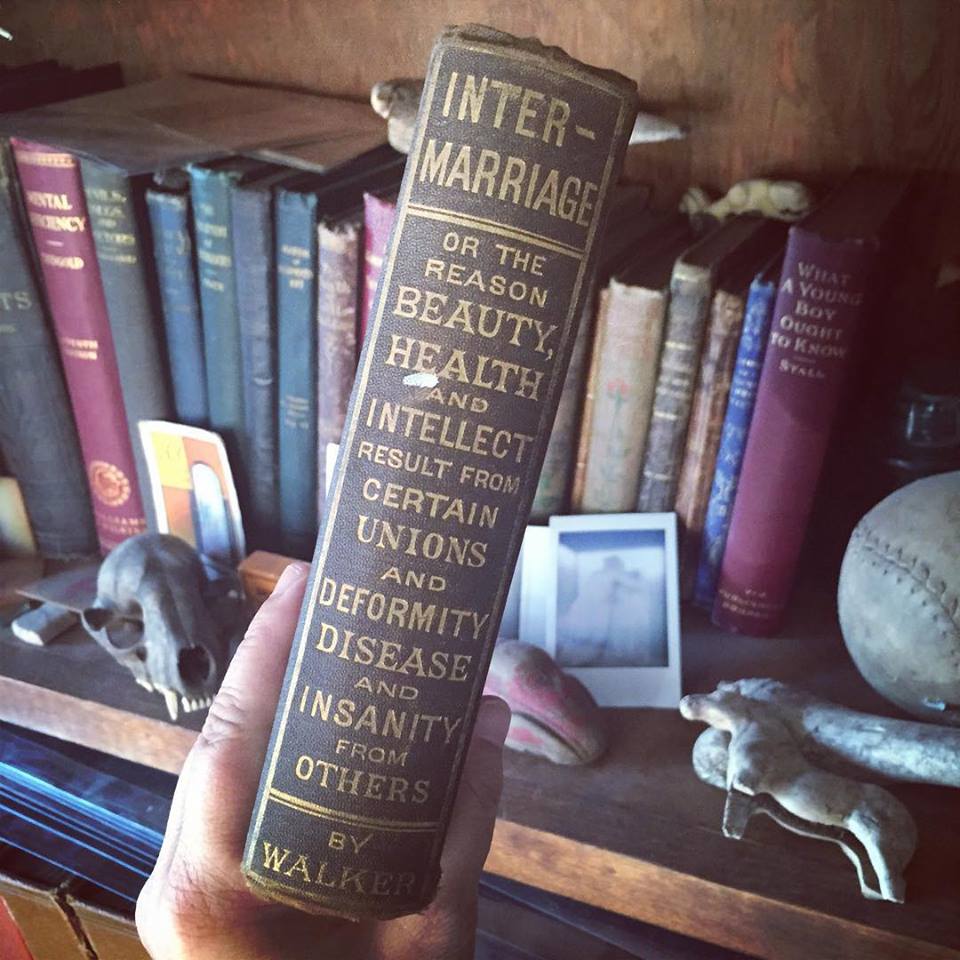
A third cause, modifying the developement [sic] of puberty, is the MORAL CONDITION. To this must be imputed the difference, independent of aliment, which we observe in this respect, between women of towns and those of the country.
In the former, the mode of living differs according to the degree of opulence; but even the poor struggle to imitate the rich, and many other circumstances multiply excitement – as the reading of fashionable novels, voluptuous pictures, licentious theatrical scenes, conversations upon love, the constant proximity of the sexes, exciting dances, and many other causes, some of them of still more injurious character. The result is that persons thus excited almost always reach puberty several years earlier than those who pass their childhood in the tranquility of rural life. Puberty may then occur about twelve years of age – a premature developement [sic], which diminishes strength of body and vigour of mind, deteriorates all moral qualities, and is extensively fatal to life and its permanent enjoyment.
In the country, on the contrary, the children of the peasantry are brought up coolly, are much in the open air, and of necessity actively employed. Toil directs the blood and the vital powers chiefly to the organs of motion, and augments perspiration. The locomotive system consequently increases at the expense of the vital one; and the developement [sic] of the bones and of muscular power predominates over every other. Amongst country people, moreover, the manners are generally simple, the sexes are less in contact, and their presence has less influence. Hence, in the country many girls do not reach puberty before eighteen.
Halloween Cometh!
More vintage Halloween fun!