Today’s Horse-Drawn Yet Truly Morbid Fact!
In the early 20th century, ordinary London funerals were characterised by horse-drawn carriages, undertakers with wands, black clothes, streets lined with crowds, head-turning processions and an abundance of flowers. People generally died at home and the body rested there until the funeral. Occasionally a coroner investigated the death, in which case the body would be held in a public mortuary for post-mortem. The neighbourhood laying-out woman, who was often the local midwife as well, attended the house to wash and dress the body before the undertaker took measurements and returned with a finished coffin. Relations, friends and neighbours would then call to view the body and to express their condolences. On the day of the funeral the undertaker would return to the house and there would then be a procession to one of the seventy London cemeteries in existence by 1910.
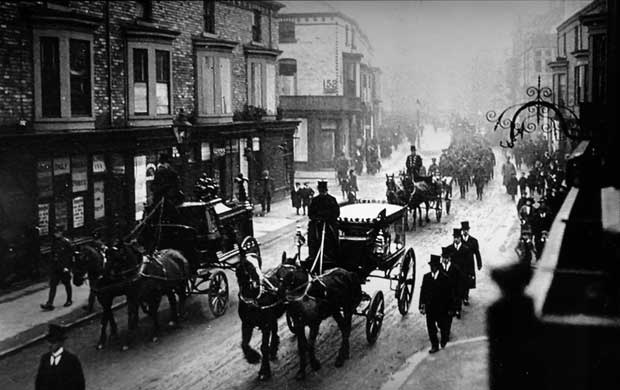
Funerals were better before…
Culled from: The London Way of Death

Arcane Excerpts: Wretched Edition
Excerpt from Sex Searchlights and Sane Sex Ethics: An Anthology of Sex Knowledge by Dr. Lee Alexander Stone (1926):
“We have seen that the everyday form of menstruation is attended by more or less discomfort, but when this increases to such an extent as to merit the name ‘pain,’ we are dealing with the fourth group or – to use a scientific word occasionally – dysmenorrhea. In addition to the sharp pain like neuralgia, the woman for days following the period may be weak and worn-out. Each return of the period is looked forward to with dread and fear. Sometimes the lining of the womb is expelled in shreds, or in a little bag, a complete cast of the interior.
“The agony suffered is such that the wretched women are actually beside themselves, and several years ago, one in Chicago after killing a small boy of the neighborhood who was annoying her by his juvenile noise, set up this painful menstruation as her defense and was duly acquitted.”
I tried to find a newspaper article validating this story but I couldn’t. Alas…