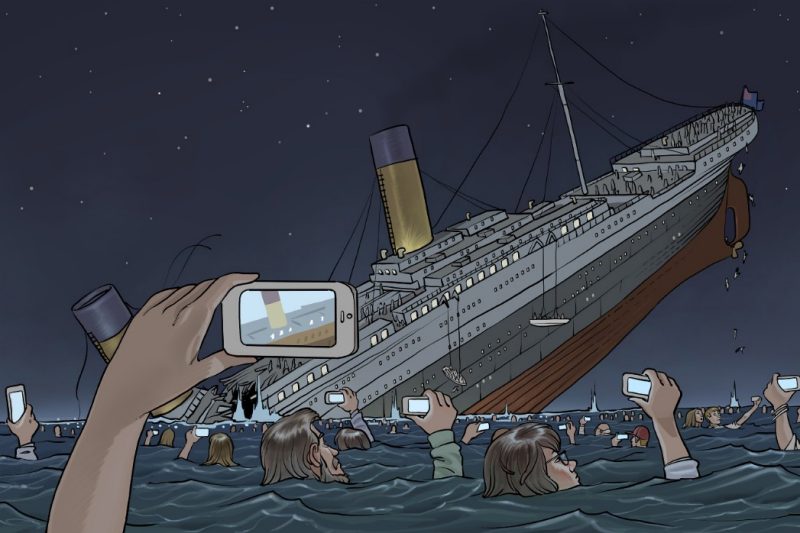
Today’s Huddled Yet Truly Morbid Fact!
As the Titanic was filling with water and sinking on the early morning of April 15, 1912 frantic activity was occurring. Up on deck, the last wooden life-boat, number 4, was being readied shortly before two-o’clock, and John Jacob Astor handed his pregnant wife into the boat. After the millionaire was refused permission to join her, he helped other women climb aboard, then stood on deck and waved as it descended only 15 feet down to the water, instead of the usual 70-foot distance. Only the collapsible lifeboats now remained. After assisting passengers, White Star Lines President J. Bruce Ismay made his escape in collapsible boat C, the last boat launched from the starboard side. More than 1,500 terrified men, women, and children remained aboard the doomedTitanic. Realizing their desperation, second mate Charles Lightoller ordered the crew to form a circle around collapsible D, the last lifeboat, and to permit only women and children to board the boat. A Frenchman who had listed himself as “M. Hoffman” passed his two little boys, Michel and Edmond, to the crew, and collapsible D got away at 2:05.
At that moment, the captain told the wireless operators and other crew members that they had done their duty and should look to their own safety. Marconi operator John Phillips, however, stayed at his post, as did thirty-four engineers, plumbers, electricians, and boiler room employees. On deck, a group of men struggled to release collapsible B from its lashings on top of the deckhouse, and a man climbed above the crowd on a chain or coil of rope, his hands stretched out as if in benediction. In steerage, “Hundreds were in a ciricle with a preacher in the middle, praying, crying.” Others fell or jumped from the ship, hoping to swim to one of the lifeboats. At 2:10 the ship’s bow lunged deeper into the water, sending the sea washing over the deck. “When the forward part of the ship dropped suddenly at a faster rate,” recalled a lifeboat passenger, “… there was a sudden rush of passengers on all decks toward the stern. It was like a wave. We could see the great black mass of people in the steerage sweeping to the rear part of the boat and breaking through in the upper decks.” Young Jack Thayer had dived into the water and clung for safety to the overturned collapsible B, which had been washed overboard before it could be launched. From the freezing water, he watched “groups of the almost 1500 people still aboard, clinging in clusters or bunches, like swarming bees; only to fall in masses, pairs or singly, as the great after part of the ship, two hundred and fifty feet of it, rose into the sky…”
On deck, J. Collins, a cook, saw a weeping woman rushing toward him, carrying a child. “I took the child from the woman and made for one of the boats,” Collins recalled. Seconds later, a huge wave washed the child out of his arms, and he and the woman were swept off the ship into the sea. People were hurled back “in a dreadful, huddled mass,” Lightoller remembered. “Those that didn’t disappear under the water right away, instinctively started to clamber up that part of the deck still out of the water, and work their way towards the stern.” The ship’s orchestra had continued to play as the deck heaved higher in the air. Now, bandleader Wallace Hartley released his fellow musicians, but none of them made a move to leave. Instead, they played a final, solemn tune as the water rolled up the deck. Some said it was “Autumn,” others remembered the hymn “Nearer My God To Thee.”
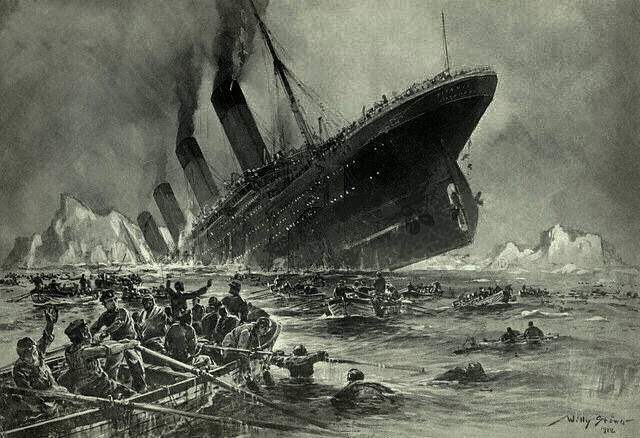
Der Untergang der Titanic
Culled from: Titanic: Legacy of the World’s Greatest Ocean Liner
Morbid Mirth Du Jour!
If the Titanic sank today…