Today’s Shocking Yet Truly Morbid Fact!
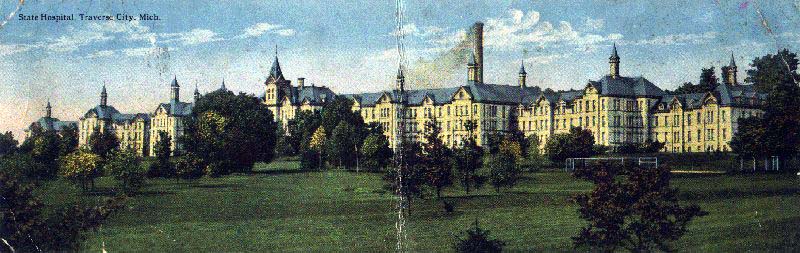
Today we continue the story of the Northern Michigan Asylum (also known as Traverse State Hospital), which between 1885 and 1920 followed “the moral treatments” of kindness, exposure to beauty, and voluntary work as espoused by Dr. James Decker Munson, the first superintendent. Alas, the beauty and kindness didn’t last…
By 1918 the quiet life and moral treatments inside the asylum were slowly slipping away. Worn and soiled rugs were no longer replaced, and wall hangings, houseplants, and small tables were eventually destroyed by patients. The plaster walls of the wards that were once decorated with phrases of encouragement such as “Kindness keeps friends” and “After Clouds, Sunshine,” were painted over with layer upon layer of institutional lead paint. In the 1920s, new patient therapies began to take the place of moral treatments. These well-intentioned therapies were uncomfortable at their best and deadly at their worst. Bizarre by today’s standards, therapies implemented over the years at the Northern Michigan Asylum included drinking a tonic made of “proto-iodide of mercury and the fluid extract of cocoa.” In other treatments, consuming various amounts of valerian root, belladonna, borax, arsenic, opium, and morphine were reported to be helpful in the treatment of “insanity.” One gentler treatment – hydrotherapy – involved long baths in deep, warm water, but most therapies were not so benign. One of these was “fever inducement,” a short-lived treatment for syphilitic insanity used between 1935 and 1940. It involved a patient being heated inside a metal cabinet until a fever was induced. Other temperature-related treatments included wrapping ice-filled tubes around a patient’s head, and “neutral pack” – a treatment in which a patient was wrapped like a mummy and dipped into cold water.
Treatments became more invasive in the 1940s and 1950s when doctors used therapies such as induced insulin shock, induced metrazol shock, lobotomies, and the most feared, yet widely used treatment, electroshock therapy. By March 26, 1947, more than thirty thousand electroshock treatments had been administered at the Traverse City State Hospital. Induced insulin shock was a particularly unusual treatment because it produced miraculous results that, sadly, were only temporary. To induce insulin shock, a doctor would inject a patient with insulin until the patient went into shock. During this procedure a nurse would always be near with a hypodermic needle full of adrenaline in case the patient’s heart stopped. Once the patient was in shock, the doctor would inject glucose, and as the patient was coming out of shock he or she would experience a few moments of complete lucidity – complete “sanity.” Nurses recall how amazing this transformation was to observe, even though it was painful to watch their patients, after a short time, slowly slip back to their previous state of mental illness. By the 1950s nearly all of these “therapies” were replaced – except electroshock, which was used into the 1970s – with psychotropic drugs such as Ritalin, Thorazine, and Serpasil.
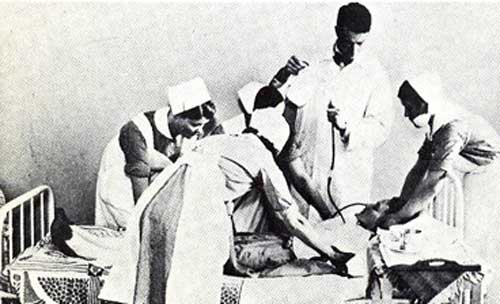
Insulin Therapy. What could go wrong?
With the success and gradual increase of drug therapies, more patients in the hospital improved or cured. This exodus, combined with accusations of civil rights violations and severe cuts in state funding, caused the Traverse City Regional Psychiatric Hospital to close in 1989, despite bitter resistance from employees, patients, and local residents. In the months and years following the hospital’s closing, many former patients with continuing mental health problems were found to be homeless, in the jail system, or in inadequate and unaffordable private care. Groundskeepers encountered former patients revisiting the abandoned institution and attempting to enter the buildings again, not as vandals, but as people who missed the only place many of them had called “home”.
Culled from: Angels in the Architecture: A Photographic Elegy to an American Asylum
Kirkbride Buildings
If you’re an enthusiast of the beautiful old Kirkbride Asylums, you might want to check out Kirkbride Buildings. They are a dying breed, sadly.
For a harrowing account of induced insulin shock in practice, check out the film (or novel) “Requiem for a Dream.”
Electroshock is STILL being used, it is now called ECT and they sedate you before inducing the seizure. You forget a whole lot of shit before you can really enjoy the benefits of it. It is an outpatient treatment now and it is performed once a month to those that are what would have “medicine resistant depression/bipolar/ptsd” etc.
Doesn’t that sound fun?