You have my deepest apologies for disappearing on you for over a month. There was no dramatic reason for my absence – it was simply life throwing too much at me at once and me not being able to find any time for my hobbies. Now it’s time to get back on the morbid track! – DeSpair
Today’s Lizard-like Yet Truly Morbid Fact!
A developing fetus has to conduct a whole orchestra of genes inside every cell, encouraging some DNA to play louder and hushing other sections up. Early on in the pregnancy, the most active genes are the ones that mammals inherited from our egg-laying lizard-like ancestors. It’s a humbling experience to flip through a biology textbook and see how uncannily similar bird, lizard, fish, human, and other embryos appear during their early lives. We humans even have rudimentary gill slits and tails – honest-to-god atavisms from our animal past.
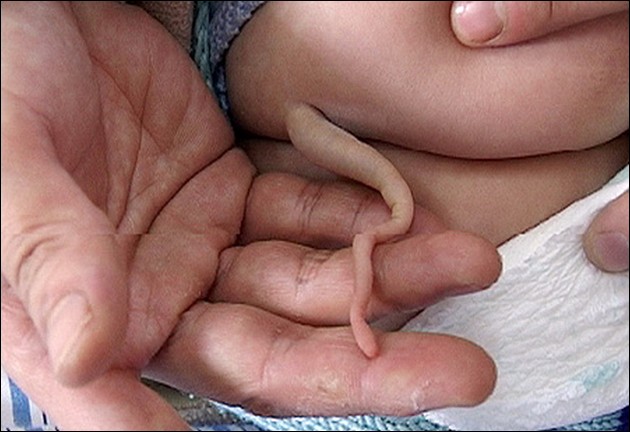
After a few weeks, the fetus mutes the reptilian genes and turns on a coterie of genes unique to mammals, and pretty soon the fetus starts to resemble something you could imagine naming after your grandmother. Even at this stage, though, if the right genes are silenced or tweaked, atavisms (i.e., genetic throwbacks) can appear. Some people are born with the same extra nipples that barnyard sows have. Most of these extra nipples poke through the “milk line running vertically down the torso, but they can appear as far away as the sole of the foot. Other atavistic genes leave people with coats of hair sprouting all over their bodies, including their cheeks and foreheads. Scientists can even distinguish (if you’ll forgive the pejoratives) between “dog-faced” and “monkey-faced” coats, depending on the coarseness, color, and other qualities of the hair. Infants missing a snippet at the end of chromosome five develop cri-du-chat, or “cry of the cat” syndrome, so named for their caterwauling chirps and howls.; Some children are also born with tails. These tails – usually centered above their buttocks – contain muscles and nerves and run to five inches long and an inch thick. Sometimes tails appear as side effects of recessive genetic disorders that cause widespread anatomical problems, but tails can appear idiosyncratically as well, in otherwise normal children. Pediatricians have reported that these boys and girls can curl their tails up like an elephant’s trunk, and that the tails contract involuntarily when children cough or sneeze. Again, all fetuses have tails at six weeks old, but they usually retract after eight weeks as tail cells die and the body absorbs the excess tissue. Tails that persist probably arise from spontaneous mutations, but some children with tails to have betailed relatives. Most get the harmless appendage removed just after birth, but some don’t bother until adulthood.
Culled from: The Violinist’s Thumb
Here are a couple of human tails:

And here is a charming case of extra nipples:

And here’s the Creepy, Creepy Cri-du-chat:
This fact reminds me of the novel “Geek Love” by Katherine Dunn. It’s about this family of circus performers who decide to breed their own freaks, so the mother pops pills and inhales all kinds of dangerous things while she’s pregnant to see what kind of deformities it will cause. They have a pair of Siamese twins, a dwarf, a kid who can levitate things, and Arturo the Aqua Boy, who has only tiny flippers for limbs and grows into a megalomaniac with a cult following. They also keep a “museum” of their failures, babies/fetuses that didn’t survive. The book is very weird and much more “literary” than you would expect from its premise.
It’s a fine book. highly recommended. I have two first editions-no waiting.