Today’s Fake Yet Truly Morbid Fact!
Most carbon monoxide murders involved faking an accident. The standard approach was to blame the death on a leaky heater or poorly closed gas valve, setting it up as just another of the many sad fatalities in the city. Both police and medical examiners acknowledged that these crimes were often difficult to detect, and undoubtedly some murderers were never caught.
But law enforcement officials had exposed enough of these schemes to warn against homicidal overconfidence.
One such success, which would be cited by forensic scientists for years following, occurred in the fall of 1923. An out-of-work painter named Harry Freindlich took out a $1,000 life insurance policy on his twenty-eight-year-old wife Leah, smothered her while she lay sleeping, and then attempted to cover it up.
Freindlich was desperate for money at the time, desperate about everything: he was jobless and unable to pay the rent, much less provide food for his family. The family home was a bare cut above living on the street anyway, a battered tenement on Manhattans’ Lower East Side. The paint was peeling off the walls. The floors were splintered. They’d been patching the appliances together with cardboard, glue, solder, anything. It was one of these cracked appliances that gave him the idea – a gaslight in the bedroom with a troublesome broken fitting that he had soldered back together more than once.
On an early October morning Freindlich put a pillow over his wife’s face and pressed it tight until she quit breathing. He then tossed the pillow aside and wrenched apart the soldered light. When he heard the hiss of the gas, he hurriedly left the room, closing the door sharply behind him, leaving his dead wife lying beside the baby son she’d brought to bed with her. As the police pieced it together, he then walked out of the apartment, not trying to save the baby or any of the other children sleeping there.
But that tossed-aside pillow had dropped right on top of the sleeping infant. The little boy abruptly woke and began crying, struggling to get free. The Freindlich’s oldest child, a ten-year-old boy, heard his baby brother wailing and ran in to see what was wrong. He tried to shake his mother awake. But she didn’t respond, no matter how hard he shook her. Now sobbing, he grabbed the baby and ran to the apartment next door. The neighbor grabbed a candle and hurried to check the darkened apartment. When she saw the dead woman in the bed, she ran to the grocer’s place downstairs to call the police.
At first it looked just like another accident, maybe a suicide. Leah had been a sweet woman, the neighbors told the police, but worn down, just tired out. But something about the neighbor’s story bothered the beat cops. If there was a lethal amount of illuminating gas in a room, it almost always ignited in the presence of fire, thanks to its explosive mixture of carbon monoxide and hydrogen. Apartments in the city blew up on a semi-regular basis when someone unwittingly struck a match in a gas-filled room.
If illuminating gas had poisoned Leah Freindlich, it would have built up in the apartment. The room should have flashed to fire when the Good Samaritan ran in with her candle.
Back at the Belleveue morgue, the pathologist found the scenario equally dubious. The dead woman was sheet pale, all wrong for carbon monoxide poisoning, which tended to flush the skin pink. Before beginning an autopsy, he drew blood samples from her body and asked for a quick analysis from the laboratory. The lab results showed that the blood was loaded with carbon dioxide, the typical finding in suffocation, but there was no evidence of carbon monoxide. When the pathologist looked more closely at the body, hidden in the hair at the back of her neck he found a black bruising of fingerprints where someone had pressed fiercely against her skin.
Freindlich broke into sobs when he was arrested and begged the police to take him to the roof so that he could throw himself off. He couldn’t have killed his wife, he said – no one could have wished her harm. He couldn’t go to jail; what would happen to his children?
He wanted his old life back.
Culled from: The Poisoner’s Handbook
Corpse Du Jour!
Here’s a crime scene photo from the Los Angeles Police Department archives as detailed in Scene of the Crime: Photographs from the LAPD Archive.
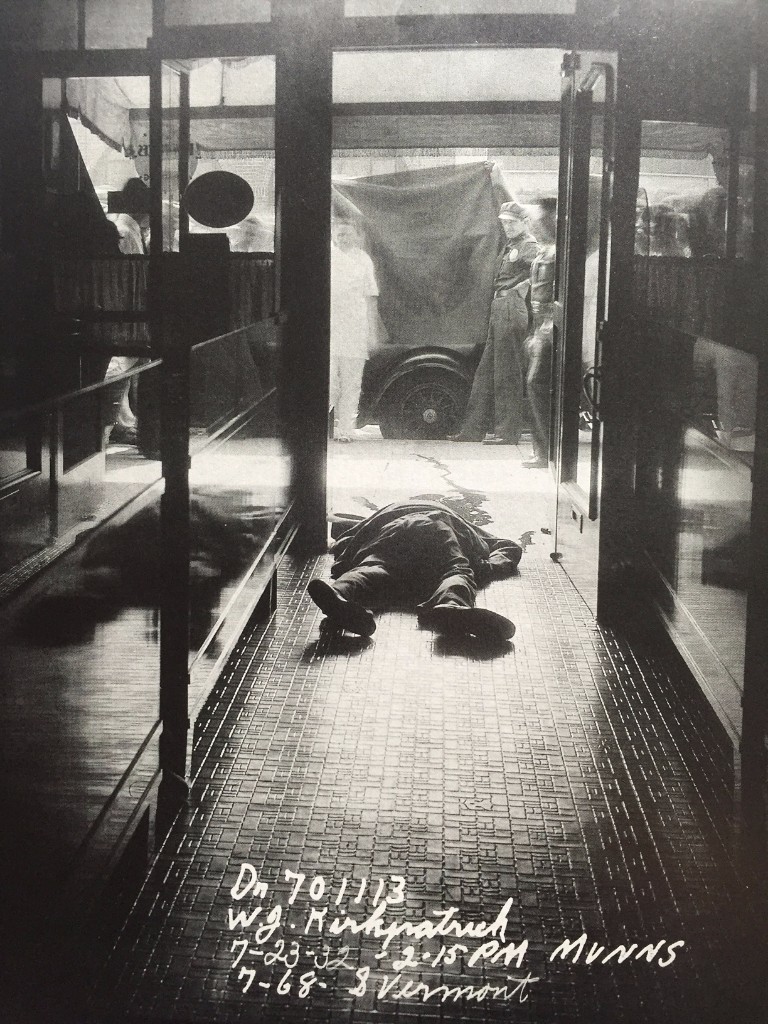
Photographer: Munns. 07-23-1932. A robbery at a South Vermont Avenue jewelry store led to the shooting death of a sixty-five-year-old customer, W. J. Kirkpatrick, who walked into the establishment as the hold-up was taking place and defied a gunman’s orders to move into the back room along with the store’s owner and a clerk. Three bandits had entered the shop while a fourth waited in a getaway car. Two of the assailants – Frank Alvarado and Henry Johnson – were killed during the robbery of a different jewelry store a month after the Vermont Avenue killing took place. Robert York (alias Dallas Egan) and a man identified as Turcott were both tried and convicted. York was hanged at San Quentin prison in October 1933.