Today’s Foreshadowed Yet Truly Morbid Fact!
In 1924, Good Friday fell on April 18. On that afternoon, members of the Chicago Fire Department’s Engine Co. 107 and Truck Co. 12 settled into their daily routine. Even though ti was a holy day, cleaning the large firehouse was still a necessary duty. After drawing the task of cleaning the first-floor windows, Francis X. Leavy, a member of Engine 107, set about his duties without any specific zeal.
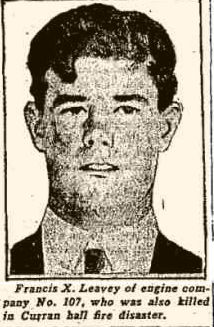
Like most of his co-workers, Leavy was Irish. He joined the fire department 13 years earlier after an eight-year stint in the navy, which he joined at age 14. A family man, he and his wife Mary were parents of a young son and daughter, Frank, Jr. and June. When Leavy said goodbye that Good Friday morning, no one guessed it would be for the last time. All day, the normally upbeat Leavy seemed uncharacteristically sullen, even melancholy.
As the firemen went about their cleaning, they listened to the Joker, the telegraph system at the front of the firehouse that devoted most of that afternoon to a four-alarm fire in the Union Stockyards. The fire was too far away; Engine 107 and Truck 12 were not due to respond. Yet, that such a large fire was burning only a few miles to the south made the men edgy. Leavy tried putting it out of his mind, concentrating on the window he was washing. He placed his left hand against the glass and wiped it clean with a soapy sponge in his right hand. It was precisely at this moment that he looked down and uttered a grim prophecy:
“This is my last day on the fire department.”
Though Leavy had spoken to no one in particular, his words, coupled with his sudden change in personality, puzzled his fellow firefighters, including Edward McKevitt, who had been standing next to him. Before McKevitt could respond, bells started ringing. Box 372 was coming in for a fire a mile-and-a-half east. Engine 107 and Truck 12 were due to cover the response because other fire companies stationed closer to the new fire were fighting the stockyards fire. “Fourteenth and Blue Island,” yelled the officer at the desk. “Let’s Go.” Leavy donned his boots, coat, and helmet and jumped on the back of the 1921 Ahrens-Fox pumper assigned to Engine 107.
The fire was bad. Burning was Curran Hall, a landmark 50-year-old brick building at 1363 S. Blue Island, southwest of the Loop. During its heyday, the four-story dance hall had been a popular party spot. But thanks to time and Prohibition, instead of dancing and fun, the hall now was home to several small businesses, including a leather goods store.
Engine 107’s crew stretched a hoseline up the fire escape and into the burning second floor. They crawled on hands and knees through the heat and blinding smoke, inching their way to the seat of the fire. In those days firefighters had no breathing apparatus, so they had to follow the hose and crawl back and forth to the door to grab a breath of fresh air. After playing water against the flames for about a half hour, it began to darken, but the firefighters could sense something was wrong. Their instincts were confirmed when fire commanders outside began frantically screaming for their men to get out of the building.
But the warning came too late because no sooner did the men from Engine 107 and Truck 12 begin scrambling for the fire escape when the building’s outer walls buckled, bringing down the entire structure, burying the fire fighters inside. The collapse knocked out electrical power to the area, leaving those searching for trapped men to use flashlights. For several hours they dug by hand amid the possibility of a secondary collapse. When cranes were finally brought in eight bodies were dug out. Frank Leavy’s dire prophecy had been fulfilled: he had been among those killed. Though Leavy’s chest had been severely crushed, his was the only body recovered with an intact face, its features clearly distinguishable.
Of the eight dead firefighters, six were from the firehouse at 13th and Oakley. One civilian had also been killed. A ninth firefighter, also from the Oakley station, died eight days later. Twenty others had been injured. A tenth firefighter suffered a fatal heart attack while serving as a pallbearer for one of the victims from Truck 12.
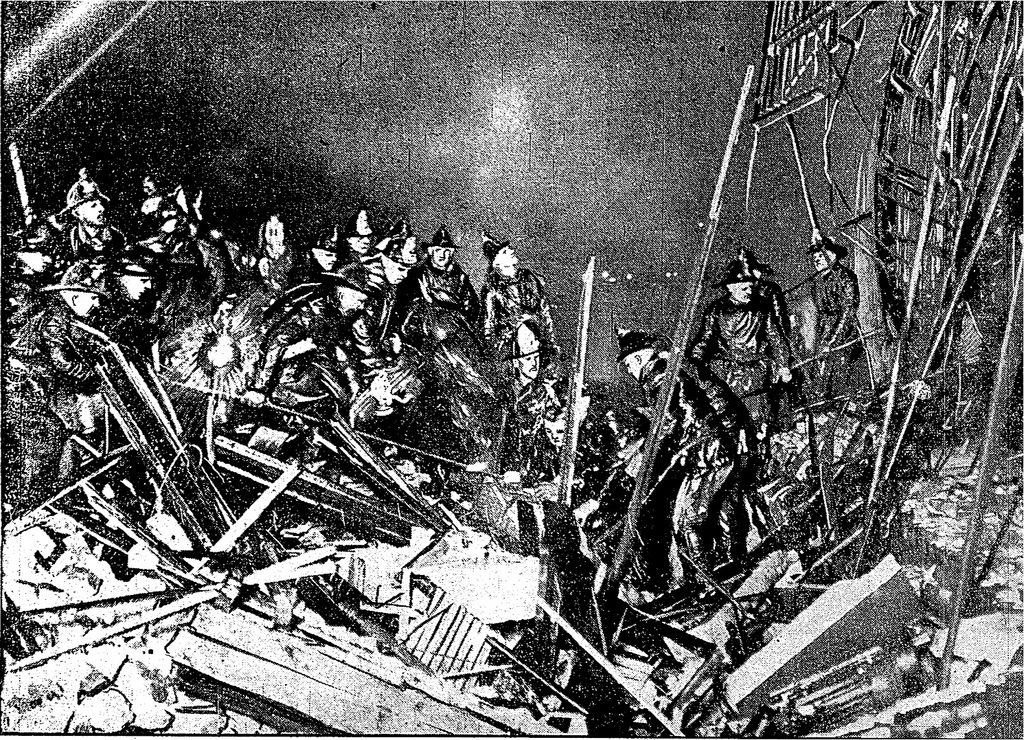
The aftermath of the fire
When the building collapsed, Edward McKevitt was working outside. The next day the shaken McKevitt related to a group of firefighters Leavy’s spooky premonition of death. As he told the story, McKevitt glanced up at the window Leavy had been wiping. Etched in the glass, in the exact spot where Leavy had rested his soapy left hand was the image of a man’s handprint. Because it hadn’t been there before, McKevitt suggested the handprint was Leavy’s, and he and the others tried scrubbing it away. When the image refused to come off, a combination of fear and mystery infiltrated the firehouse.
The legend of the ghostly handprint lived on for many years. Firefighters assigned to Engine 107 and Truck 12 came and went but in the course of their daily house duties, many had tried to scrub the mysterious handprint from the window. Not one effort, including the use of ammonia or scraping the glass with a razor blade, had succeeded. Finally, the Pittsburgh Glass Company, which had manufactured the window, was called in. Still, the apparently supernatural print resisted even their toughest chemical cleaning compounds, causing the handprint to become all the more famous. When a city official obtained a copy of Leavy’s thumbprint, it was compared with the print on the window. The two thumbprints matched perfectly. There could be no doubt: the handprint on the glass definitely belonged to Frank Leavy.
The handprint remained undisturbed for 20 years until one day in 1944, when a newsboy accidentally threw the afternoon paper through the window, shattering the glass containing the handprint. What made the accident eerie was the date of its occurrence: April 18, 1944, exactly 20 years to the day of Leavy’s death.
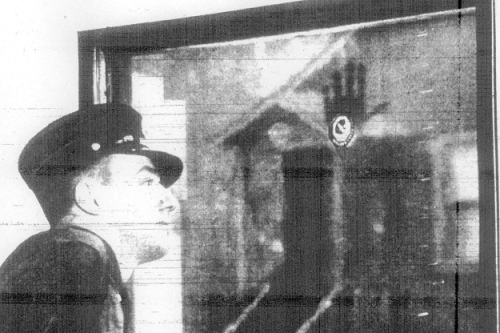
Frank Leavy’s Handprint Circa 1939
Culled from: Great Chicago Fires: Historic Blazes That Shaped a City
Ghastly! – Explosive Edition
While we’re on the topic of fire deaths, here are some post-mortem photos of a fire tragedy that occurred in Los Angeles in 1943, as culled from the book Death Scenes: A Homicide Detective’s Scrapbook.
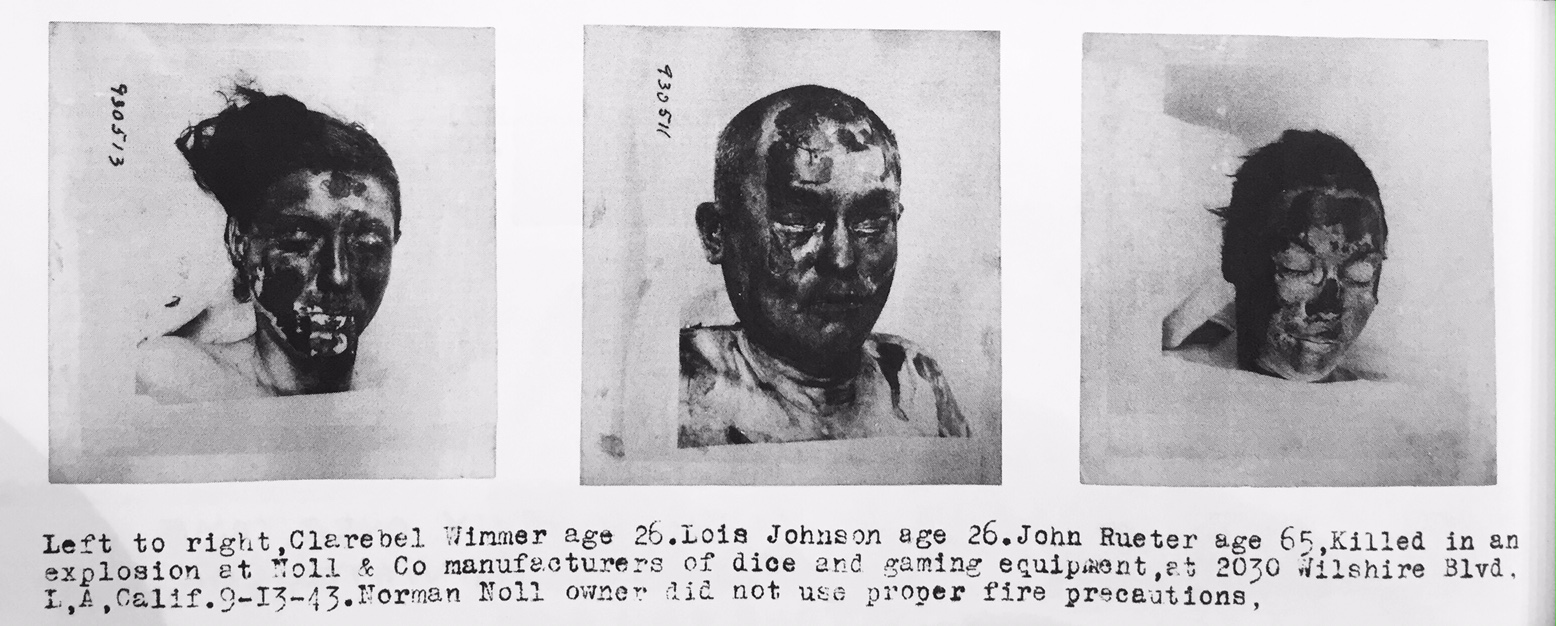
Processed with Snapseed.
“I can think of no more stirring symbol of man’s humanity to man than a fire truck.” –Kurt Vonnegut
And that must have been one heavy whopper of a newspaper, or the newsboy had one hell of a pitching arm.