Today’s Elegantly Malignant Yet Truly Morbid Fact!
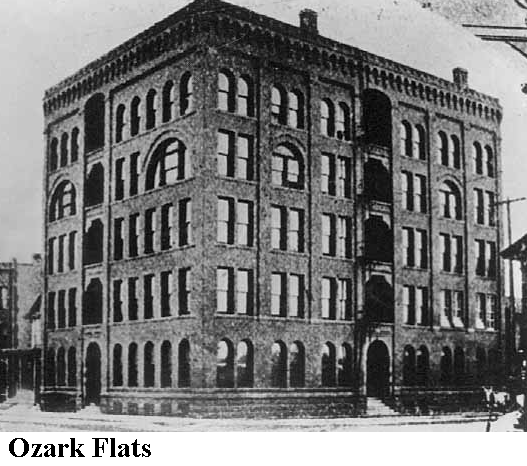
By far the most relentlessly publicized murder of the late nineteenth century in the Twin Cities was that of Katherine (Kitty) Ging in Minneapolis. Mixing cold-hearted villainy with tantalizing whiffs of forbidden sex, the case couldn’t help but stir up excitement in the press. It all began on December 3, 1894, when the 29-year-old Ging, a seamstress with a rather checkered reputation, was found shot to death near Lake Calhoun in south Minneapolis. She lived at Ozark Flats, an apartment hotel (now condominiums) built just a year earlier at 1225 Hennepin Avenue and owned by William Hayward. In January 1894 Ging had hooked up with another hotel resident, William’s youngest son Harry, also 29. Handsome, dangerous, and sexy, Harry Hayward was a classic bad boy whose chief pastimes were gambling and carousing. Within a matter of days he became the prime suspect, even though he had an alibi for the time of the murder.


Charming but Deadly Harry Hayward
Ging’s brutal murder – she was shot in the head at point-blank range – produced a torrent of coverage that washed across the front pages for months. The Minneapolis Journal led the way, producing story after story to create what may well be the most complete account of a murder case ever published by a Twin Cities newspaper. The tale featured a tangled backstory complete with counterfeiting, fraud, arson, and sexual intrigue, not to mention an unlikely cameo appearance by a “trance medium.”
Even without benefit of news photography (as the half-tone photo printing process had not yet been implemented by the Minneapolis newspapers), the Ging murder became such a sensation with the public that Hayward, who was arrested a few days after the crime, had to moved to the Ramsey County jail in St. Paul out of fear that a mob might form in Minneapolis and try to lynch him. Police and other city officials, including Minneapolis mayor William H. Eustis, did their best to ride the waves of publicity that accompanied the investigations. Eustis, a lawyer by profession who apparently viewed himself as the Sherlock Holmes of municipal government, personally led the police team that interrogated Hayward. The press, meanwhile, reported every aspect of the investigation in extraordinary detail. Hayward himself quickly acquired the notoriety of a contemporary Hollywood celebrity, and he could hardly go anywhere without the press following. When, for example, Eustis and several police officers brought Hayward to the morgue to identify Ging’s body (and to see how he would react to the sight), a Journal reporter was there to record the scene:
Mayor Eustis was the first to speak, “Harry, is that your friend?”
The young man, stifling his feelings, replied slowly, “Yes it is,” and then continued to gaze upon the corpse…
Suddenly he looked up and said: “You gentlemen think I’m guilty? — God knows I am not.”
Then for some time he lapsed into silence, looking intently at the body as it lay before him, and the others in the room did not speak, respecting his evident deep feelings for the young woman. Undertaker Connolly was about the close the coffin when Hayward spoke up: “Leave it open; I like to look at her.”
Again the coffin lid was removed and in a trembling voice, Hayward said: “Oh, my God, if she could only speak!”
“Yes, I wish she could,” replied the mayor, and again the coffin lid was closed down and the solemn little party started out of the morgue.
It was one of a number of fine performances Hayward delivered even as evidence mounted that he had arranged for Ging’s murder to collect on a $10,000 life insurance policy. Hayward’s older brother, Adry, was also implicated in the crime, but it was Claus Blixt, a none-too-bright janitor at the Ozark, who actually killed Ging after being recruited by Hayward for the job.

By December 8 authorities had pieced together most of the story behind the murder as newspapers followed every step of the process. The Journal remained at the head of the journalistic pack, sending out reporters to interview numerous witnesses, among them Hayward himself, who greatly enjoyed palavering with the press. The newspaper also dug into Ging’s background, reporting in one of the coded euphemisms of the day that she had been on “very familiar terms” with Hayward in the weeks just before her murder. So obsessed was the Journal with the case that its reporters even consulted with “alienists” to explore possible motives for the crime.
Once the suspected murderers were in custody, the Journal on December 8 devoted its entire front page to the case under a banner headline that read, “The Murder of Poor Kitty Ging.” The page included two-columns drawings of Ging (identified as “the fair victim”) and of the three “arch-conspirators” – Harry and Adry Hayward and Claus Blixt. Adry, in fact, was never indicted for the murder and later testified against his brother, while Blixt ultimately pleaded guilty and received a life sentence. Like other newspapers of the time, the Journal did not bend over backward to protect the rights of the accused, describing Hayward, perhaps a tad too enthusiastically, as “the coldest-blooded scoundrel in criminal history.” The next day, the Journal printed a front-page cartoon depicting Hayward as Jekyll and Hyde, “unmasked at last.” This depiction, however inflammatory, may well have been close to the truth, since beneath his surface charm Hayward seems to have been a pure psychopath who undertook Ging’s murder in part for the sheer thrill of it.
Hayward’s trial, which opened on January 21, 1895, drew breathless moment-by moment attention from the local dailies. The chief attraction, of course, was Hayward himself, who played the villains’ role with his customary aplomb. Crowds of young women filled the front rows of the courtroom every day, presumably to admire his elegant malignity. Although the trial’s outcome was a foregone conclusion, Hayward made a point of testifying on his own behalf, whipping up a smooth meringue of lies and half-truths, but his legendary charm couldn’t save him from a guilty verdict and a trip to the gallows.
Following Hayward’s conviction, the press lost interest in him for awhile, but when his appeals all failed and the execution date of December 11, 1895, drew near, the newspapers once again put him squarely on the front pages and kept him there until his dying moment. Hayward, who was apparently no more afraid of death than anything else, cheerfully confessed in a final newspaper interview to arranging Ging’s murder, then dropped into eternity after telling the hangman, “Pull her tight; I’ll stand pat.”
Culled from: Murder Has a Public Face: Crime and Punishment in the Speed Graphic Era
Oh, the Tragic Irony!
Murder Has a Public Face by Larry Millett is a collection of crime and punishment photos in the Speed Graphic camera era taken in the St. Paul, Minnesota area. Here’s a kind of amazing entry from the book. Can you imagine being that photographer and realizing what an amazingly ironic shot you’re about to get?
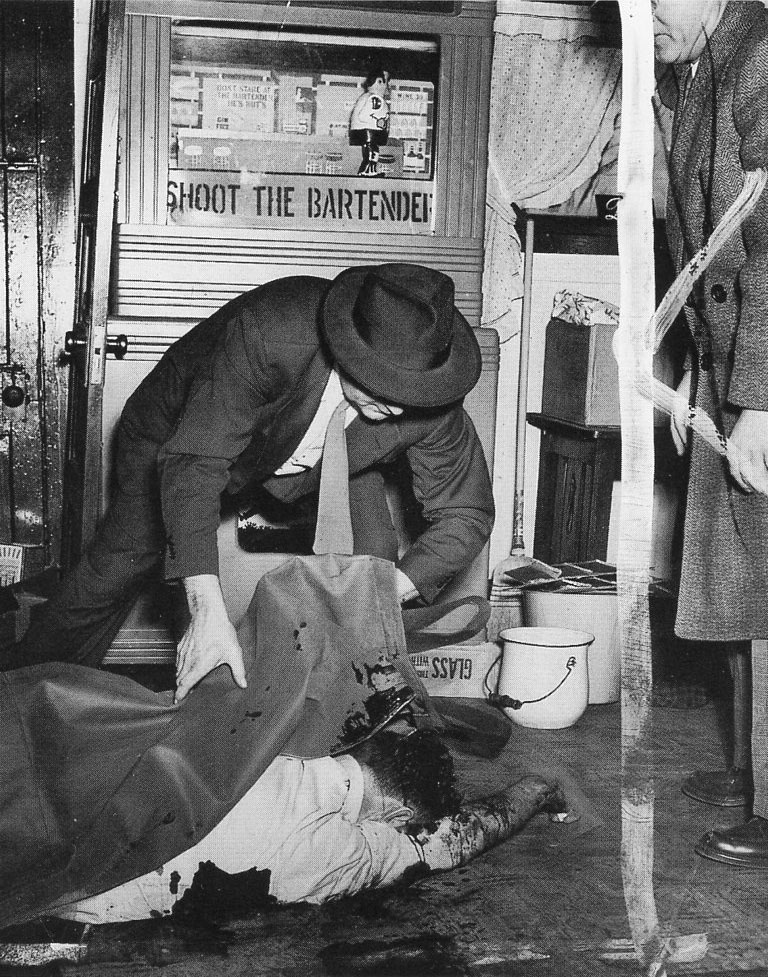
With its blunt visual irony, this photograph from January 1948 qualifies as a classic example of a Speed Graphic “death shot.” Lying dead next to the “Shoot the Bartender” game is Hite Snow, 33, who with his mother-in-law, Catherine Fredericks, operated a tavern near Superior, Wisconsin. One afternoon an ex-convict named George Demo went into the bar, gunned down Hite, wounded Mrs. Fredericks, and then fled with all of $40. He was soon apprehended on the interstate bridge between Superior and Duluth and confessed to the crime. Douglas County coroner Harry Dingwall is the man covering Snow’s body.
Pioneer Press, Jan. 8, 1848