Today’s Expertly Analyzed Yet Truly Morbid Fact!
It’s hard to deny the hypocrisy of nineteenth-century collectors who condemned headhunting as barbaric while seeking out human heads to display at home. It was not just commercial traders who were implicated in this macabre business. By the end of the century, scientists, in particular, were encouraged to collect heads and other body parts in the most definite terms. Headhunting, in this sense, was little short of a professional duty.
Take, for example, the guidance given to collectors in Notes and Queries on Anthropology, which was the standard handbook for British anthropologists working in the field. The first edition, published in 1874, advises that skeletons and skulls of natives ‘should, if possible, be brought to England for expert analysis’. In addition, if ‘after a battle, or other slaughter, the head of a native can be obtained with the soft parts in it’, it should be packed and sent home in a small keg of spirit or brine. The second edition, published in 1892, was even more thorough in its recommendations: ‘The general traveller may also do much to advance the study of the more technical part [of the subject] by collecting specimens of skeletons, hair, even parts of the body, such as the hands, feet, brain, or the entire head, and sending them to our laboratories or museums to have their character worked out by skilled anatomists’.
This appeal for human body parts was printed under the auspices of two of the most respectable academic institutions in Great Britain, and the academic community was only too happy to oblige. Science, it seemed, excused a multitude of sins, particularly when the ‘subjects of study’ were impoverished, imprisoned or deemed to be primitive. While travelling abroad, collectors behaved in ways that would have been criminal at home. Some scientists in foreign lands dug up graves under cover of night. Others stole the dead from hospital morgues, bought bodies from prisons, offered people goods in exchange for bits of their dead relatives, or asked the locals politely for enemy body parts after battles and raids.
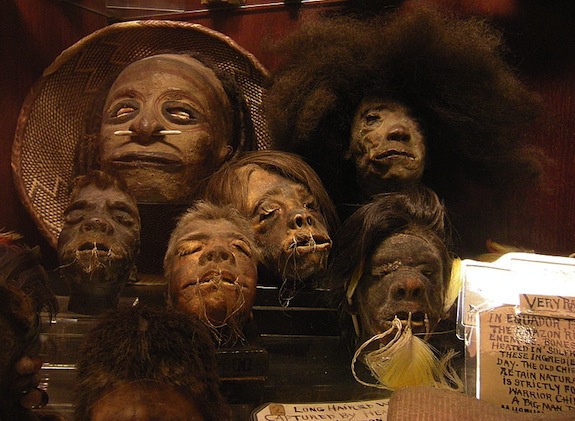
The most arresting evidence for this morbid avarice is the ‘loot’ itself, because our museums are filled with the dead bodies that these learned men, and occasionally women, proudly sent back to the metropolis for further examination. On arrival in a museum, each new addition – each skull, each skeleton, each shrunken head, each piece of dried skin, each organ preserved in a jar – was carefully recorded by a curator before he decided whether to put it on public display. Reading through these accession books is a sobering experience, as on page after page human lives are reduced to a cursory list of acquisitions.
- Three heads from Tangalung, Central North Borneo, from C.V. Creagh, Governor of Sandakan
- An artificially deformed ‘Flathead’ skull from Dr. Franz Boas, Clark University, Worcester, Massachusetts
- The ears of an adult man and woman, from Professor George Thane
- A Patagonian skeleton from C. MacMunn
- The scalp of an Andaman Islander collected by Colonel Cadel, Cheif Commissioner of the Andaman Islands
Culled from: Severed: A History of Heads Lost and Heads Found
Of course, perhaps it’s the anthropology major in me, but I’ve always felt that it should be seen as an honor to be a museum specimen. I’d love to be one – wouldn’t you?