Today’s Poetic Yet Truly Morbid Fact!
For some, the blast of genius has a short lifespan. Once this period of hyperactive creativity begins, one’s physical age becomes irrelevant and follows the ticking of another clock, many times ending in its own implosion soon after it began. Thomas Chatterton exemplified this phenomenon like few others, and is now considered the first Romantic poet of the English language. His was a burst of ingenious brilliance during puberty when, at age twelve, he became obsessed with achieving literary greatness. He came from a poor family in the overcrowded town of Bristol, England. His widowed mother arranged to send Thomas to a private school but he was dismissed, considered an idiot and too scatter-brained to learn. At age eight he was sent to a charity school that was set up for the less bright to become business apprentices, being taught only the barest of remedial skills. Here he had his head shaved, was made to wear an ankle-length smock, and was treated invariably as no more than an indentured servant. However, when he went back home during holidays from school, his mother gave him the few pennies he needed to borrow books from the library to satisfy his unusual thirst for knowledge. Thomas’s favorite place to study was a nearby graveyard, crotched behind lopsided tombstones etched with skeleton heads and angels. When he was twelve, Thomas found a stash of old, blank parchments sequestered in a forgotten trunk in his attic, which his deceased father had once removed from the family’s parish church. Stealthily, he took these faded parchments to a lumber room and, with pieces of charcoal and lead powder, wrote original poems that looked authentically like the work of some ancient, medieval writer. He saw the marketing potential of this immediately, and guessed correctly that if he presented his poems as anything other than a “discovered” medieval classic, he would be patted on the head and dismissed as a lower-class urchin grasping beyond his capabilities. He showed one of his parchment poems to an official at the school and duped him immediately into believing it was indeed an ancient find. The favorable reaction was so great that Thomas went on to create an entire body of work by a made-up monk he called Sir Thomas Rowley.
Thomas’s station in life at school, and later when at age fifteen he was apprenticed to a Bristol lawyer, irked him, forced as he was to sleep with the footboys, being spied upon to make sure he wasn’t idling away a moment of time. Thomas was frequently insulted and belittled, and if he was caught writing a poem the head of the house ripped it up, kicked him in the ass, and sent him to scrub a bedpan. Meanwhile, in his secret life as Sir Rowley he saw his poems put in print, published in respectable magazines, and purchased by a notable scholar who included his medieval pieces as examples of the work of a late honorable citizen of Bristol. When Thomas came forth and revealed he was the true author, he was scoffed at, believed incapable of creating such masterpieces, and ridiculed as a liar. Thomas grew morose, and devised a plan to be relieved of his apprenticeship obligation by saying that he intended to commit suicide in his master’s house. He was promptly deposited to the curb, dismissed with not a cent to his name.
In April 1790, when Thomas was seventeen, his friends donated money for his transportation to London, where he quickly got hired as a freelancer for numerous magazines. For a time he subsisted on the paltry payments for his writings, though when summer approached, back when businesses in the big city traditionally closed down, work dried up, which suddenly left Thomas in dire financial straits. He continued to write cheerful letters to his mother, extolling his rapid rise in the ranks of writers, while in reality he was holed up in a rundown boarding room without a crumb to eat. It’s reported that many tried to offer help, and that his landlady, named Mrs. Angel, brought him food, which he refused, insisting that he was fine and needed charity from no one. At the end of August, on one exceptionally hot evening, three months shy of his eighteenth birthday, Thomas Chatterton drank a cup of arsenic tea. He was found in his room the next morning amid a shredded heap of his torn-up manuscripts. His death was deemed a suicide due to reasons of insanity.
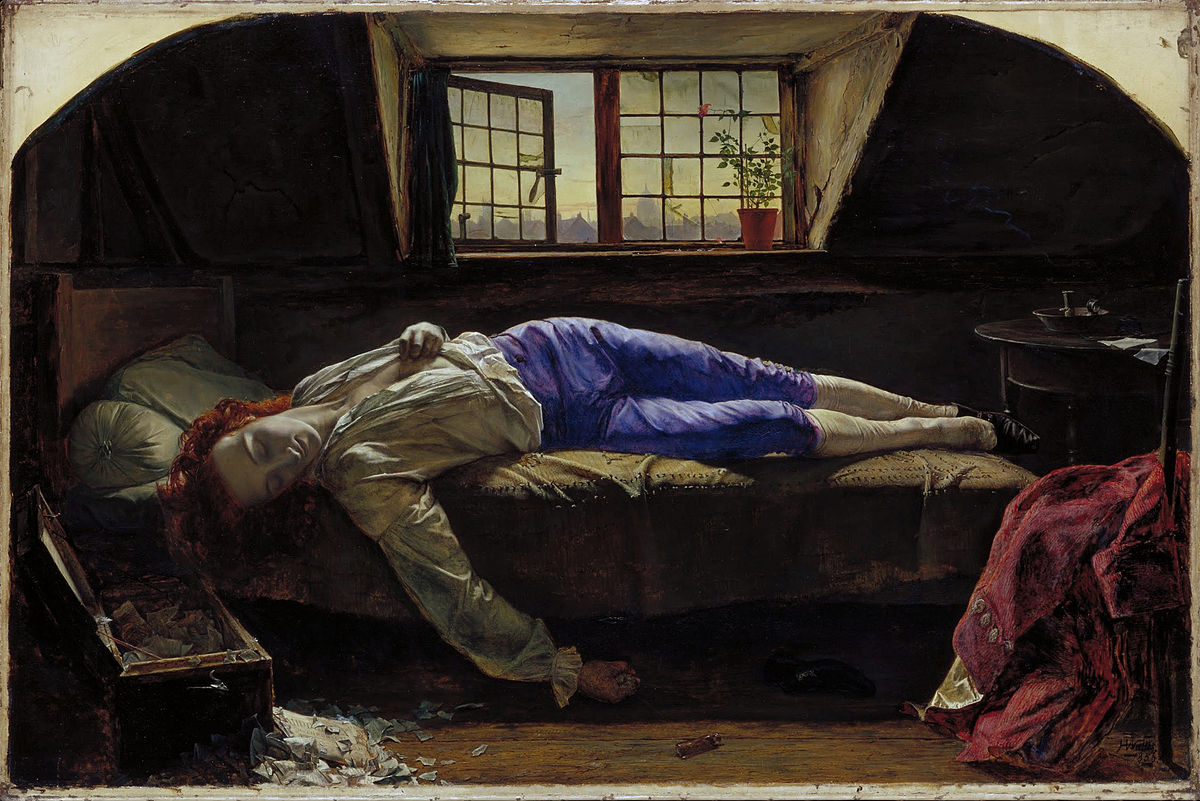
The Death of Chatterton, 1856, by Henry Wallis
Culled from: Genius and Heroin: The Illustrated Catalogue of Creativity, Obsession, and Reckless Abandon Through the Ages
Here’s a Chatterton verse (from Ælla, A Tragical Interlude):
Harke! the ravenne flappes hys wynge,
In the briered delle belowe;
Harke! the dethe-owle loude dothe synge,
To the nyghte-mares as heie goe;
Mie love ys dedde,
Gon to hys deathe-bedde,
Al under the wyllowe tree.
Chatterton died in 1770, not 1790!