Today’s High-Altitude Yet Truly Morbid Fact!
The following is an excerpt from Jon Krakauer’s account of the deadly 1986 mountain climbing season at K2, where 13 people died.
On July 5, four Italians, a Czech, two Swiss, and a Frenchman, Benoit Chamoux, reached the summit via the Abruzzi route. Chamoux’s ascent was done in a single twenty-four-hour push from base camp, an extraordinary athletic feat, especially considering that just two weeks before, the Frenchman had sprinted up the neighboring slopes of 26,400-foot Broad Peak in seventeen hours.
Even more extraordinary, though, were the deeds underway on K2’s south face: a two-mile-high expanse of steep, ice-plastered rock, avalanche gullies, and tenuously hanging glaciers delineated on one side by the Abruzzi Spur and on the other by the Magic Line. On July 4, the Poles, Jerzy Kukuczka, thirty-eight, and Tadeusz Piotrowski, forty-six, started up the center of this unclimbed wall in light, impeccably pure style, bent on pushing the limits of Himalayan climbing to a whole new plane.
Kukuczka was the heir apparent to Messner’s unofficial title as the world’s greatest high-altitude alpinist. When he arrived at the base of K2, Kukuczka was nipping at Messner’s heels in the race to climb all fourteen 8,000-meter peaks; he had already bagged ten of them, an accomplishment that was especially impressive considering the expense of mounting Himalayan expeditions and the pathetic rate of exchange for Polish zlotys. To fund their expeditions, Kukuczka and his Polish comrades had been routinely forced to smuggle vodka, rugs, running shoes, and other unlikely commodities that could be bartered for hard currency.
Just before sunset on July 8, after a lot of extreme technical climbing and four brutal bivouacs (the last two of which were without tent, sleeping bags, food, or water), Kukuczka and Piotrowski struggled to the summit of K2 in a howling storm. They immediately began to descend the Abruzzi Spur. Two days later, with the two climbers totally strung out and still battling their way down through the blizzard unroped, Piotrowski—who, because of numb fingers, had been unable to properly tighten his crampon straps that morning—stepped on a patch of steel-hard ice and lost a crampon. He stumbled, righted himself, then lost the other crampon. An attempt to self-arrest wrenched his ice axe out of his hands, and he was soon hurtling down the steepening slope out of control. Kukuczka could do nothing but watch as his partner bounced off some rocks, then disappeared into the mists.
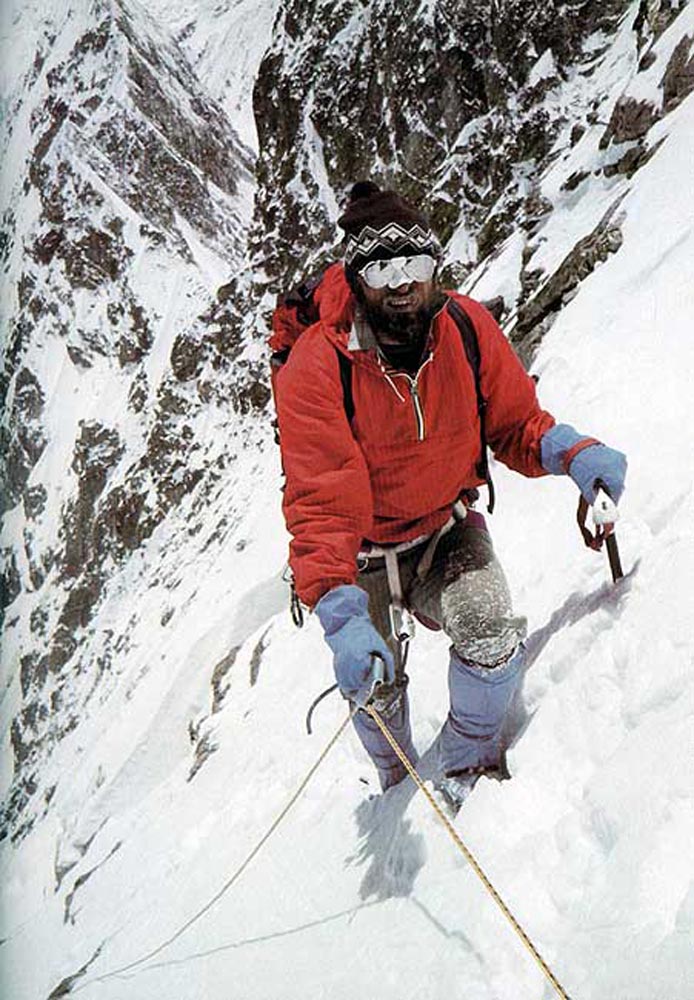
Piotrowski climbing K2 before the fall
By now the summer’s death toll was beginning to give pause to most of the climbers still on the mountain, but for many the lure of the summit proved stronger. Kukuczka himself departed immediately for Nepal to attempt his twelfth 8,000-meter peak and gain ground on Messner in the race to knock off all fourteen. (The effort would prove to be in vain when Messner reached the summits of Makalu and Lhotse, the following autumn, to claim the fourteen-summit crown.)
Shortly after Kukuczka returned to base came to tell his troubling tale, the thirty-eight-year-old Italian solo climber Renatto Casarotto set out on his third attempt that summer to climb the Magic Line alone. This attempt, he had promised his wife, Goretta, would be his last. Solo ascents of difficult new routes on Fitzroy, Mt. McKinley, and other major peaks in South America and the Alps had given Casarotto a heroic, damn-the-torpedoes reputation, but the Italian was in fact a very cautious, very calculating climber. On July 16, a thousand feet below the summit and not liking the look of the weather, he prudently abandoned his attempt and descended the entire South Pillar to the glacier at its base.
As Casarotto made his way across the final stretch of glacier before base camp, climbers watching through binoculars from the camp saw him pause in front of a narrow crevasse that blocked his path and prepare to hop across it. To their horror, as he did so the soft snow at the edge of the crevasse gave way and Casarotto suddenly disappeared, plunging 130 feet into the bowels of the glacier. Alive but badly injured in a pool of ice water at the bottom of the crevasse, he pulled his walkie-talkie out of his pack and called Goretta. At base camp, she heard her husband’s voice whispering over the radio, “Goretta, I have fallen. I am dying. Please send help. Quickly!’
A multi-national rescue party immediately set out, reaching the crevasse in the last light of the day. A pulley system was soon rigged, and Casarotto, still conscious, was hauled to the surface of the ice. He stood upright, took a few steps, then lay down on his rucksack and died.
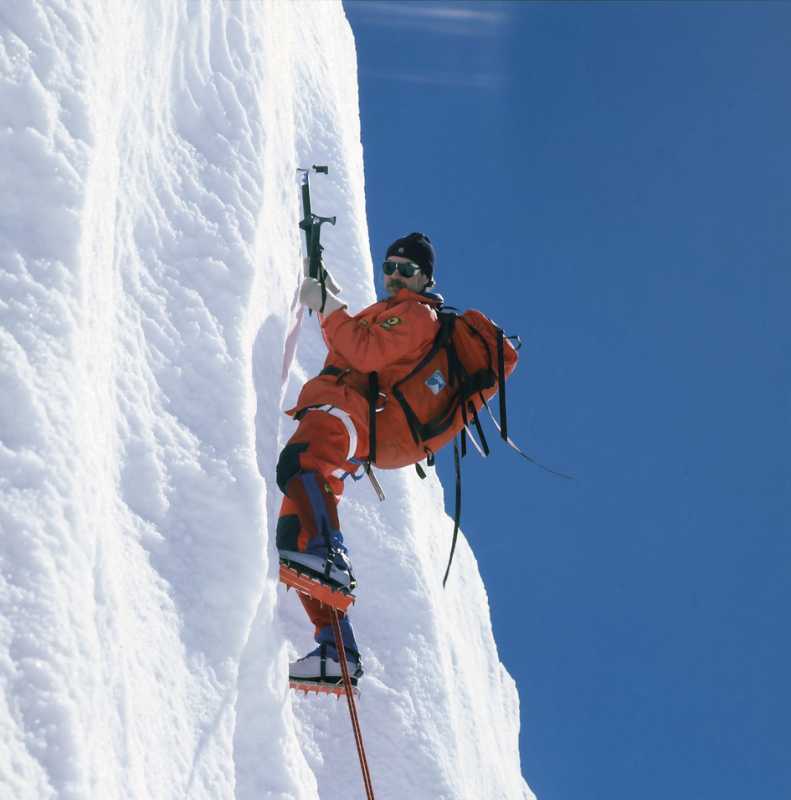
Renatto Casarotto in better times
Culled from: High: Stories of Survival from Everest and K2