Today’s Accidental Yet Truly Morbid Fact!
Mine Inspector’s Report
for
HOUGHTON COUNTY, MICHIGAN
FOR THE
YEAR ENDING SEPTEMBER 30, 1902.
JOSIAH HALL, Mine Inspector.
ACCIDENT No. 40.– July 19. Michael Smith came to his death by accidentally falling from the 5th to the 6th level in E shaft of the Champion mine. The deceased, with three others, were fixing the skip road in the shaft. Smith was knocking off a plank from the end timber of the shaft with a hammer; he missed his blow and lost his balance and fell down the shaft. An inquest was held before Coroner Brand. Witnesses testified as above stated.
Verdict of the jury: We, the jury, find that Michael Smith came to his death by accidentally falling from the 5th to the 6th level of E shaft of Champion mine; and we exonerate one and all from any blame whatever.

Inside the Champion Mine
Culled from: Some Fatal Accidents in the Atlantic, Baltic, Champion, Trimountain and Winona Copper Mines
Asylum Inmate Du Jour!
In The Library Eclectica, I have a book entitled The Faces of Madness: Hugh W. Diamond and the Origin of Psychiatric Photography (edited by Sander L. Gilman), 1977. It contains a wonderful collection of photographs of asylum inmates taken in the 1850’s by pioneering medical photographer and psychiatrist Dr. Hugh W. Diamond, along with engravings that were made of them and used in teaching. There are also several case studies by Dr. John Conolly (the leading British psychiatrist of the mid-nineteenth century) for some of the patients. The portraits are beautiful and sad and the text reveals the psychiatric thought processes of the mid-19th century. Here’s a case study.
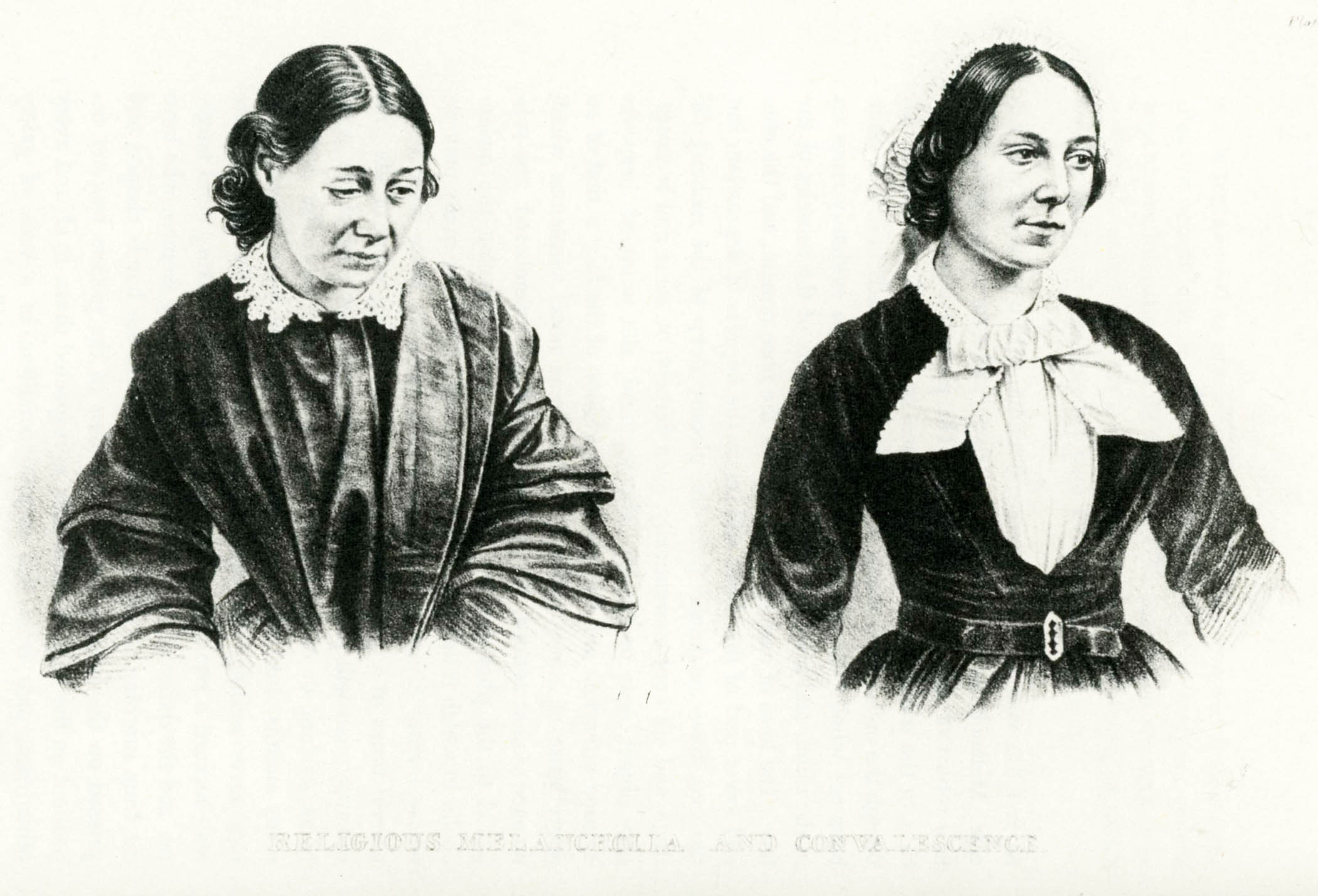
At first this was a case of puerperal mania, with a propensity to suicide. Melancholia succeeded to this stage, and after a time gave place to a return of maniacal excitement. The portrait represents the patient in the transition stage from sadness to renewed excitement. Although the melancholy traces of the form of her malady in its first stage have not wholly disappeared, new emotions have evidently risen up in the mind, and have modified the movements of the muscles of the face. The lines of care from the alae of the nose remain, and the chin and lower part of the cheek still retain the impress of depression; but the eyes have awakened from the gloomy sleep of the melancholic stage, and are bent energetically, even fiercely, on some real or imaginary object, near or distant. The forehead, still wrinkled, bespeaks aroused attention; and the general expression of the face is that of an angry sense of injury inflicted, and of some novel suspicions which menace violent actions. The patient, it will be remembered, was subjected to the photographer when mania was displacing the melancholia to which it had previously given way. There are many patients whose mental disorder, being incurable presents these alternations several times in a year, and for all the remaining years of life. An unhappy man will pace up and down some chosen part of the ward of an Asylum, or of the gravel-walk of a garden, day after day, for many months, until the very earth and stones are worn; never peaking, never smiling; the personification of misery. But to this state may succeed a strangely-contrasted gaiety, lively talking, wild laughter, and the dance of merriment. Unhappy-looking women, who have sat from morning to night, week after week, the hands clasped and pressed on the breast; the eyes heedless of the passers by; and dependent on the help of attendants as respected dress, food, and every other care; pass from this moping condition to a state of gaiety which produces amusement even among their fellow-patients; unexpectedly making their appearance in some old and carefully preserved finery; their hair curled and ornamented; their whole deportment displaying the vanity of fancied beauty and of faded grace marvelously restored.
(I think we call that “Bipolar Disorder” in modern times – DeSpair)