Today’s Crooning Yet Truly Morbid Fact!
Rarely has a singer and actor had such a meteoritic rise to fame, only to have his life cut short by a bizarre accident before his talents peaked, as did Russ Columbo. The youngest of twelve children, Colombo was born Ruggerio Eugenio di Rodolpho Columbo to Italian immigrants Nicola and Guilai Columbo, in Camden, New Jersey, on January 13, 1908.
Columbo’s family moved often during his younger years, with stretches in Philadelphia, San Francisco, Calistoga, and finally Los Angeles, purportedly so young Ruggerio could keep taking singing lessons from Phantom of the Opera star Alexander Bevani. Russ made his professional debut at the Imperial Theater in San Francisco at the age of thirteen. While spending his high school years in Los Angeles, he was the first violinist in the Belmont High School orchestra and worked as a professional musician performing mood music on the sets of silent films.
While working on movie sets, young Russ hooked up with the glamorous Polish actress Pola Negri. The former lover of Charlie Chaplin and Rudolph Valentino, Negri no doubt showed Russ the ins and outs of Hollywood, as his career suddenly took some lucky breaks. Playing the ballroom circuit around Los Angeles, he ended up in Gus Arnheim’s Coconut Grove Orchestra, which was the house band at the Ambassador Hotel.
Arnheim’s band was big time in Los Angeles in the 1920s and 1930s, with many of his band members, like Bing Crosby, Fred MacMurray, and arranger Jimmie Grier, going on to achieve fame of their own. Although Columbo played violin in the orchestra, he also sang, sometimes with Crosby, whom he eventually replaced in the band.
By 1928, Columbo was performing in small singing roles in movies, often dubbing the singing for the top-billed star. The next two years were filled with cameo singing parts to quickie movies. Columbo also ran the unsuccessful Pyramid Café nightclub on Hollywood Boulevard.
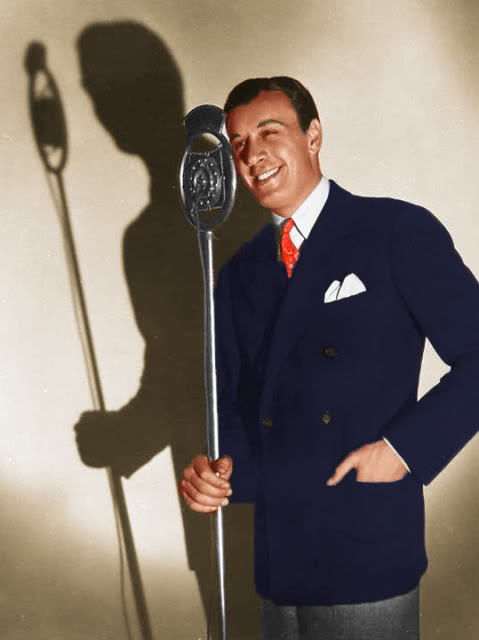
In 1931, popular songwriter Con Conrad heard Columbo singing and talked him into going to New York City with him. While on the cross-country train, Conrad and Columbo wrote Columbo’s signature song, “You Call It Madness”. Conrad who had written the hit songs, “Ma, He’s Making Eyes at Me” and “Lonesome,” and had also won the very first Academy Award for Best Original Song with “The Continental,” from the film The Gay Divorcee, but at this stage of his career he focused on Broadway shows and radio.
Conrad got Columbo a radio slot on Tuesday night at 11:30 p.m., on NBC, and the young singer was soon making $3,000 a week. Conrad got the show’s time changed to go up against Bing Crosby’s radio show on CBS, and a fake rivalry was concocted, dubbed The Battle of the Baritones. Columbo’s live performances were consistently sold out. Considered a crooner by the public, a label that Columbo hated, he was on the cutting edge of music at the time, along with Crosby and Rudy Vallee. The amplified microphone was a brand-new invention at the time and it changed the way singers sang. No longer did vocalists have to belt out songs so the people in the balcony could hear. The microphone made it possible for baritones to be heard clearly for the first time by a large audience, and Columbo took advantage of the new technology. During this time, when he was known as the Romeo of Radio and the Valentino of Song, Columbo was romantically linked with beauty queen/actress Dorothy Dell, singer/comedian Hannah Williams, and the great Greta Garbo.
In 1933, Columbo’s radio program lost its main sponsor, Listerine, and the program was cancelled. After some disputes with Conrad, Columbo fired his manager, put together a band, and toured his way back to California. Arriving in Los Angeles, he moved his family into an ornate Spanish style home at 1940 Outpost Circle in the Hollywood Hills, an exclusive neighborhood to this day.
Columbo continued to write songs and perform. Always striving to improve his talents and to help distinguish himself from all the other crooners, Columbo began taking voice lessons. He had a decent role in the film Broadway thru a Keyhole and sang several songs in the film.
Offered the lead role in Universal’s Wake Up and Dream, Columbo had finally gotten top billing. With music by Cole Porter, Wake Up and Dream was a flop on Broadway, but was brought to film anyway. Columbo’s acting had grown and his singing voice was never better. It looked like the twenty-six-year-old crooner had locked into a bright future.
On August 31, 1934, Columbo and his movie-star pal (i.e. girlfriend) Carole Lombard attended a Friday night preview of Wake Up and Dream at the Pantages Theater on Hollywood Boulevard. Anxious to see the audience reaction to his first movie in which he had received top billing, Lombard and Columbo supposedly attended the festivities in disguise.
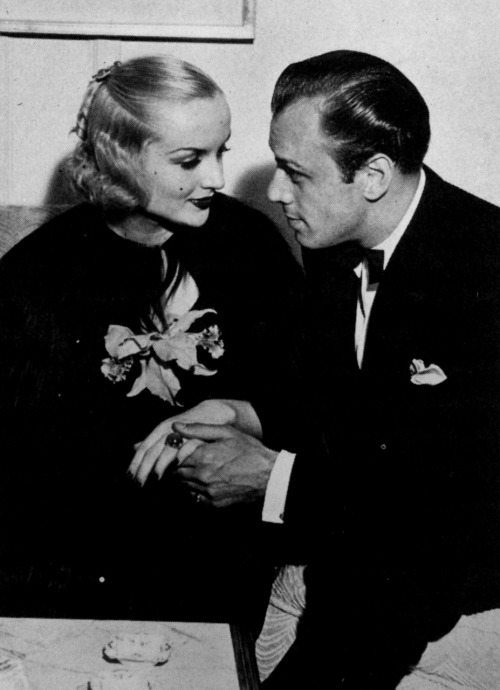
Carole and Russ sittin’ in a tree…
Colombo’s good friend, portrait photographer Lansing Brown, Jr., also attended the preview, but Columbo didn’t get a chance to talk with him after the film. Columbo wanted to know what Brown thought of his acting and the film in general. Columbo tried to reach him the next day but was unsuccessful, so Columbo drove to Santa Barbara for another preview of Wake Up and Dream. Lombard was exhausted from her nonstop work schedule and drove with her secretary to Lake Arrowhead for some rest and relaxation in the country. She planned on having dinner with Columbo on Sunday evening.
On Sunday morning, September 2, 1934, Columbo finally got in touch with Brown, who invited him to his home at 584 N. Lillian Way in Hancock Park. While they were discussing the weekend’s events in Brown’s den, Brown took one of his Civil War era flintlock dueling pistols off his desk. Hew as in the habit of lighting matches off the hammer of the gun, but unknown to anyone, the pistol still had decades-old gunpowder and a mini ball in the barrel. The gunpowder ignited and fired the bullet out of the barrel with such force that it ricocheted off a mahogany desk and into Columbo’s left eye.
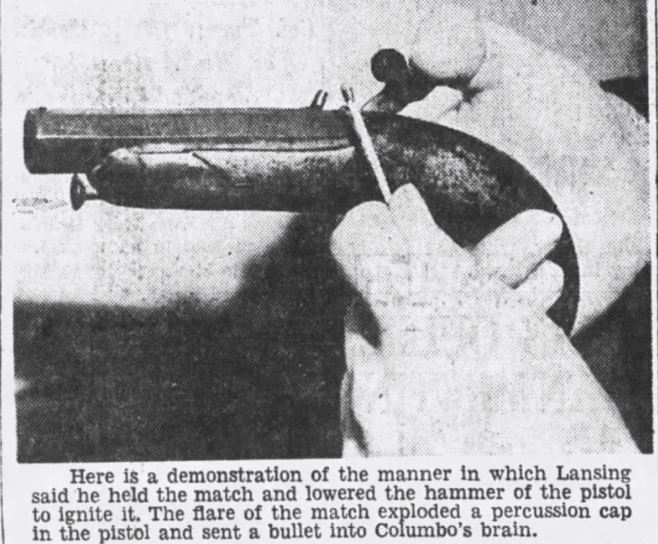
The ill-fated pistol
Columbo screamed as he fell into a chair. The room was filled with gun smoke when Brown’s parents, who were visiting him, ran into the room. Thinking that Columbo was dead, they called the police, who found that Columbo still had a pulse. He was taken by ambulance first to Hollywood Receiving Hospital, then transferred to the Hospital of the Good Samaritan, which was better equipped for treating this type of injury. Surgery failed to save Columbo and he died in the hospital at 7:30 that evening with actress and old flame Sally Blane, film star Loretta Young’s older sister, at his bedside.
An investigation cleared Brown of any wrongdoing, although there were suspicions that the two men had recently been at odds with each other. Brown took the death of his friend very hard and, according to his friends, he was never the same man. He moved out of his house where the death happened and remained a broken man for the rest of his life.
Three thousand people attended Columbo’s funeral at Hollywood’s Blessed Sacrament Church. Pallbearers included Columbo’s friendly rival Bing Crosby, director Walter Lang, and actors Gilbert Roland and Zeppo Marx. Lansing Brown was seen in the back of the church, kneeling and crying.
Columbo’s mother, suffering from blindness, was never told about her son’s death. The family made excuses for the absence of her beloved son for the last ten years of her life.
Culled from: Death In California
 |
| In case you were wondering what all the fuss was about… |
Treasures Du Jour!
Ah, the Mütter Museum. The home of such incredible delights! Like these eight little darlins!
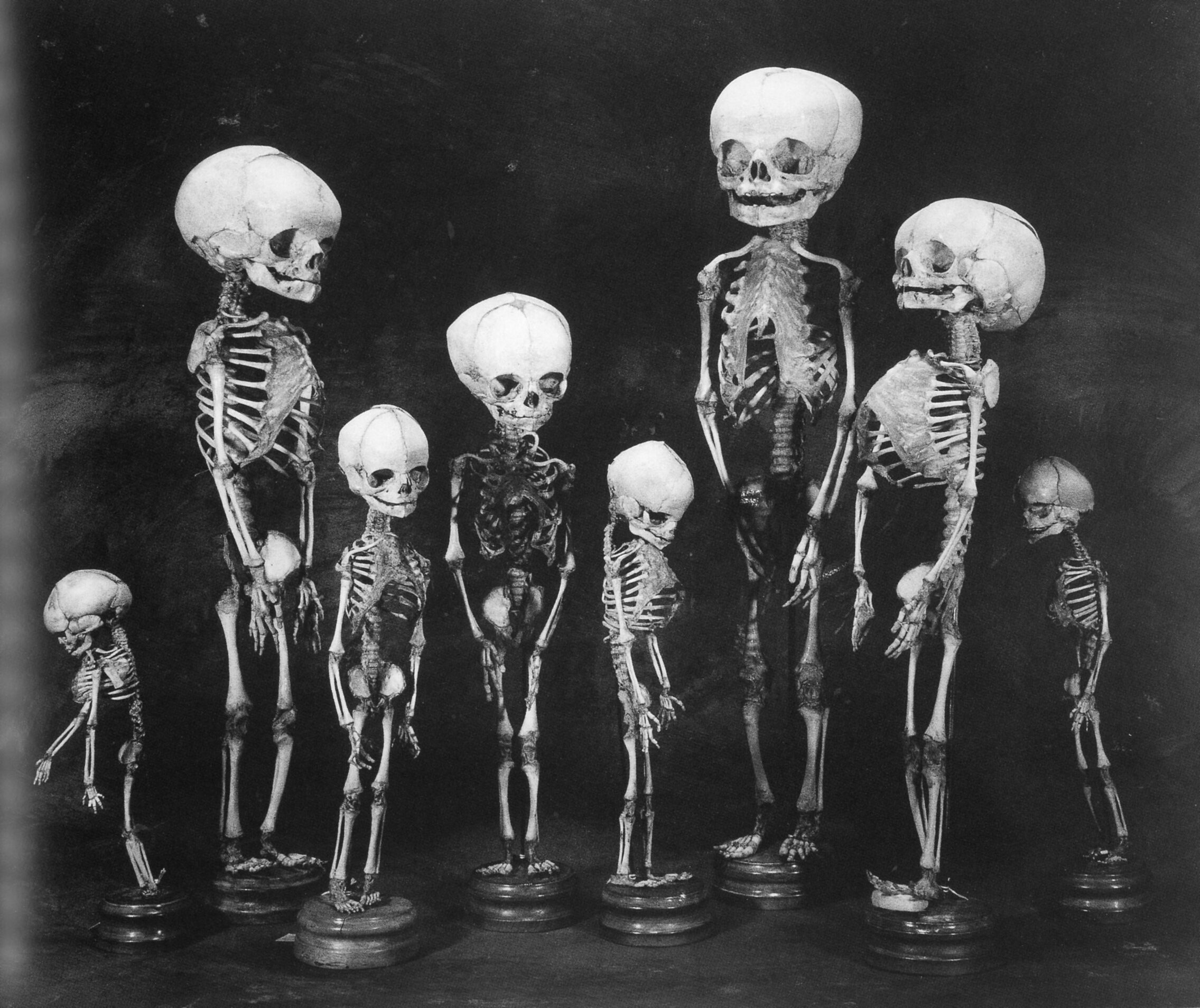
8 Foetal Skeletons
1986 Gwen Akin and Allan Ludwig, platinum print.
Part of a series showing the development of the foetal skeleton, second-month gestation to postpartum. Prepared in Vienna, purchased 1883.
Culled from: The Mütter Museum of the College of Physicians of Philadelphia