Today’s Masked Yet Truly Morbid Fact!
The last great Twin Cities murder case of the early twentieth century was that of Alice McQuillan Dunn in St. Paul in 1917. Alice Dunn was the daughter of a well-known plumbing contractor, James F. McQuillan, with family roots extending deep into St. Paul’s past. In 1914, at age 24, she’d married Frank Dunn, a prosperous teaming contractor 16 years her senior. The marriage did not go well, and a year later Alice obtained a legal separation that, among other provisions, required her husband to pay her $70 a month in support. She then moved back into her parents’ home at 793 Selby Avenue. Frank despised the idea of paying money to a woman he’d come to hate, and he eventually set in motion a plot to kill her.
Early on the morning of April 26, 1917, a masked intruder broke into the McQuillan house, climbed the stairs to the second floor, and made his way to the bedroom where Alice slept with her younger sister, Katherine. Noise from the break-in awakened both women. Upon entering the bedroom, the masked man told Katherine, who had begun screaming, “Be quiet, there, be quiet, damn you; I saw her [Alice] and I just want to do a little shooting.” He then proceeded to blow away the left side of Alice’s head with three close-range shots from a .44-caliber pistol, after which he left without harming Katherine.
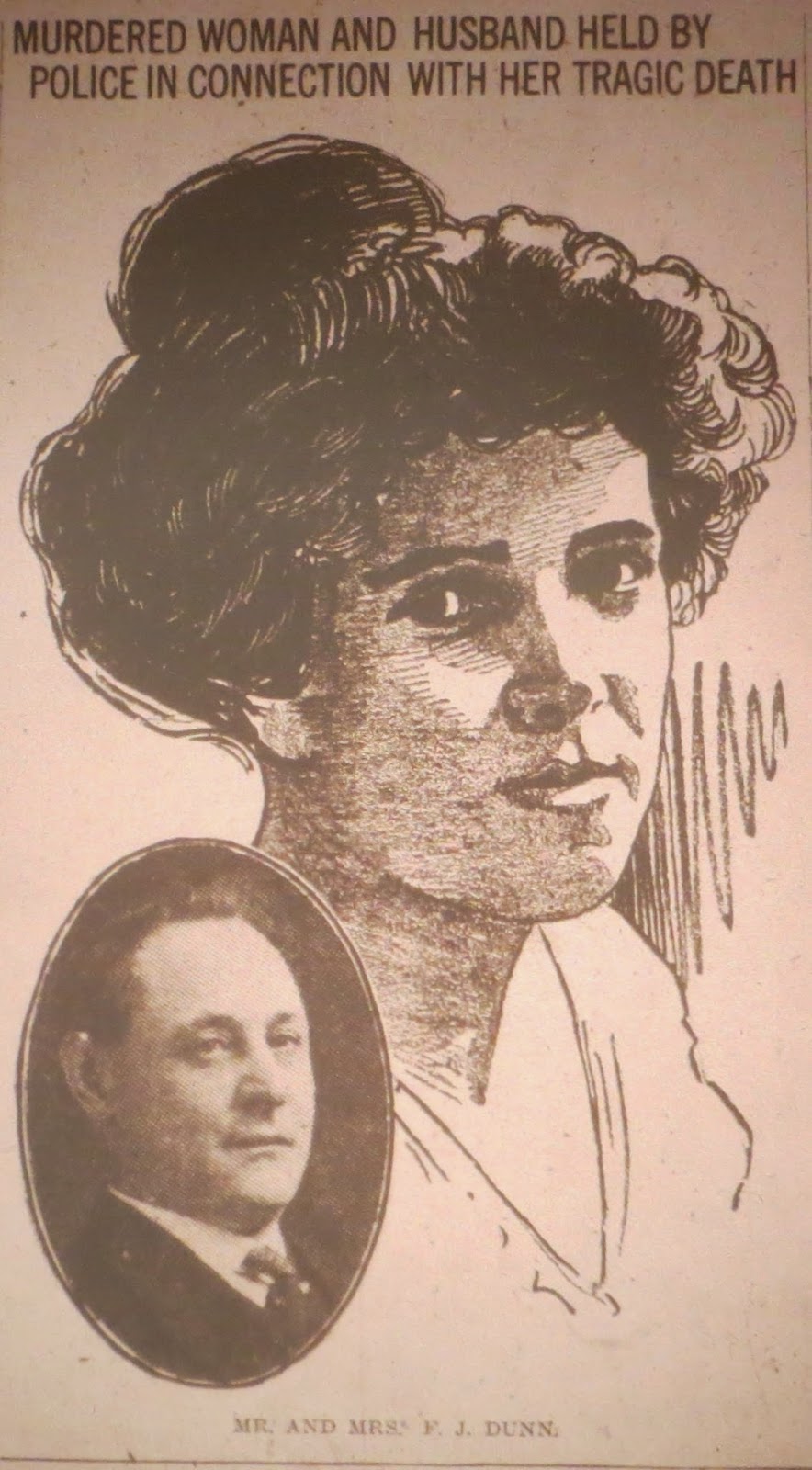
The execution-like killing stunned St. Paul, which was already experiencing a mini-epidemic of homicide; six other murders had been recorded since the first of the year. “Beautiful Woman of Old Family Is Slain in Home,” headlined the Dispatch. The Daily News, less concerned with pedigree, was more blunt: “Young Woman Shot Dead in Bed Beside Sister.” Although all the major Twin Cities newspapers had photographers by this time, surprisingly few pictures accompanied early accounts of the murder. The Dispatch published a studio portrait of Alice, while The Daily News offered a photograph of the house where she was murdered. Both newspapers also provided floor plans of the McQuillan house, complete with lines and arrows indicating how the killer had reached the bedroom.
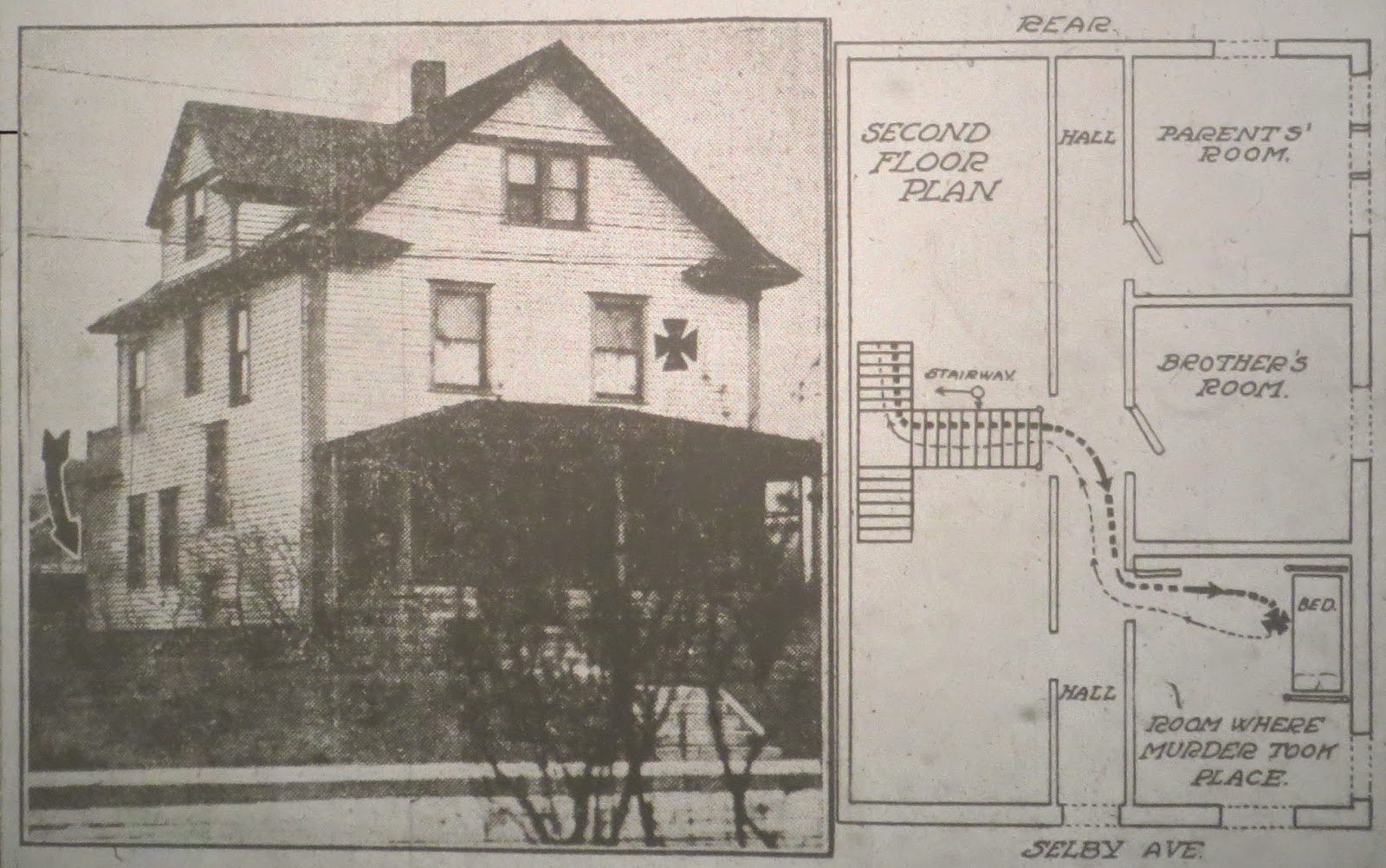

So I decided to drive by the address while I was out and about today and – lo and behold! Some lucky person is still sleeping in the bedroom where Alice’s face was blown off (see the cross in the upper pic). I wonder if they know? And I’m agonizing over not quite getting the angle right in the picture, but here you can see the other side. – DeSpair
What the newspapers lacked in pictures they made up for with a torrent of words. The Dunn case exploded onto the front pages, and it would be weeks before the blast of publicity subsided. The St. Paul police, led by the redoubtable Chief John J. O’Connor, methodically cracked open the murder conspiracy orchestrated, with no particular brilliance, by Frank Dunn, who was placed under arrest almost immediately. The hired killer who shot Alice Dunn was identified by fingerprints as Joseph Redenbaugh, 19, of Kansas City. Later described by one newspaper as “the toughest kid in America,” Redenbaugh was indeed a born killer. A day before murdering Dunn, Redenbaugh and another Kansas City criminal, Frank McCool, had been stopped for speeding by a Minneapolis police officer. They shot and killed the policeman, George Connery, and dumped his body in a wooded area just north of the city simply because they didn’t have enough money to pay a fine. Both gunmen were tracked down and arrested by mid-May, as was Mike Moore, a St. Paul bartender who’d helped recruit them for Frank Dunn.
Redenbaugh pleaded guilty to killing Connery (and also, much later, to murdering Alice Dunn) and testified against the other conspirators, all of whom were tried and convicted. Dunn’s trial, which began on June 14, 1917, was the last to be held. It made front-page news every day until June 30, when the jury found Dunn guilty of first-degree murder after deliberating for less than two hours. The presiding judge, Hugo Hanft, seems to have been very strict about keeping photographers out of the courtroom; the only trial scenes published in newspapers were drawings. Cartoonist Frank Wing, who later went on to some renown as a book illustrator, produced especially lively drawings for the Pioneer Press, including crowd scenes and crisp caricatures of lawyers, witnesses, and spectators.
Culled from: Murder Has a Public Face
Torture Instrument Du Jour!
Pillory
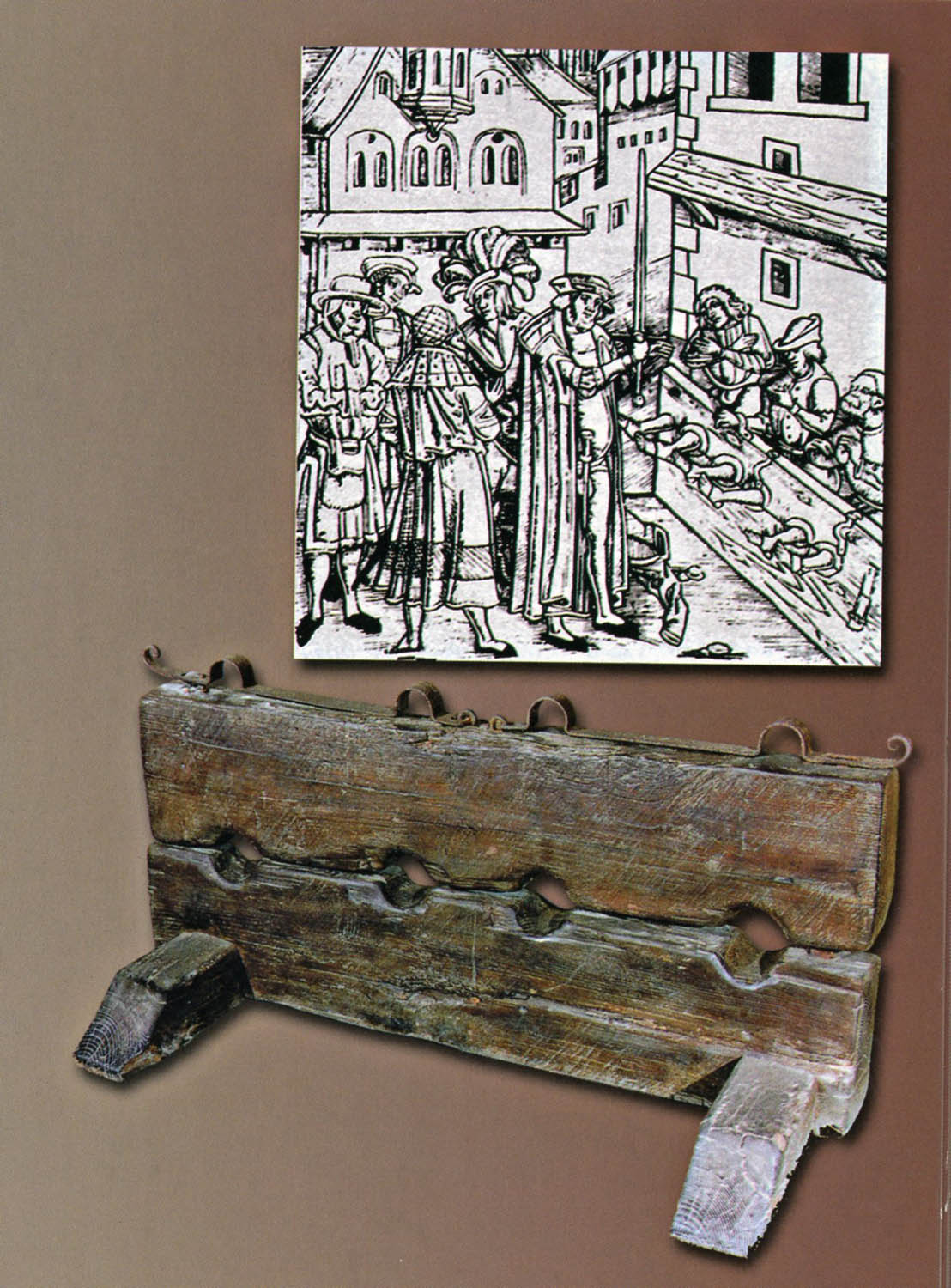
Upper image: The “Hohe Scharfrichter” – the chief executioner – confirms the sentence of the stocks to three evildoers, who, judging from the implorting gestures of the first and third, seem to know very well what horrors await them in the next hours and days. [Judging by *his* expression, I think the Hoho Scharfrichter loves his job! – DeSpair] Woodcut by Herman Wautz, Nuremberg, about 1510.
These were rudimentary instruments made of wooden bars, opposite one another, with pertinent holes to lock the victim’s hands and feet, or waist and ankles.
The victim was exposed in strategic places in town. Depending on what limb was immobilized, the victim was allowed to walk, in some cases just as far as permitted by the chain that fastened the pillory to an iron ring attached to a wall.
Besides the suffering of being immobilized, the victim was exposed to public insult, scorn and even the physical violence of passer-bys, with no possibility to react.
That is without taking into consideration the psychological suffering inflicted by being publicly exposed in this fashion.
In their main square of every medieval European town, but mostly Italian and Spanish towns, one can find iron rings drive into a wall. Their position indicates that they were too high to be used to fasten horses, we leave it to the imagine of the reader to guess what they were actually used for.
Culled from: Torture – Inquisition – Death Penalty