Today’s Brilliantined Yet Truly Morbid Fact!
In the shadows of the darkened Palace Theater in Chicago on February 25, 1942 a teenage suitor kissed his sweetheart goodbye then killed her in a jealous fit of rage. “Why did you do it, kid?” asked Coroner A.I. Brodie hours later. The shooter, seventeen-year-old Clarence McDonald of west suburban Berwyn, was pensive. He ran his fingers through his brilliantined hair and answered: “I killed her because I didn’t want anyone else to have her.”
As McDonald combed his wavy hair, a squinty-eyed Chicago cop leaned over and whispered to the boy, “It’s too bad when they have to cut that hair off!” The cop was referring to the standard procedure of shaving a condemned man’s head before walking the final thirty paces to the electric chair.
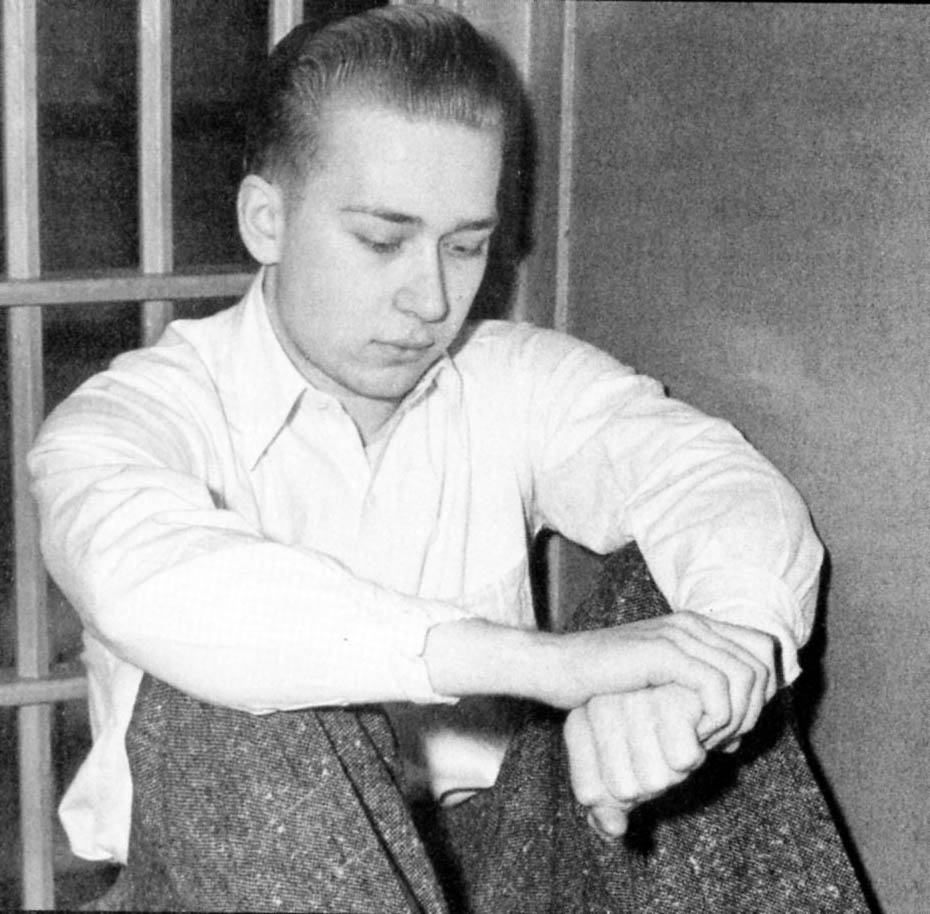
Full of remorse, Clarence McDonald went on a hunger strike inside his jail cell.
McDonald was suddenly contrite, now that he had had time to think about the real reason he had decided to fire a .38-caliber slug into the side of pretty Dorothy Broz seconds after kissing her goodbye in a final gesture of love.
McDonald, a handsome blond youth, and Broz, a schoolmate of McDonald’s at J. Stirling Morton Township High School in Cicero, had been dating off and on. Citing religious differences and a loss of interest, the pretty high schooler decided to call off the romance and abandoned any premature promises of marriage that she had made to McDonald. Bright and ambitious, Dorothy had turned her attention to college. She planned to attend either the University of Chicago or Steven’s Beauty College in the Loop.
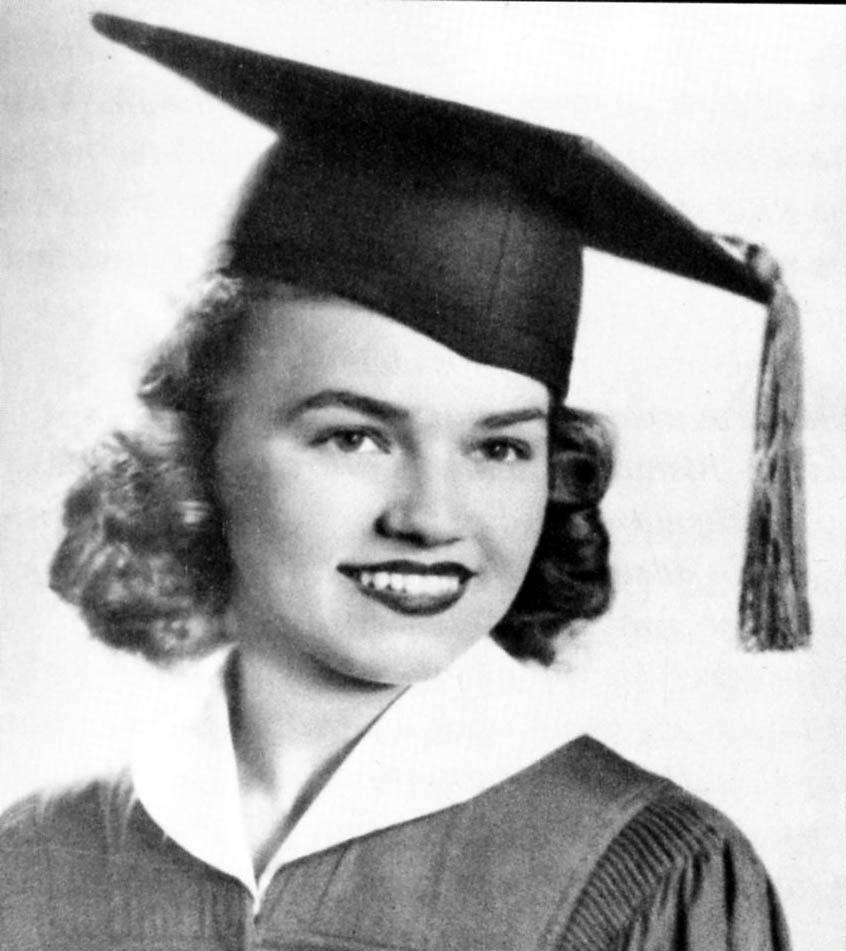
Pretty Dorothy Broz never made it to graduation day.
It was common knowledge in the hallways of Morton High that McDonald did not take kindly to the rebuff, and on one earlier occasion had pointed an unloaded gun at Broz inside Lanke’s ice cream store in Cicero. In a fit of anger, he had also allegedly punched her in the face. And two weeks before the tragedy, McDonald had placed a $5 bet, wagering that Dorothy “would never graduate.” “Just kidding—a joke, that’s all,” the youth said with a chuckle.
The murder weapon was stolen from the Great Western Railway freight yard where McDonald had been employed as a messenger during the previous Christmas holiday.
Apparently unconcerned about McDonald’s aberrant behavior toward her, the trusting girl made a date with him to attend a downtown matinee. They left the high school campus at 12:45 p.m., arriving in the Loop about a half-hour later. Dorothy and Clarence killed time until the next show by browsing for sweaters at the Carson Pirie Scott department store at State and Washington. They walked over to the Palace at two o’clock, just in time to catch the matinee-showing of Hellzapoppin‘, a rollicking, slapstick comedy starring Martha Raye and Olsen & Johnson, a nationally known vaudeville act.
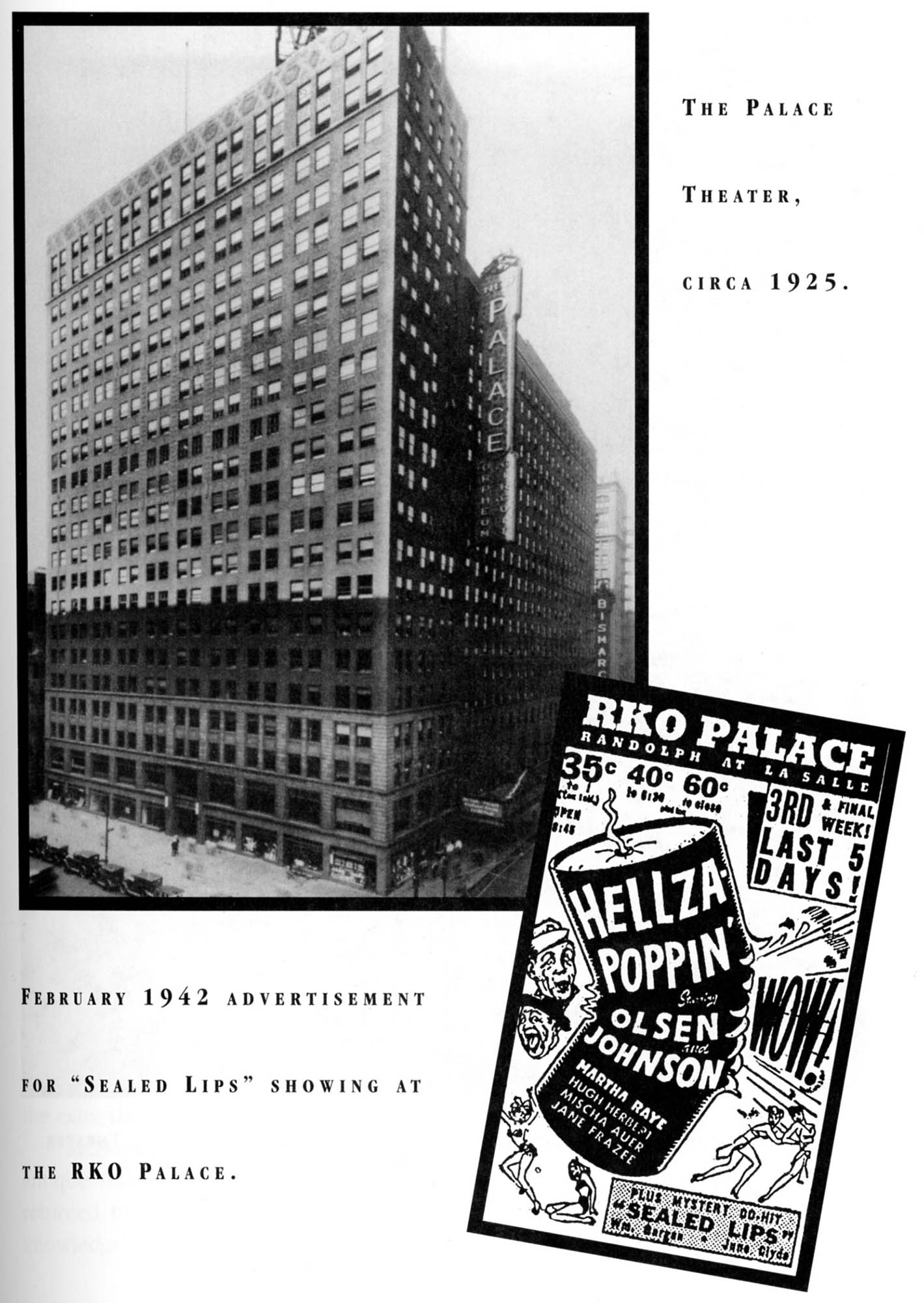
As they sat together in the lower balcony in the midst of fifteen hundred other movie patrons, McDonald coolly cradled his loaded .38 inside his left suit pocket, waiting for the right moment. At 4:26, following a March of Time newsreel, the film noir crime picture Sealed Lips rolled through the opening credits. Two minutes later, amid the clamor of an onscreen depiction of a prison riot, McDonald planted a firm kiss on Dorothy’s sealed lips and pressed the .38 into her left side.
The girl’s sudden scream was barely audible above the movie gunshots and mayhem. “My God! He’s got a gun!” Then a muffled shot, and the girl slumped over. McDonald composed himself and quietly retreated to the upper balcony where he blended in with the crowd. Lingering for just a moment, he then made a hasty retreat down the stairs and exited through an alley door before the audience could fully comprehend what had just happened. Eyewitnesses told police that they assumed it was a promotional stunt tied in with the whiz-bang shoot-’em-up antics in Hellzapoppin’. By the time the police arrive to seal off the exits, the killer had fled.
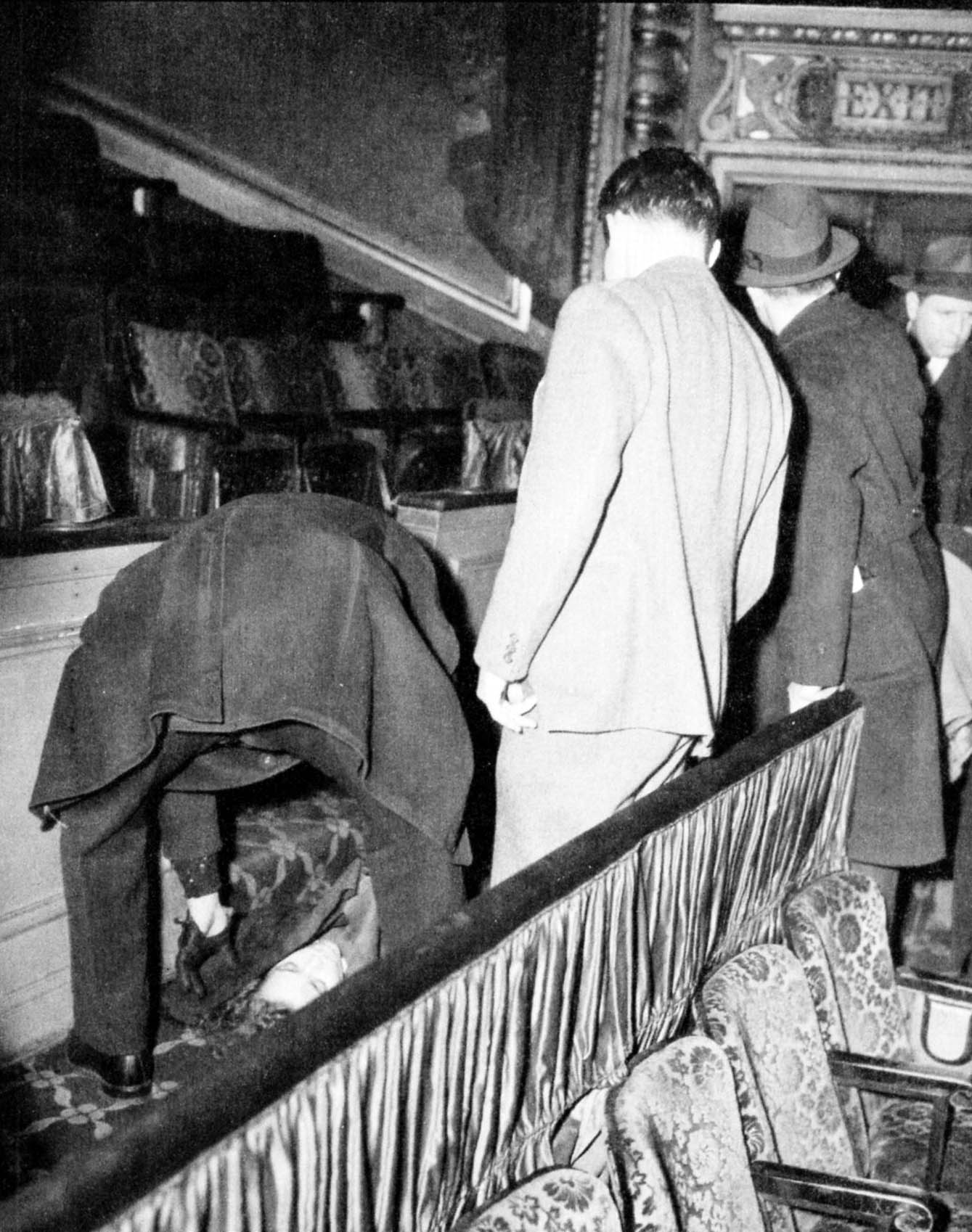
Detectives prepare to transport Dorothy Broz from the Palace Theater balcony to the county morgue.
McDonald caught the Douglas line elevated train at Quincy and Wells (the antique train station still stands, a block west of the Rookery Building) and returned to his sister’s home. Feeling no guilt, or simply dazed by the awful knowledge of what he had done, the boy took in another double feature at the Olympic Theater in Cicero with a schoolmate companion before retiring. He concealed the murder weapon in the garage behind the house.
The expected knock on the door came at 3:45 the next morning after police had questioned girlfriends of the deceased.
Police learned from the accused’s sister that McDonald’s family life was in shambles. Clarence’s father hanged himself inside the Marquette District Police Station on September 3, 1936, after he was accused of raping his thirteen-year-old daughter, Phoebe. Police feared that Clarence would follow his father to the grave in a similar fashion following his arrest. “There’s nothing more to live for since Dottie’s dead,” he wailed after the tough Chicago detectives helped strip away his bravado.
Put on a twenty-four-hour suicide watch, McDonald was taken back to the Palace the next morning, where he was forced to reenact the shooting for the benefit of police, reporters, and the county coroner. That was standard police procedure in those days. Afterward, the boy gave a full confession to Captain Thomas Duffy in the interrogation room of the First District Police Station. He said that he had thought about “doing away” with Dorothy for three days before he actually worked up enough nerve to pull the trigger.
After the dead girls’ indignant uncle punched the killer in the face during the inquest, McDonald’s sister, Mrs. Robert Wagner, pleaded for sympathy and understanding. “He was full of hate and anger and it grew in him until he had to get it out some way. He was taunted by a relative who repeatedly told him, ‘Your father was insane and killed himself. Someday you will be insane too!'”
Jaded by one too many homicides, the Chicago press corps dubbed the teenager killer, “Kiss of Death” McDonald. Before the grand jury, the boy’s lawyer described his client as “a seventeen-year-old Penrod gone berserk.” (Penrod was the incorrigible boy created by Booth Tarkington.)
Penrod he wasn’t, but Clarence McDonald was obviously a troubled youth who was a puzzle to the psychiatrists who testified for both the defense and the State during the trial.
The jury convicted him of murder on May 22, 1942, setting the penalty for the crime at life in prison. Clarence McDonald served eighteen years of the original sentence at the Pontiac, Illinois, reformatory before receiving parole on March 17, 1961.
Culled from: Return Again to the Scene of the Crime
Unusual Death Scene Du Jour!
LAPD ’53 is a book by James Ellroy that combines 1953-era photographs from the Los Angeles Police Department archives with Ellroy’s own interpretations.
Here’s one of the amazing crime scenes, from December 15, 1953, which is labeled a “suicide” but I have my doubts. Below the photos is Ellroy’s interpretation.
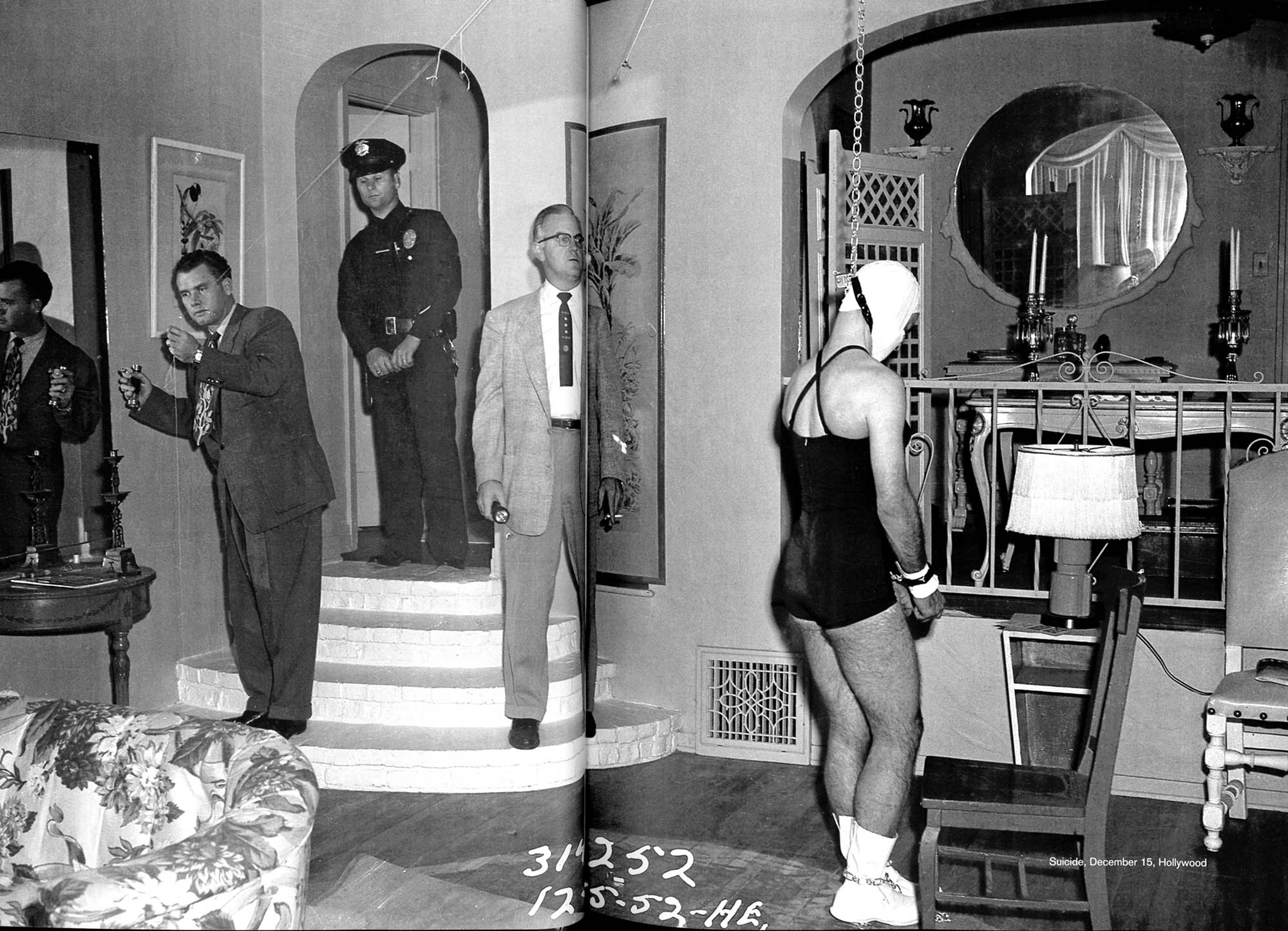
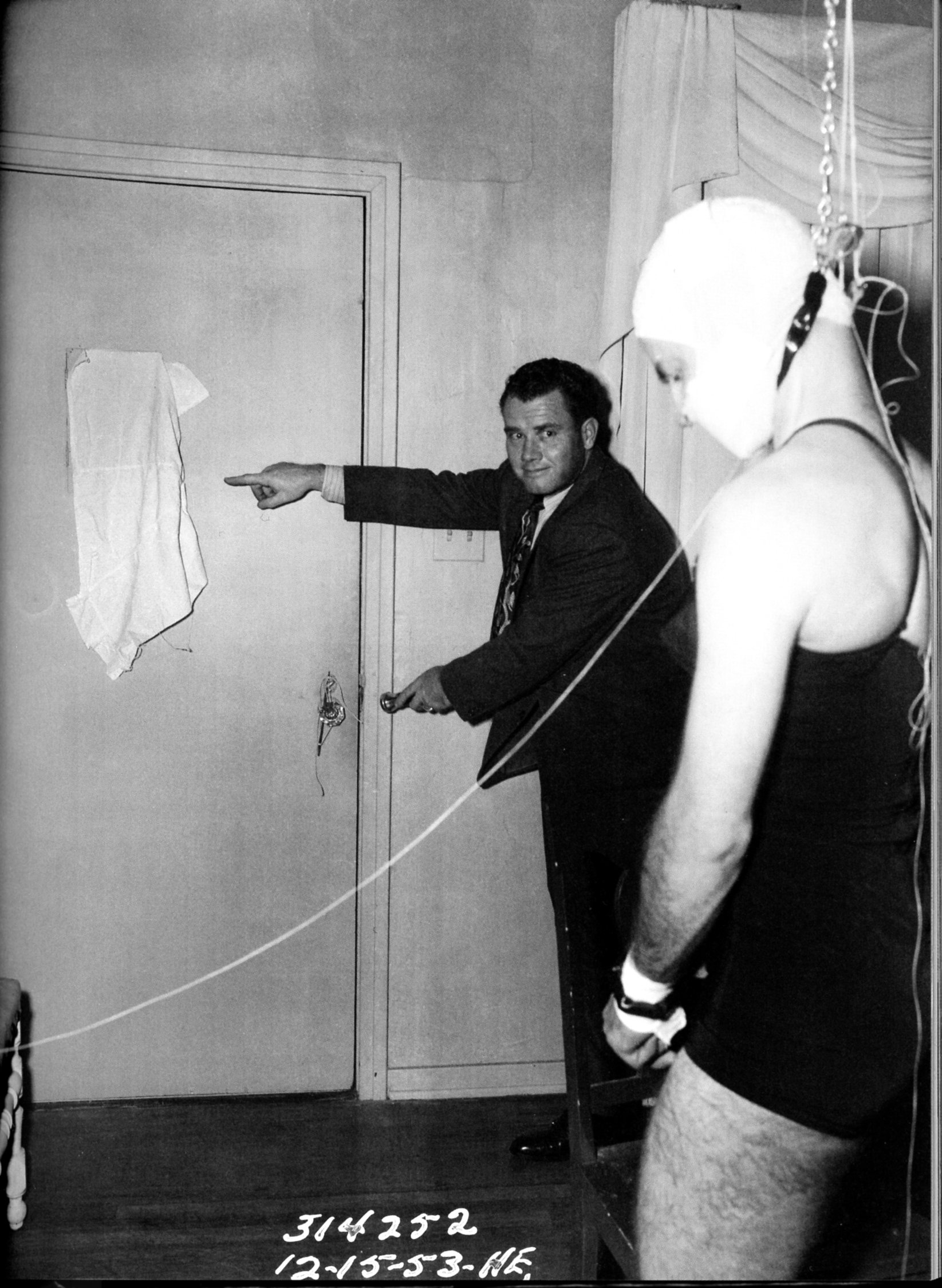
Consider this photo.
It’s quintessential L.A. Then. It emits undertones of L.A. Now. The pic reeks of creepsville Laurel Canyon. The canyon straddles West Hollywood and Mulholland Drive. It’s pricey real estate – but the pads look cheapshit. Laurel Canyon is a perv zone and death zone. Silent film heartthrob Ramon Novarro was offed in his canyon crib in ’68. He picked up two rent boys and brought them home. They asphyxiated him with a giant dildo. Cut to ’81 and the “Four on the Floor” murders. John Holmes – “Mr. 14 inches” – is dick-thick in it. The snuffs derived from cocaine intrigue and a botched home invasion. The means of death was lead pipe blows to the head. Laurel Canyon is Shit City. It’s a lurid lodestone for rock-and-roll scum and sicko Sids of all stripes. Cut back to ’53. Our more recent Thens are violently perverse. Our photo-subject Then is hauntingly pathetic. Ghastly self-annihilation. Sexual identity horrifically asserted in death. The suicide tableau for All-Fucking-Time.
It’s artful.
It’s ingenious.
It bespeaks an unutterable horror. The man could not take it one second longer. The man spent a full week composing his own death.
He purchased a woman’s swimsuit, bathing cap and fetishistic white boots. He fashioned a system of pulleys, weights and chains in the living room of his house. The living room is spacious, in the California-Spanish style. The man knew he would be studied, scrutinized and photographed in death. He intended to make a statement. It might have been “I’m a woman in a man’s body” or something never brought to formal consciousness. It came down to “look at me” in the end.
Look:
The man deliberately prolonged the death process. An elaborate system of candles, cords and weights caused him to self-exsanguinate. Now, cops and forensic crews are looking at him. A tech man is measuring a cord stretched taut, from the body to a point near the living room couch. Patrol cops and detectives are viewing the stiff.
His arms are cinched in front. His feet are trussed together. He’s a large man with hairy legs in a tight woman’s swimsuit. His head lolls on his chest. Read the cops’ faces. It’s “Holy Shit” crossed with pity and contempt. One cop is studying the dead man very closely.
The cop’s name is Donald Grant. He’s wearing a new-looking suit with an up-to-the-minute cut. Grant is about 45. Grant looks intelligent and mean. He strongly vibes film noir. He could be the psycho cop with the rubber hose and the personal call to vendetta. He’s fresh off a tavern heist blastout. He worked the Caryl Chessman “Red Light Bandit” caper in ’48. Chessman accused Grant of beating the shit out of him at Hollywood Station. That was an earlier Then. Laurel Canyon ’53 is this foto Now. Maybe Grant did tune up Chessman. Maybe Chessman was playing the pity card with the press. Look at Grant’s eyes Now. They’re laser beams. He’s looking through the dead man.
Maybe Grant possessed the gift of prophetic imagination. Let’s cut from ’53 to a more-recent Then. It’s 5/2/60. Caryl Chessman enters the green room at San Quentin. He sits down in the hot seat and waits for the eggs to drop. Aaaaaaaah, the wages of sin are death! Is Grant looking through the dead man and at Caryl Chessman? Is it because the dead man is beyond his comprehension? Is it because Chessman is a tried-and-true, empirically confirmed freak?
This photograph says, “I don’t know.”
The suicide got minor ink as the “weirdest in Hollywood history.” What did the dead man think he was doing?