Today’s Reeking Yet Truly Morbid Fact!
The historian Joanna Bourke has written about the euphoria of killing in battle and the carnivalesque atmosphere that warfare can foster. The combat gear, the face paint and the “endless refrain that men had to turn into ‘animals'” all represent a kind of exhilarating inversion of the moral order. These rituals seem alien when taken out of context—they seemed alien to the new troops arriving to fight—but they provide a way to cope with the shocking realities of combat. It is hard to comprehend conditions for combat troops on Guadalcanal in 1942. Even the service troops, behind the front line, had little idea what it was like to be plunged into the ‘meat grinder’, where time had no meaning and there was no hope of escape: if it did not kill you, it sent you insane.
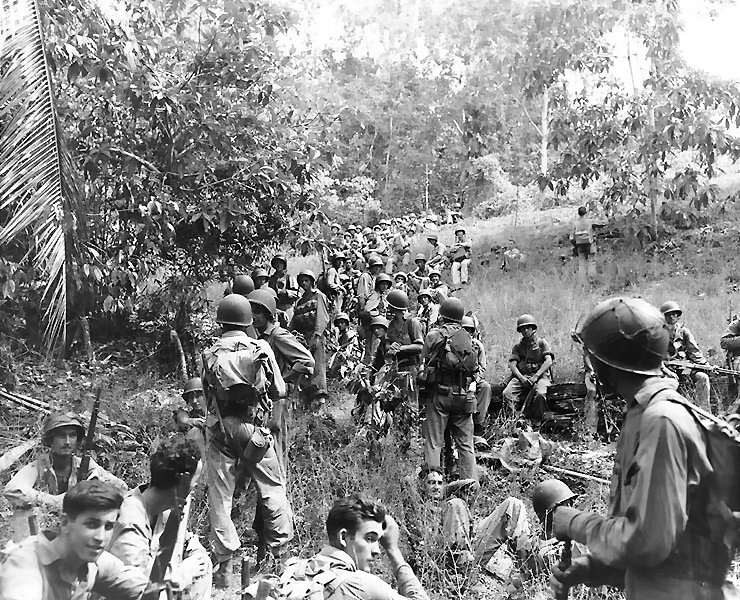
Famously, the Japanese refused to surrender and the Americans refused to take prisoners, so it became a fight to the death. In Biak, New Guinea, Japanese soldiers occupying a system of limestone caves had reportedly tried to surrender, but the Americans told them to ‘get the hell back in and fight it out’. Meanwhile, the Japanese fired on stretcher-bearers, tortured Americans to death and mutilated their bodies. Some prisoners were beheaded, and there were reports of Japanese eating the flesh of their enemies, and of their own men. In these conditions, there was no hope of escape: you must either kill or be killed.
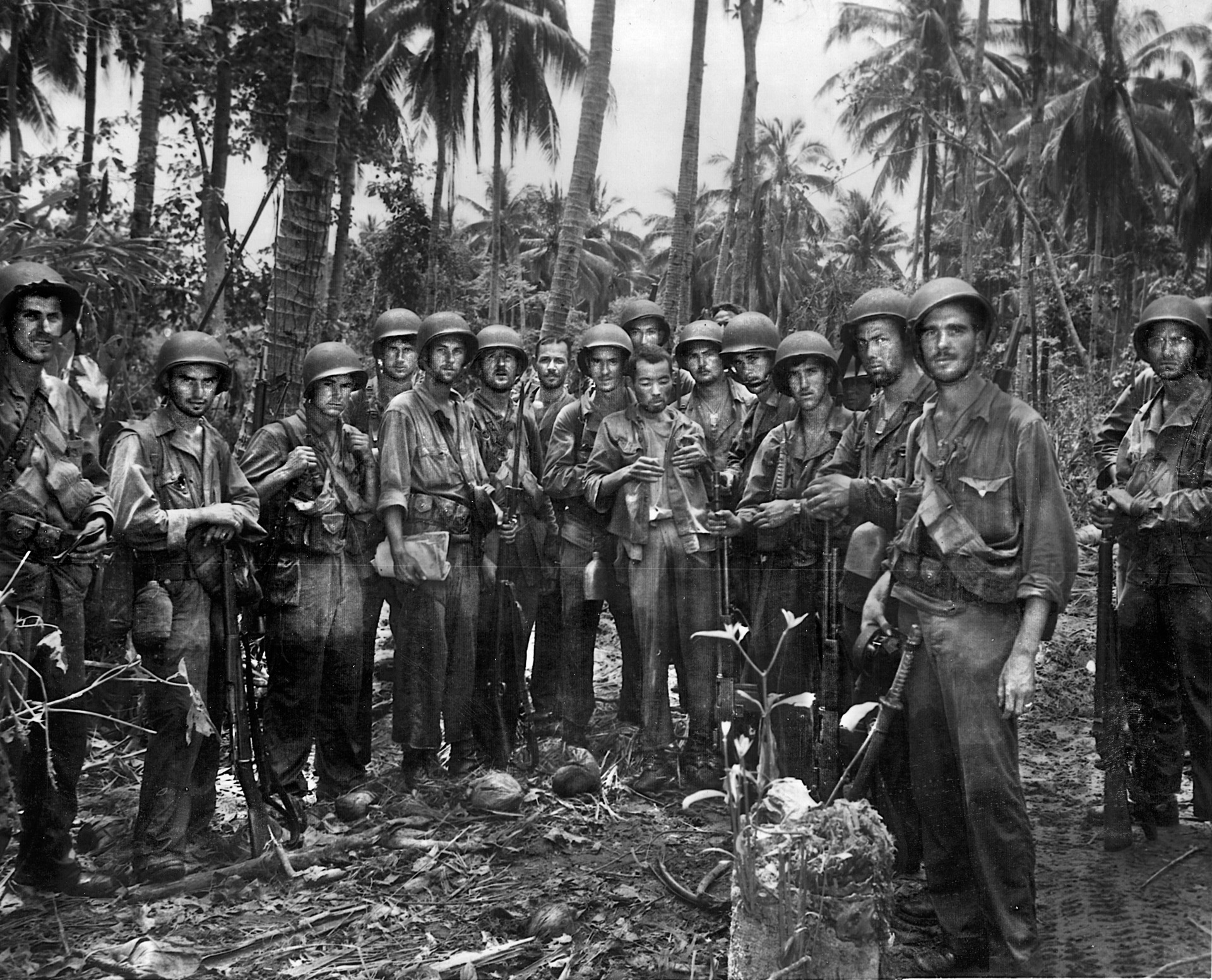
Soldiers who fought on the frontlines were easy to spot. They were filthy and covered in coral dust and rifle oil; their uniforms were in tatters and had been stiffened by weeks of rain, sweat and sun; they were thin and haggard, unshaven, with bloodshot eyes, and their hands were blackened and calloused; they were hungry, thirsty, exhausted, smelly, and, more often than not, they were suffering from ‘jungle rot’, fungal growths between the fingers and toes and in the ears; they had sores on their limbs from the filth, insect bites, and many of them were suffering from malaria or other tropical fevers.
All the troops serving in the Pacific faced hunger, illness and hard labor in heat and heavy rain. The humidity rotted everything, from guns and clothes to people’s bodies: the rain turned men’s skin white and puffy. Camps were often flooded or submerged in mud, and men had to cut their way through the thick vegetation with machetes, walking in a single line. It was said that in some places, where the jungle was particularly dense, if a man didn’t keep his eyes on the feet of the soldier in front, he could be lost.
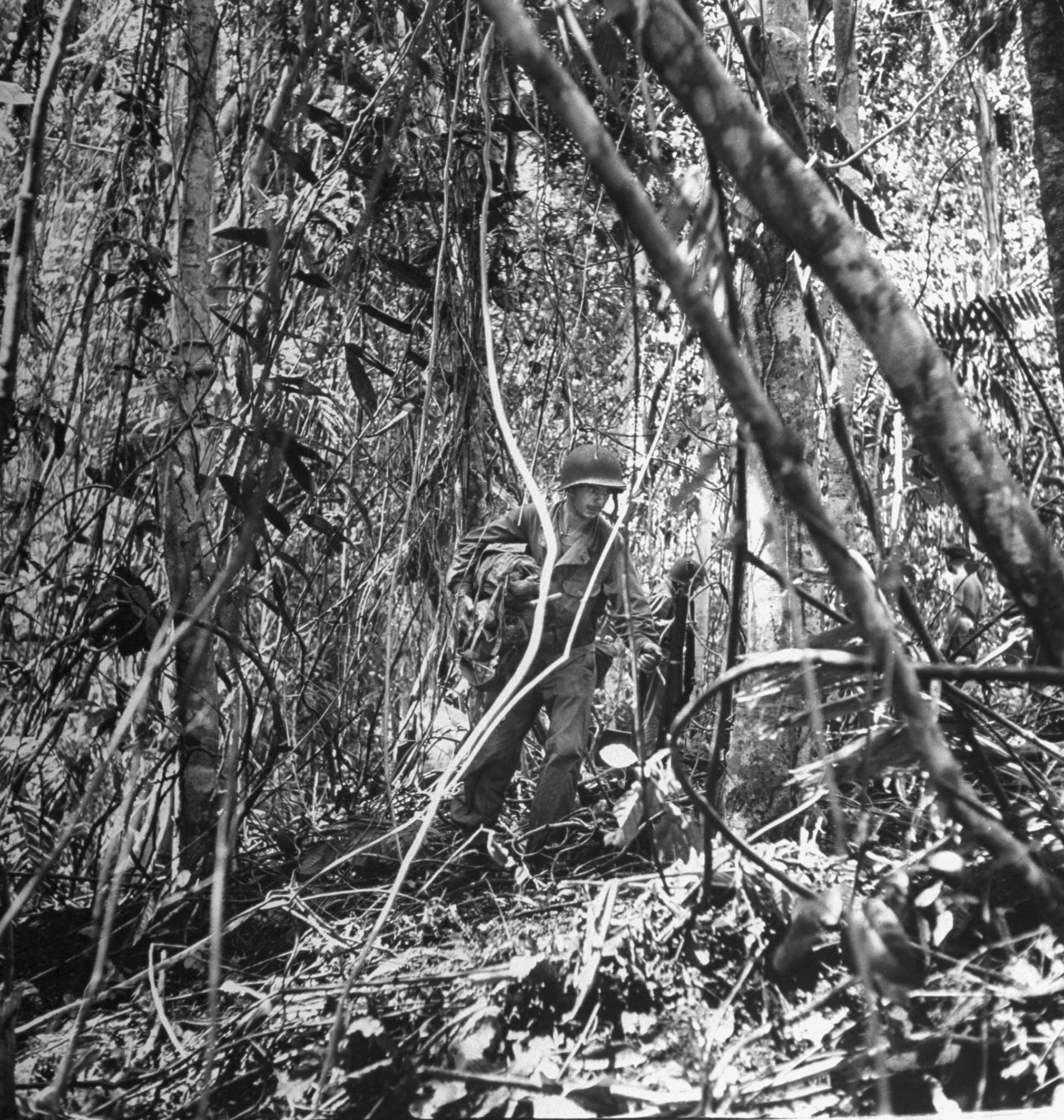
Caption from LIFE. “Through dense jungles near foot of grassy knoll, American soldiers make their careful way on patrol.”
There were mosquitoes and leeches, spiders, lizards, snakes and maggots. There was no running water or electricity, and despite the legion of hard-working service personnel, there were inevitable supply problems, which meant regular food and water shortages. When water did arrive, it might be delivered in an old oil drum, foul-tasting, stomach churning, full of rust with a blue greasy film, but the soldiers drank it anyway because they were so desperate. It is hardly surprising that there were outbreaks of typhus and dysentery. The vast majority of those who died in the Pacific succumbed to disease, heat, accident, and famine; during some phases of the campaign these casualties out-stripped combat fatalities by as many as 100 to one.
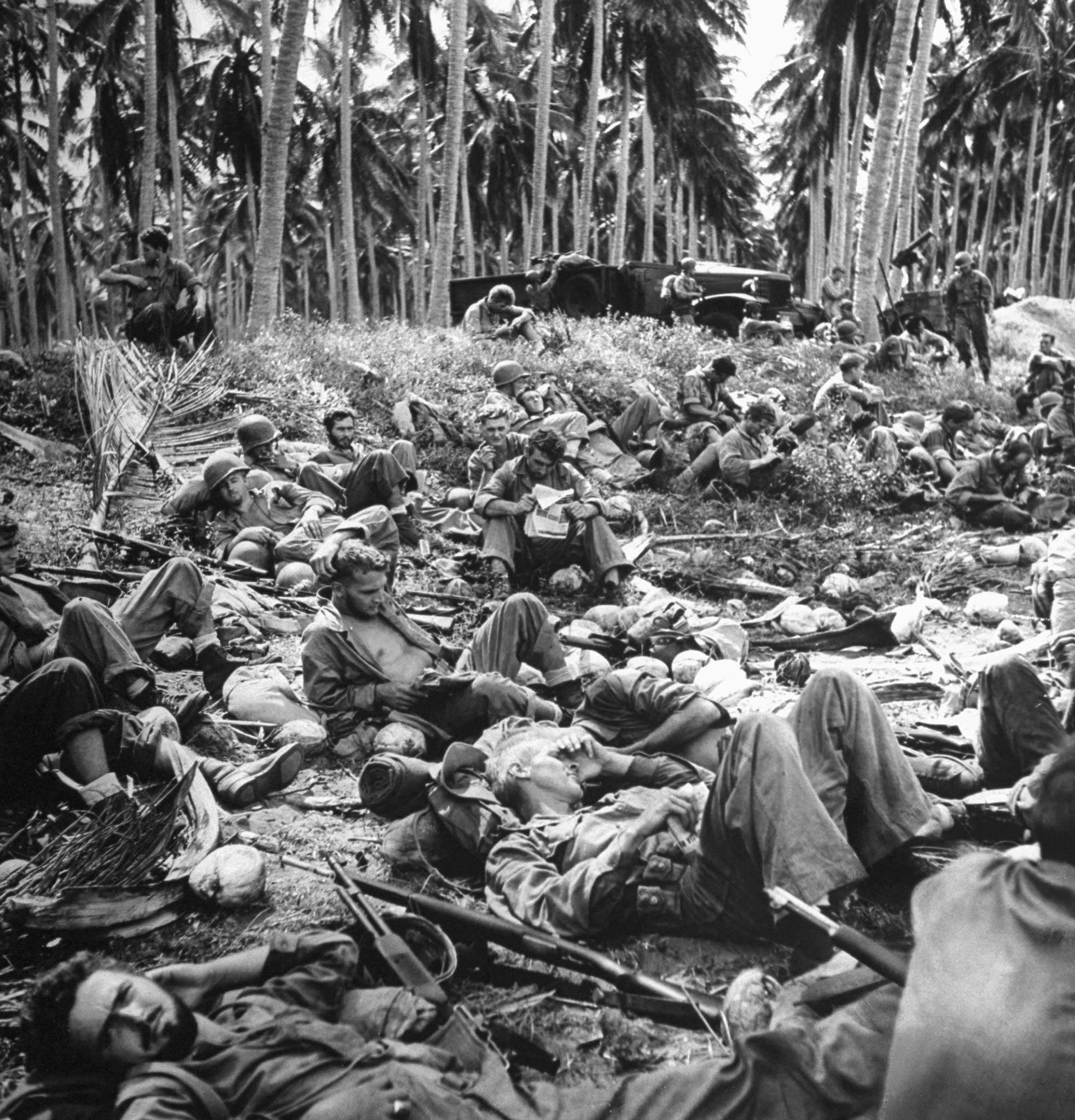
Not published in LIFE. Exhausted U.S. Marines sprawl on the beach while waiting for landing craft to take them off Guadalcanal following four months of fighting the Japanese.
Then there was the ‘reek of mass death’, as Ladd remembered. ‘Never mind the heat, the smell alone was enough to drop a strong man in his tracks.’ The dead were all around, in every stage of decomposition. Mangled bodies hung from barbed-wire entanglements, floated in rivers, and lay by the thousand where they had fallen, ensnared by the forest, protruding from the muddy ground and shallow graves. Many had been mutilated by the explosions that killed them, blown into pieces, burned by napalm attacks, and blackened by exposure to the tropical elements. It was not unusual to see headless bodies and bodiless heads on the battlegrounds, and horrific accidents happened behind the frontlines too. A snapping cable on a ship could decapitate a man, as could the propeller blades of an idling aeroplane. One member of the US Army Transportation Corps, enduring months of backbreaking work on the supply vessels, fell into the lower hold of a ship during a blackout and hit a strong hook on the way down which severed his head. He was brought up again in a basket.
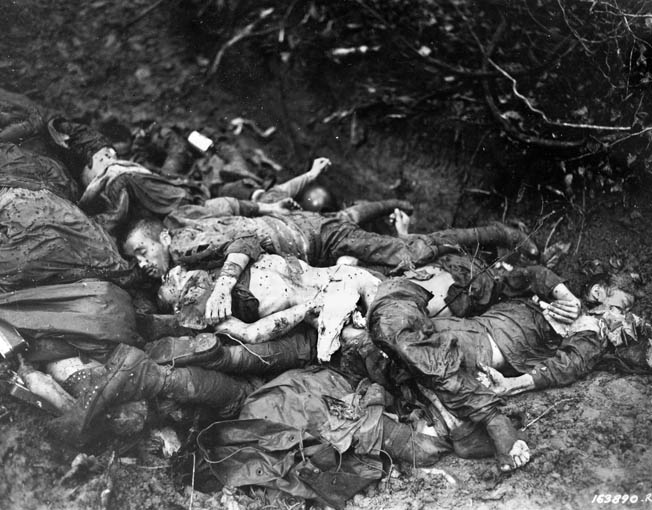
Eugene Sledge wrote that the ‘fierce struggle for survival… eroded the veneer or civilization and made savages of us all’. There was a feeling that the habitat had caused a kind of social degeneration. Human body parts were commonplace, and enemy bodies were there for the taking. In other words, the moral landscape was as surreal as the physical landscape, since soldiers lost all the normal social structures that framed their lives at home. They were surrounded by the dead, they were ordered to kill and they thought they were going to die: in these circumstances, men could, in the words of historian Jonathan Glover, ‘escape the restraints of moral identity’. They became numb to their surroundings.
Take the instance when Sledge and his unit, fighting their way towards enemy lines on Peleliu, came across a Japanese machine gunner who had been killed in position, so that he looked as though he was about to fire his weapon, still staring along the gun sights, even though the top of his head had been blown off. As Sledge talked to the American gunmen who had been in the fight, he noticed that one of them was lobbing coral pebbles into the dead soldier’s open skull. ‘Each time the pitch was true I heard a little splash of rainwater in the ghastly receptacle.’ But, as Sledge noted, the American might as well have been a little boy playing with stones in a puddle back home, because his movements were so casual, and ‘there was nothing malicious in his action.’
Culled from: Severed: A History of Heads Lost and Heads Found
Garretdom: A Fool and His Cigar
A Fool and a Can of Powder.

LAFAYETTE, Ind. Oct. 3.—A horrible and fatal explosion occurred at Bringhurst, Carroll county, on Friday. A man named Britton came to the store of Shanklin & Kearns for some powder. Mr. Kearns, with a lighted cigar in his mouth, poured out the powder from a large can into the scales. In setting down the can the cigar was knocked from his mouth into the can of powder, which exploded with great violence, tearing out the front part of the building and scattering the goods into the street. It was a fearful wreck. Mr. Kearn’s arm was broken in two places, his shoulders were dislocated, and his head and face were burned in a frightful manner. He died in a few hours after intense suffering. Britton had both arms broken and was terribly burned. His injuries are fatal.
Culled from the collection of The Comtesse DeSpair – 1886 Morbid Scrapbook
More grim olde news can be read at Garretdom.