Today’s Regulated Yet Truly Morbid Fact!
Faced with plague, medieval physicians had no power to effect public-health measures; that was the magistrate’s business. In Venice a committee of three nobles laid down burial regulations, banning the sick from entering the city and jailing intruders. In Milan, the council sealed in the occupants of affected houses and left them to die (perhaps this draconian measure worked: Milan had only a 15 per cent death rate).
Secular and religious strategies were sometimes at odds. In 1469, despite the risks of congregating in large numbers, the civic authorities in Brescia allowed the Corpus Christi procession to go ahead because deliverance, hoped the pious, would come through divine intervention. By contrast, in time of the plague the Venice Health Board banned preaching, processions and feast-day assemblies. Churches were locked and in 1523 and 1529 even the shrine of St Roch, a popular intercessor against plague, was shut.
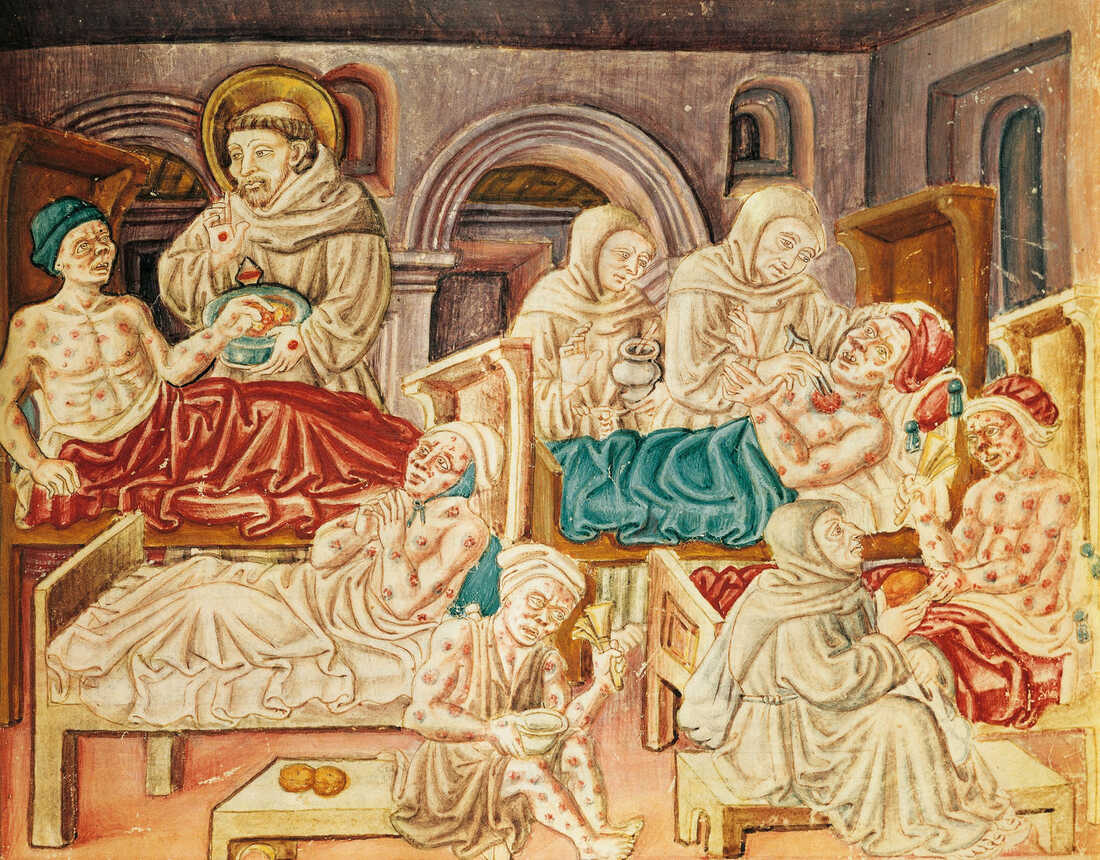
15th-century image by Jacopo Oddi from the La Franceschina codex depicting Franciscan monks treating victims of the plague in Italy
Certain routines became standard. The committees appointed to coordinate public health measures began to remove the sick to leper houses beyond the city limits (hence ‘lazaretto’ came to mean a plague hospital), while also establishing a system of exclusion, banning persons or goods from entering or leaving. Such measures were adopted throughout Italy. In 1377 Ragusa (Dubrovnik, Croatia) instituted a regular thirty-day isolation period on a nearby island for all arriving from plague-infected areas; in 1397 this was increased to forty, thus becoming a true quarantine (quarantenaria, forty days). Marseilles took similar action in 1383; Venice imposed quarantine measures in 1423; in 1464 Pisa followed and Genoa three years later.
Before the fifteenth century such health boards, composed of nobles and officials, were ad hoc creations. In Milan, however, a permanent magistracy ‘for the preservation of health’ was established around 1410, with (by 1450) a staff of a physician, surgeon, notary and barber, two horsemen, three footmen and, sensibly, two grave-diggers. Doctors acted not as full members of such boards but as advisers. Other Italian cities followed; in 1486, Venice appointed a permanent Commission of Public Health, consisting of three noblemen; Florence set up a similar commission of five in 1527, and Lucca one of three in 1549. Bills of Mortality were initiated in Milan, listing names and causes of death. Health Boards extended quarantines and the closing of borders, and health passes were introduced. In this respect, north European towns lagged behind Italy by more than a century.
The regulation of markets, streets, hospitals and cemeteries, the control of beggars, prostitutes and Jews – in short, public health measures – fell under the health boards. Resentment was expressed about their cost and powers, especially since economic disaster was almost inevitable once plague had been declared official, with commerce and travel suspended and markets closed. [Everything old is new again, eh? – DeSpair]
Culled from: The Greatest Benefit to Mankind
Dissection Photo Du Jour!
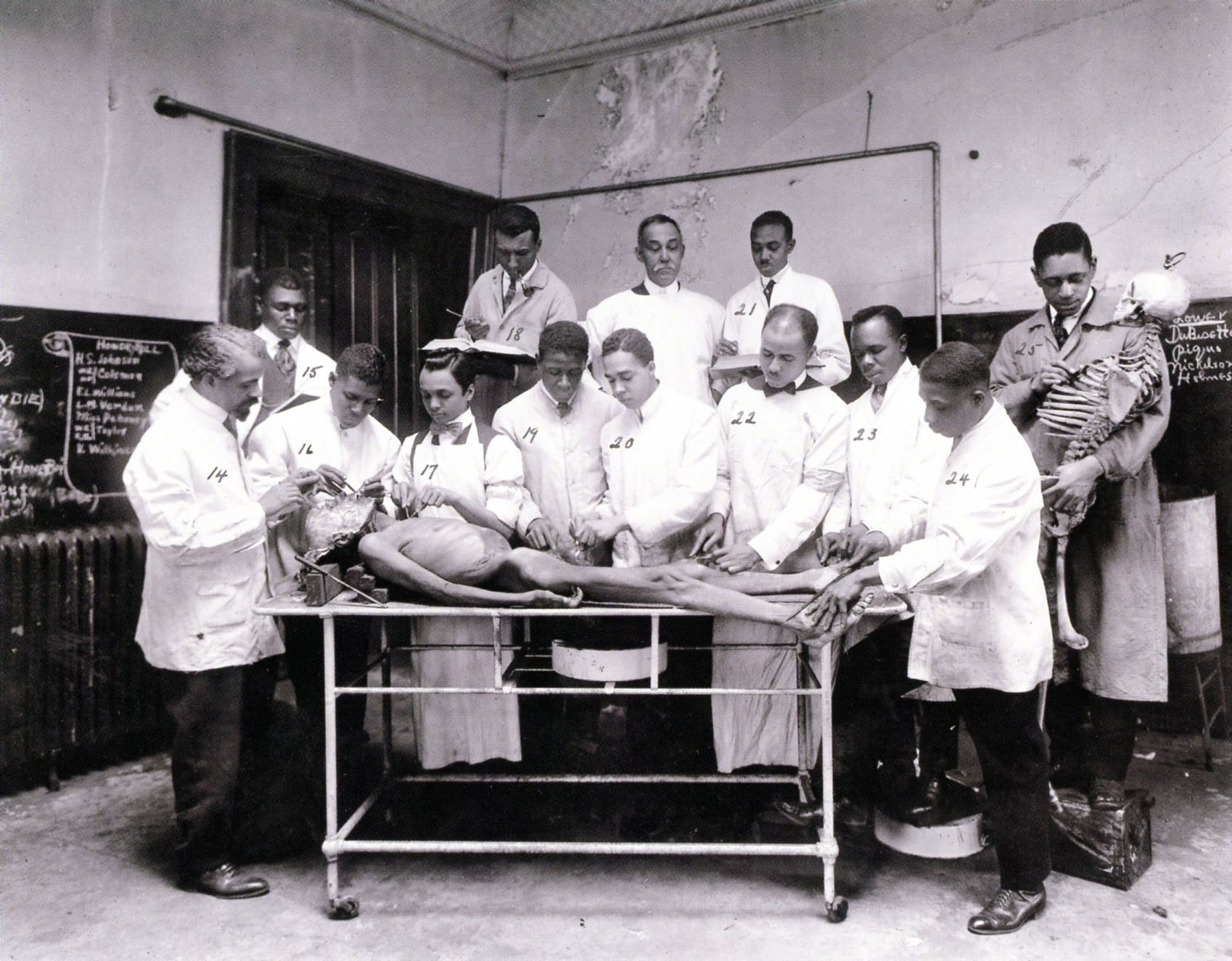
Howard University Medical School, Washington, D.C., March 20, 1918.
Howard had established the first medical school chiefly for African-Americans in 1868.
Culled from: Dissection