Today’s Ill-fated Yet Truly Morbid Fact!
The British emigrant ship Omega, with 345 passengers and crew aboard, lost her masts in a severe storm in the Atlantic in February 1848. In danger of foundering, the Omega transferred nearly all her passengers and crew to three passing vessels. One of those vessels subsequently sank in heavy seas, taking 115 people to their deaths. A shortage of water resulted in the deaths of seventy other “rescued” passengers. The Omega, meanwhile, returned safely to port.
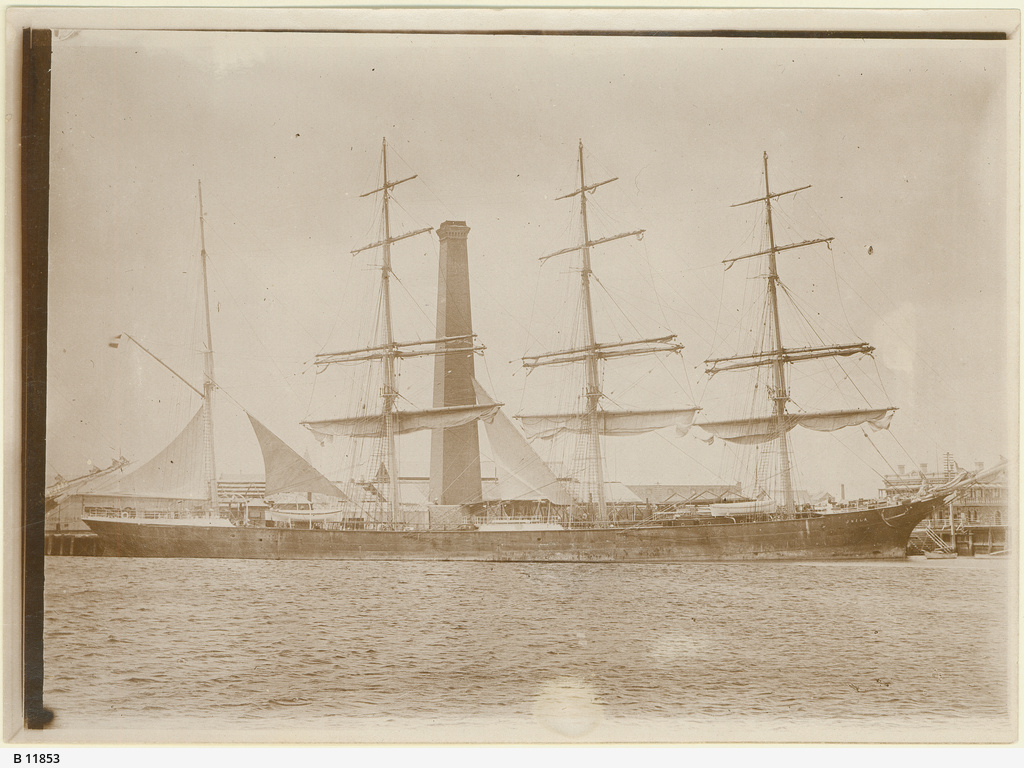
The Omega
Culled from: The Pessimist’s Guide To History
Here’s a newspaper account from The Northern Tribune (Bath, Maine), March 28, 1848:
Dreadful Loss of Life at Sea.
We are indebted to Gunnison’s Express, for St. John, N.B. papers of the 23d, from which we have gathered the following dreadful particulars of the fate of a portion of the immigrant passengers of the ship Omega, reported a day or two since as having been foundered at sea:—The Omega was a Br. ship of 1300 tons, bound from Liverpool to New York, with 327 passengers. These passengers, before the ship foundered, were taken 140 (chiefly women and children) on board the barque Aurora; 163 on board the brig Barbara; and the remainder on board the Highland Mary, for New York.
The barque Aurora reported by the Highland Mary at New York, as taking on board part of the passengers of British ship Omega, from Liverpool, arrived at Halifax on Saturday last, with seventy-three of these unfortunate people, having landed 33 at Canso, and the remainder, about sixty, having died on board!
Many of the survivors are suffering from sickness. During the last seventeen days they were on board the Aurora, the allowance of food was limited to 1 1/2 ounces of bread, and a wine glass of water per day each. The British brig Barbara, Capt. Skinner, from New York for Cork, with a cargo of corn, took on board about 150 more of these passengers on the 15th of February, and afterwards bore away for Newfoundland.
On the 2d inst. the steamship Britannia, Captain J.C. Lang, from New York, via Halifax, hove in sight. A signal of distress was made, and the steamer bore down to the Barbara, when the Captain of the latter vessel acquainted the steamer that they were out of water, and it was further added, “there are one hundred and fifty person on board dying for want of water”; to which the reply from the steamer was, “there is the land; go there and get water.”
The steamer passed on, though the wind was blowing strongly from the land, so that it was impossible for the unfortunate brig to reach it.
In attempting to reach St. John, N.F., they mistook the land, and drifted into a cove at Petty Harbor, N.F., and went ashore, and on account of the heavy surf, struck a cliff, and stove a hole in the brig’s bow.
Thirty-five individuals managed to reach the shore, and in about five minutes after, the Barbara fell over and went down, carrying with her about one hundred and fifteen souls, among whom was Captain Skinner, of the Barbara.—Boston Traveller.
Arcane Excerpts: Simple Melancholia!
A Compendium of Insanity is a book written by John B. Chapin, M.D., LL.D. and published in 1898. Chapin (1829-1918) was an American physician and mental hospital administrator. He was an advocate for the removal of mentally ill patients from the almshouses in New York State to a hospital setting and helped to pass a state law that provided hospital care for the patients. Here is an excerpt from the book which answers the question that I often ponder: am I suffering from Simple Melancholia? (It turns out, yes – yes, I am!)
Symptoms of Simple Melancholia.—
The patient is observed to be sad and dejected. There is a sense of depression that cannot be explained, a vague fear of some impending trouble, an unaccountable gloom that overshadows every relation the patient may hold to his various interests. While he seems to have an appreciation of his condition, he cannot throw off the gloom that oppresses him. He loses his interest in his business, secludes himself from his friends and family, reviews his past life, reproaches himself for his past mistakes and shortcomings, and indulges in retrospection and forebodings. Life seems to him undesirable and unendurable. The simplest daily transactions are burdensome. The most trivial occurrences are distorted to the detriment of the patient. The slightest exactions or exertions, as rising, dressing, exercise, and taking food, are avoided. The gait is slow, the gaze is downcast, obstacles that seem impossible to remove are made to every suggestion for mental or bodily effort. Everything is opposed, nothing is proposed, and the patient desires to be left alone. [Opening lyric of my next single – DeSpair] If the history and temperament of the patient are known, many of these manifestations maybe recognized as exaggerations of his normal characteristics. The conversation is deliberate and coherent, and the patient can, and often will, furnish a connected history of his own case. Thus far the emotions and feelings are principally affected, but the judgment may not be impaired to such an extent that clearly-defined delusions are formed.
On a physical examination of a mild case of melancholia the facial expression is one of sadness and misery. The face may be pale and sallow. The eye has lost its accustomed expression. The appetite is not good, and food is taken sparingly. [This was obviously in the days before good comfort food. – DeSpair] There is no fever—the temperature may even be subnormal. The tongue is pale or flabby and coated. The bowels are constipated, the urine is scanty and high-colored, the skin is dry and harsh, and the pulse is slow and soft. The pupils are quite susceptible, and perhaps are more than normally dilated. The patient is, and has been for some time, probably, insomnious. The blood may show an excess of uric acid; the hemoglobin may be from twenty to forty per cent below normal, and the blood-corpuscles one million or even two millions below the average of five millions per cubic millimeter. In women, the function of menstruations is usually suspended. [We should be so lucky! – DeSpair] A decline in weight has probably been going on for several months, attracting little attention, and may amount to a loss of twenty, thirty, or forty pounds below the average; so that it should always be a subject of serious concern if mental depression is accompanied with decided loss of body-weight. The patient may complain of dull pain or a sense of fulness and pressure at the vertex or in the frontal or occipital region—a symptom arising from the stasis of the cerebral circulation, or fulness of the sinuses. The physical condition of the patient is usually below the average or normal standard. It may be noticed that not an organ of the body is performing its function in a normal manner. The case has all the aggravated symptoms of neurasthenia, or nervous exhaustion, but there is superadded a melancholy more or less profound.
It is usual to discover that there has been some strain from mental or physical overwork, such as comes from constant and prolonged application without change or rest; from exhaustion attending the puerperal state; or there is physical and nervous exhaustion from ill-health, sexual or other excesses, or the alcohol-or opium-habit. For all purposes of diagnosis, treatment, and management, it is a safe course to assume that from some cause, even if not apparent, there has been defective or altered nutrition of the brain or of some portion of it, or that damage has been done to its cellular organization.
An attack of simple melancholia may run a course of several months without other mental disturbance than the presence of depressing ideas. The emotions are principally affected, but the intellectual faculties may not be involved to such an extent that clearly-defined delusions appear. The danger to be guarded against from the commencement and throughout the attack is suicide. The danger of such a tragic end at this stage may be even enhanced from the fact that the intellectual faculties are still intact, and a disposition to end a condition that seems intolerable is more likely to be executed than at a later stage, when the patient is likely to be more carefully guarded and the will-power is more or less impaired.