Today’s Lowly Yet Truly Morbid Fact!
In the 1700s, surgeons all over Europe wanted to distance themselves from their lowly brethren, the barbers. In England, for instance, the Barber-Surgeon’s Company (i.e., Guild) split up in 1745. But what to do with the guild symbol, a red-and-white-striped pole, meant to represent bloody rags hung out to dry, topped by a brass basin which would catch the blood during bloodletting. (Patients used to grasp the pole to make their veins swell for easier puncturing.) As Charles Panati put it in his Extraordinary Origins of Everyday Things, “When surgeons and barbers split, the barbers got the pole.”

Culled from: An Underground Education
Mütter Museum Specimen Du Jour!
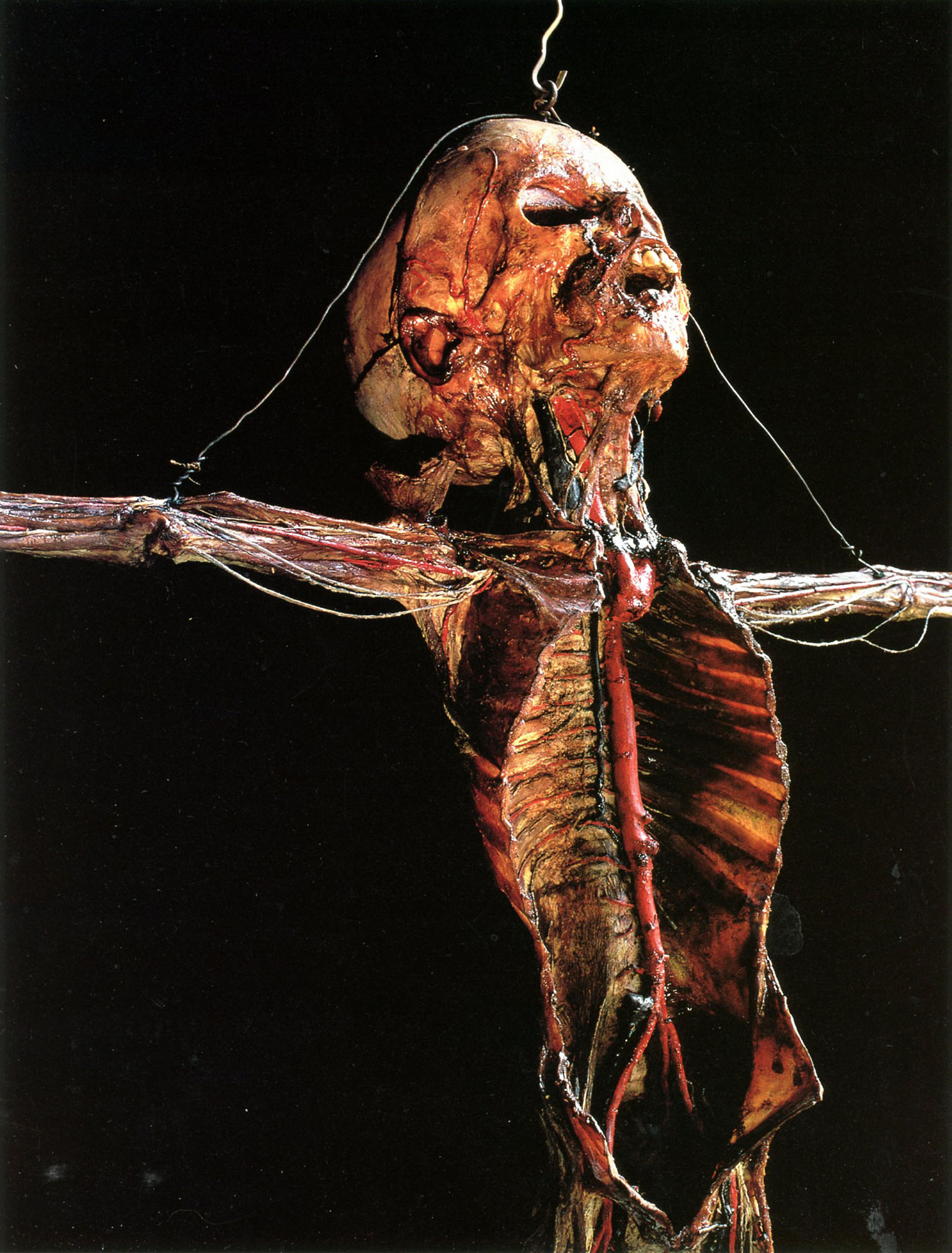
Dried Skeleton of a Child Showing Veins and Arteries (© 1994 Olivia Parker)
Dried skeleton of a child, showing the veins and arteries, probably prepared by Dr. George McClellan (1849-1913). After studying with Professor Joseph Hyrtl of Vienna, he established a surgical practice in Philadelphia and in 1881 opened the Pennsylvania School of Anatomy and Surgery. One of his students said that “his anatomy was art. He dissected a body as a great sculptor would carve a statue.” Such dried preparations were useful adjuncts to models and cadavers in demonstrating the anatomy of the circulatory system.
Culled from: Mütter Museum Calendar, 2000
Andersonville Prisoner Diary Entry Du Jour!
This is the continuation of the 1864 diary of Andersonville prisoner Private George A. Hitchcock (see the archived version for all entries up until now).
Here’s today’s entry:
July 10th. Very hot, with showers around us. More prisoners came in. The monotony of camp was broken by the parade of several camp-police with two or three prisoners, with their heads and faces shaved on one side, and a card attached to their backs bearing the word “Thief.” They were greeted with brick-bats and cudgels as they passed along through the noisy, unsympathetic crowd.
Culled from: Andersonville: Giving Up the Ghost