Today’s Deranged Yet Truly Morbid Fact!
A Catholic town in Bavaria, Eichstätt, suffered three waves of witch persecutions, in 1590, 1603-30, and 1637. The exact number put to death is not known, but about 1629 a judge claimed he had examined 274 witches “who had to all appearances died.” For the period when the gender of the victims is known, the ratio of women to men was about fourteen to one. Every village in the region had its victims; for almost fifty years the area can have known no rest from the terror, because between the waves of arrests, accusations were constantly being made. Terror is the accurate word, for the accused were tortured not once but repeatedly, convicted witches suffered the hot pincers, and one had her right hand cut off. Add to this the psychological terror of neighbor accusing neighbor, and one begins to see the disruption that a witchcraze caused.

The trial of a poor woman at the end of the Eichstätt witchcraze (1637) epitomizes the mind-set of the times. Known to us only as “N. N.,” she did not know the names of her parents or where or when they were born or died. Apparently she kept a little store. Forty years old, she had been married twenty-three years and had borne eight children, two of whom had died of smallpox and a six-year-old of unspecified causes, all some years ago. Because of “these suspicious circumstances of death” she has now been summoned to the Town Hall. But there is more to the case: she is accused by fifteen persons of passing through locked doors, riding through the sky, attending the sabbat, having a demon lover, raising storms, exhuming corpses—but, surprisingly, not of harming humans or animals. South German definitions of witchcraft had by this time been so demonized that they no longer depended on maleficium at all.
Imprisoned, subjected to an “indecent” examination, and identified as having a devil’s mark, she begins bravely enough, laughing heartily and denying all charges, until she is stretched on the ladder. Then she confesses she is a witch, only to retract the statement as soon as the ropes are loosened. This process of denial, torture, confession goes on until she admits to practicising evil magic. One night after she had just given birth to another child, her husband had come home drunk and cursed her, wishing the devil would take her and all the children. And she thought, “Oh, when would he come? Oh, soon!” She then had a love affair with the hangman, who turned out to be the devil himself. The devil-hangman forced her to deny God and do evil everywhere.
As the torture continues, day after day, she confesses to many crimes, even some she was not accused of: poisoning her six-year-old and causing her former mistress’s four-year-old to die of plague. When she is not repentant enough to satisfy the court, she is flogged, and then admits that some years ago she had killed her own horse and cow and had had intercourse with the devil in her prison cell. She also tries to commit suicide there, by scratching open an old wound in her arm so she would bleed and by suffocating herself. But each time they lessen the torture, she denies all that she had said.
Throughout her trial the judges have assumed her guilt and worked only to get her to confess and to name others. Although this was secular court, it opened each day’s session with prayer (was a priest present also?). Finally her mind grows confused; she now confesses without the prompting of the ladder. Describing in detail her visits to the sabbat, she names (and thereby implicates) a number of other persons whom she saw there. The twelfth day into the trial, the court presses charges relating to harm to the community, namely, storm raising. In order to elicit her confession to this monstrous crime, she is placed in the Spanish boots (which crush the leg bones) and is lashed “while the bells tolled the Ave Maria.” Discord is suspected between her and her husband.
Her most shocking confession is of exhuming the corpse of her own child, buried six years and all rotted away, in order to cook the remains to make a magic powder that she gave to her devil. But what haunts her most are her sexual failings: because of her seduction by the devil she cannot pray anymore, and fears she will not go to Heaven. Yet she got no pleasure from her affair, for the devil beat her and caused her pain when they were in bed together so that she screamed out, waking her husband, who then began to sleep in a separate bed.
Confessing finally the one action she may in fact have taken out of all this fantasy, she says that she often seduced her servant, “indeed, he had let her show it to him often.” She dies penitent, having assured the judges that they have helped her to salvation.
This fully developed form of witch trial was designed to drive the accused insane. First, the stark imbalance of power, between the top officials of the district and a poor woman who does not know her parents’ names, would be enough to paralyze her with fear. Condescendingly, they repeatedly assure her they can protect her from the devil, all the while torturing her to force her to confess her “guilt,” playing with her as cat with mouse. They have every advantage over her—of education, community prestige, and, of course, of access to the implements of torture.
Second, the gender imbalance, one woman against at least six men (for we must count in the torturers too), would further intimidate her. Not even a female jailer is mentioned; N. N. says that “being alone, she feels afraid and does not know why.” When she confesses to having a devil-lover, she describes him as “the hangman,” possibly a clever jibe at a hated local figure, possibly a sign of the disintegration of her mind. Or it may be that she was indeed having a forced relationship with him; it was the hangman who searched the bodies of accused women for the devil’s mark, giving him every opportunity to rape his prisoners.
Her relationship with her husband had been fractured long before; she implies that it was his rejection of her that made her long for the devil in the first place, and we know of many women who claimed that the devil seduced them when they were down. It is not surprising that the husband does not support her at the trial.
In fact, no one supports her. Fifteen of her acquaintances accuse her and she takes revenge by naming forty-five individuals as co-witches. But she was alone indeed—although she was a religious person who went to confession and took communion, no priest is mentioned as advising or consoling her. She had to go through this physical and mental ordeal unaided.
The charges cleverly tear down all that she might have been proud of. Attacking her as a mother, the court blames her for the deaths of her three children, even though two died of smallpox, a common contagious disease. The worst of it for her, however, seems to have been the issue of the truth about who and what she is. Again and again she risks begin sent back to torture in order to protest that she is not a witch. To clear her name, to make the world acknowledge the truth about her, seems to have been what drove her. When the torture breaks her down and she describes every possible lurid detail of the sabbat, confessing finally even to infanticide, the shock of telling these lies deranges her mind. When she pleads, “O Jesus Christ, be with me, and because I have grievously sinned against thee, please, dear God, open your ears again to me,” she is not begging to be released from torture but to be forgiven for having said that she had sex with the devil. The extent of her derangement is shown in the alarming number of persons she was willing to implicate, her attempts at suicide, and the way she finally groveled in front of the authorities.
Culled from: Witchcraze
The book didn’t say how she was executed, just that she was executed, but I would assume the poor woman was burned at the stake.
Concentration Camp Victim Du Jour
Fyodor Sybin was born on May 10, 1902 in Alexino, Russia. In the 1920s, he first worked as a groom at a stable and later as a security guard at the Revtrud plant in Tambov, a closely guarded armaments factory. Sybin worked there until he was drafted into the army at the beginning of the war. In September 1941, he was captured by the Germans at the village of Kholm in the Smolensk oblast. One month later, he arrived at Stalag X D (310) in Wietzendorf, where he died on May 2, 1942.
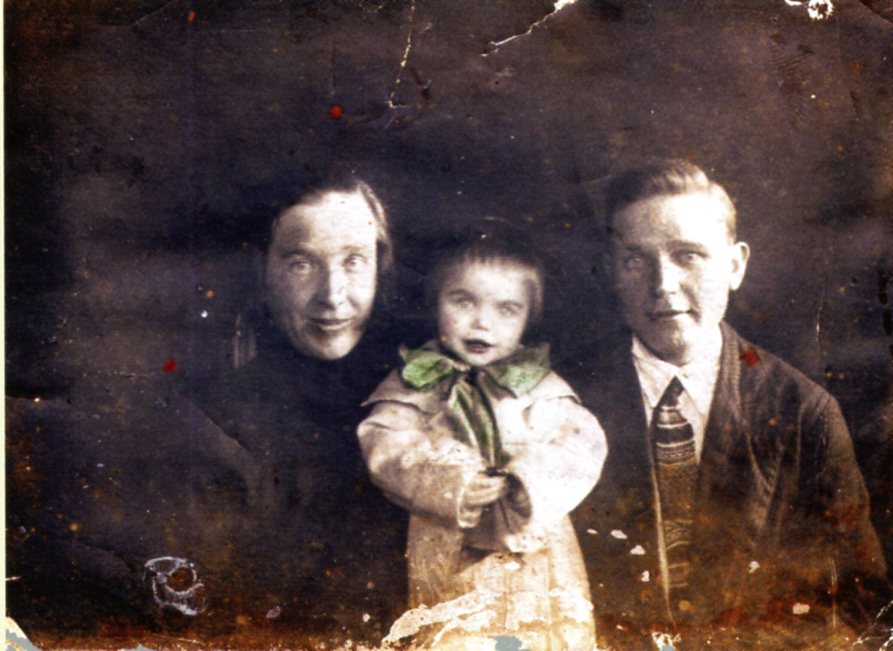
Fyodor Sybin with his wife Yevdokiya and his daughter Lydia, Tambov, mid-1930s.
This is one of the few family photographs Fyodor Sybin’s children have which shows their father.
Apart from his daughter, Lydia, Fyodor Sybin also had two sons, Vladimir and Valeriy. The latter was born in 1941 and never got to know his father. He only knew that he was listed as missing. It was not until 2003 that Valeriy Sybin learned that his father had died in the Wietzendorf camp in 1942.
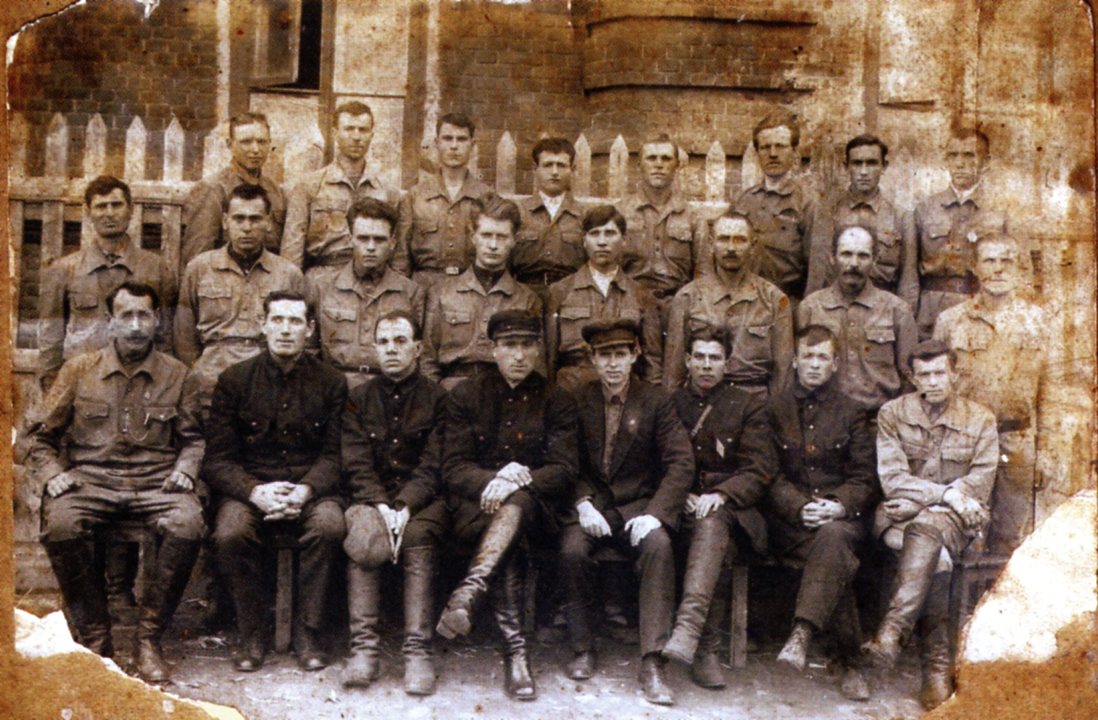
Fyodor Sybin (top left) with colleagues, Tambov, 1930s.
This photograph shows Sybin with other security guards from the Revtrud factory in Tambov. On the back is a note in a child’s hand which reads: “Revtrud. Dad was photographed together with his fellow workers.”
Culled from: Bergen-Belsen
Andersonville Prisoner Diary Entry Du Jour!
This is the continuation of the 1864 diary of Andersonville prisoner Private George A. Hitchcock (see the archived version for all entries up until now).
Here’s today’s entry:
July 12th. Showers around us have cooled the air and it is quite comfortable. Six hundred prisoners from Grant’s army came in today, among them Allen from Baldwinsville, of the 36th Massachusetts. I bathed in the muddy creek in the evening. Prayer-meetings every pleasant evening and very largely attended.
Culled from: Andersonville: Giving Up the Ghost