Today’s Demented Yet Truly Morbid Fact!
Alongside leprosy and plague, another condition of public concern in medieval times was insanity. Madness remained particularly disputed. On Galen’s authority, medical writers distinguished four main categories: frenzy, mania, melancholy, and fatuity, each the result of a particular humoral imbalance. Folklore believed the moon caused lunacy; theology saw it as a consequence of diabolical possession or sorcery. Some viewed it as divinely inspired, perhaps involving the gift of tongues; others praised the innocence of the village idiot; while troubadours might sing of tragic love-madness.
Nor was there agreement over remedies. Some advocated drugs and bleeding to sedate the demented and evacuate peccant humours. Shock treatment might be tried, such as hurling a maniac into a river. For demoniacal possession, there was exorcism, while certain saints had the power to cure madness. Three shrines enjoyed a special reputation: St. Mathurin at Larchant and St. Acairius at Haspres (both in northern France), and St. Dymphna at Geel in Flanders. A hospice built there to house the mentally ill proved too small and many were lodged in village households. From this a special ‘family colony’ developed, in which the mentally ill were tended by the villagers. The Geel community still exists.

St. Dymphna Church in Geel
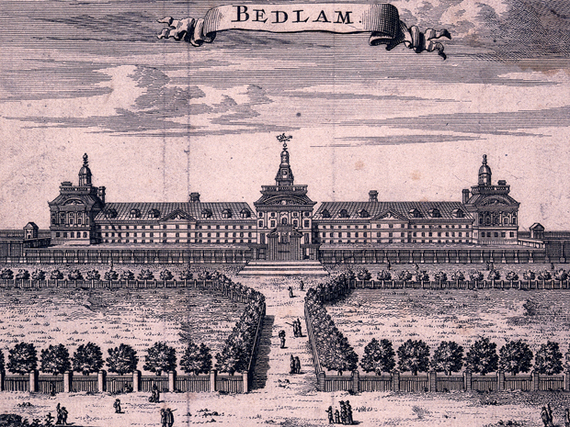
Public attitudes towards the insane were mixed. German municipalities sometimes expelled idiots or insane persons, whipping them out of town — though the celebrated ‘ship of fools’ is not a reality but a literary conceit, symbolizing humanity’s follies. The insane were cared for in monasteries; various towns had madmen’s towers (Narrentürme); in Paris, special cells were set aside at the Hôtel Dieu; and the Teutonic Knights’ hospital at Elbing had a madhouse (Tollhaus). Specialized hospitals began to appear, notably under the influence of Islam in Spain: Granada (1365), Valencia (1407), Zaragoza (1425), Seville (1436), Barcelona (1481) and Toledo (1483). The priory of St Mary of Bethelehem in London, founded in 1247, was by 1403 housing six men ‘deprived of reason’; it developed into the nototrious Bedlam. Such moves towards incarceration were counterbalanced by the image of the mad person as a holy fool, while in the ‘feast of fools’ medieval society came to terms with mental alienation through the carnival notion of the world turned upside down — madness as dionysian release.
The insane also became linked to witchcraft, with demonic possession serving as the explanation for deranged behaviour. Haunted by plague and heresy, the late medieval church warned against the Devil and his minions; women were considered particularly susceptible to Satan; and during the next 300 years the witch-craze seized Europe, leading to the execution, often after judicial torture, of upwards of 50,000 victims, mainly women (the figure of nine million burnings, often cited in feminist writings, is pure fantasy).
Culled from: The Greatest Benefit to Mankind
Post-Mortem Portrait Du Jour!
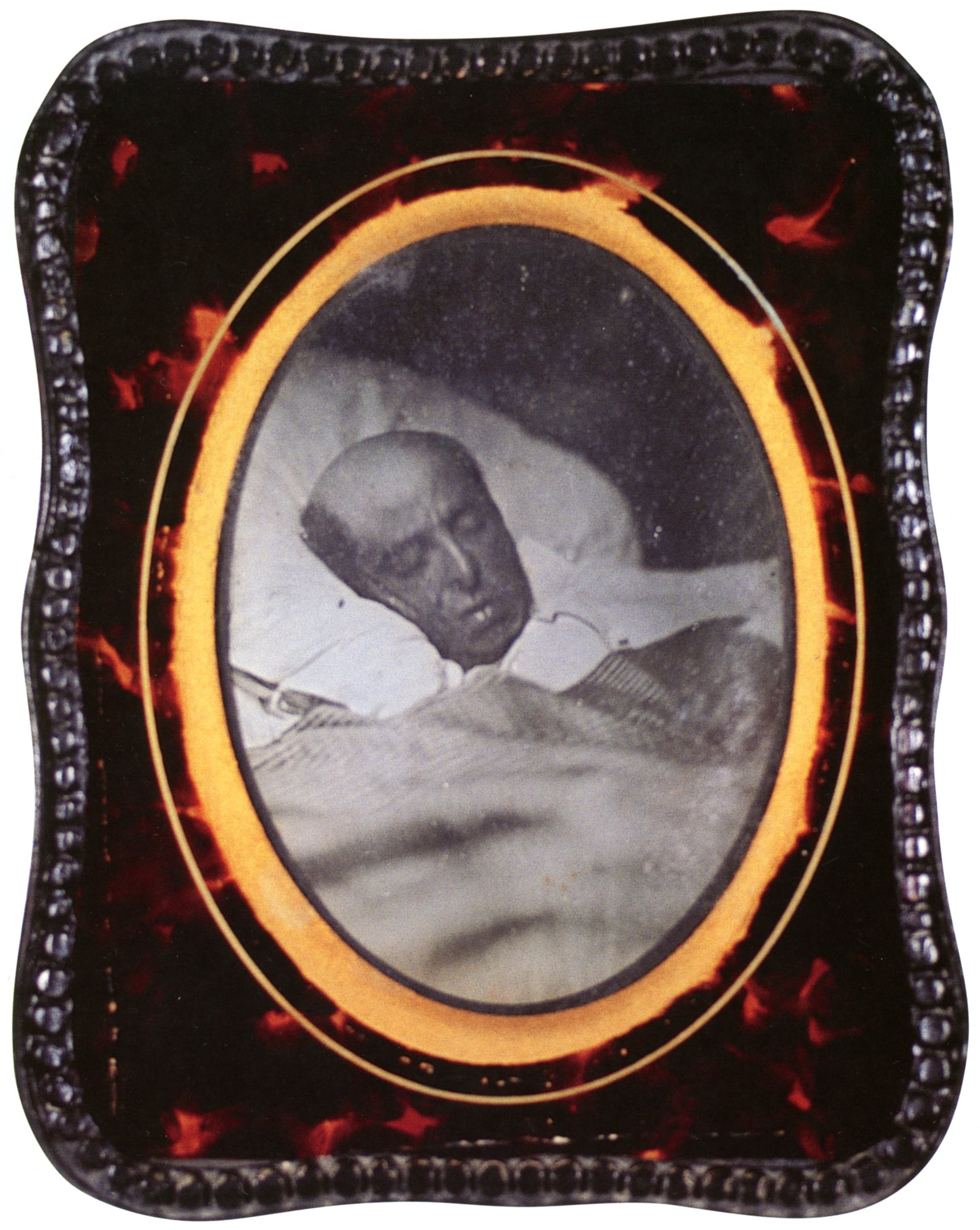
BALD MAN IN BED
Daguerreotype 3/4 plate (5 1/2 by 7 1/4 inches), circa 1850
This daguerreotype was taken in the style of the centuries-old European tradition of the deathbed portrait painting. Most of these artworks concentrated on the deceased’s head lying on a pillow. This formal presentation is represented here. These images were made to accurately document people’s features in their “last sleep.” They were the photographic equivalent of death masks, which had been done of the rich and famous for centuries, but fell out of favor as photography produced an acceptable alternative. As with all French portrait daguerreotypes, this image was framed for hanging. Only the inner part of the frame is shown here.
Culled from: Sleeping Beauty II
Andersonville Prisoner Diary Entry Du Jour!
This is the continuation of the 1864 diary of Andersonville prisoner Private George A. Hitchcock (see the archived version for all entries up until now).
Here’s today’s entry:
August 23d. Very hot all day and night; mosquitoes very troublesome. [E] Baker, of the 34th Massachusetts, of our mess, and another member of the 34th, died to-night, near by. Prisoners from Kilpatrick came in.
Culled from: Andersonville: Giving Up the Ghost