Today’s Violent Yet Truly Morbid Fact!
On July 13, 1863 began several days of violence in New York City known as the Draft Riots. These civil disturbances rocked New York City and revealed a deep racial and class divide that existed in New York City in 1863, one that was particularly visible in the Far West and South Village.
On July 11, 1863, two years into the Civil War, the Conscription Act took effect with the first drawing of draft numbers in New York City. While this went off largely without incident, tensions were brewing, and would soon manifest violently. The act required all male citizens between the ages of 20 and 35 and all unmarried men between 20 and 45 to submit to a lottery for military duty. But here’s the catch: anyone who paid $300 or hired a substitute could avoid service.
Because African-Americans were not considered citizens, they were not allowed to serve. Thus the act exacerbated tensions building from the Civil War, further enflaming white New York City workers dealing with war-driven inflation, food shortages, and unemployment. In addition, Lincoln’s Emancipation Proclamation in January helped solidify the connection between the war and rights for African-Americans, furthering tensions between white, mostly Irish immigrant workers and blacks, who were often in competition for jobs.
Tensions came to a head on July 13, when German-speaking artisans, native-born Protestant journeymen, and working-class Irish laborers attacked and burned the Provost Marshall’s office on 46th Street and Third Avenue, the location of the first draft lottery two days earlier. By the afternoon, the streets had become entirely unsafe for African-Americans. Rioters attacked a nine-year-old boy then stormed the Colored Orphan Asylum at Fifth Avenue and 43rd Street, burning the four-story building to the ground. The violence soon moved to the docks, where a predominantly Irish mob attacked more than 100 black longshoremen, killing several.
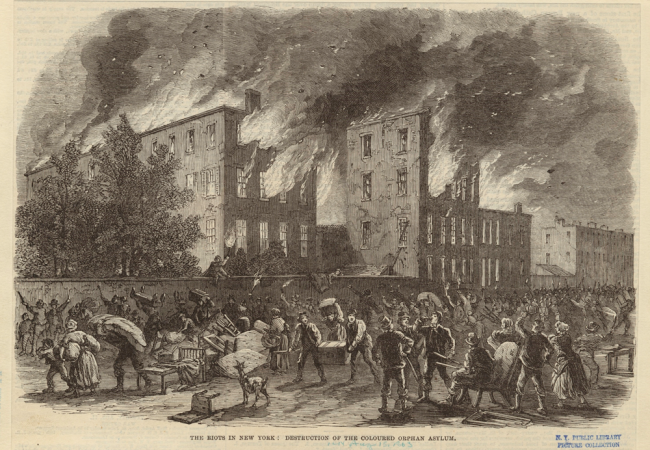
Burning of the Colored Orphan Asylum
On Clarkson Street on the lower Greenwich Village waterfront, African-American William Jones was confronted by a gang led by Irish bricklayer John Nicholson. Jones was beaten and hanged from a nearby tree, and his dangling body was set on fire. Sadly, violence against Africans-Americans was not new in the neighborhood. Historian Andrew Coe writes in his book Ear Inn Environs, about the James Brown House at 326 Spring Street, that a street gang called the Spring Street Fencibles were known for “knocking down black females.” During the Five Points riot of 1834, Irish immigrants destroyed the interior of the Spring Street Presbyterian Church on Spring and Varick Streets, just south of the Clarkson Street Draft Riots lynching of William Jones (the church was on the site of what is now the Trump SoHo Condo Hotel, the construction of which the Greenwich Village Society for Historical Preservation fought; in 2006, Trump’s workers disturbed the former church’s graveyard which was underground on the site.)
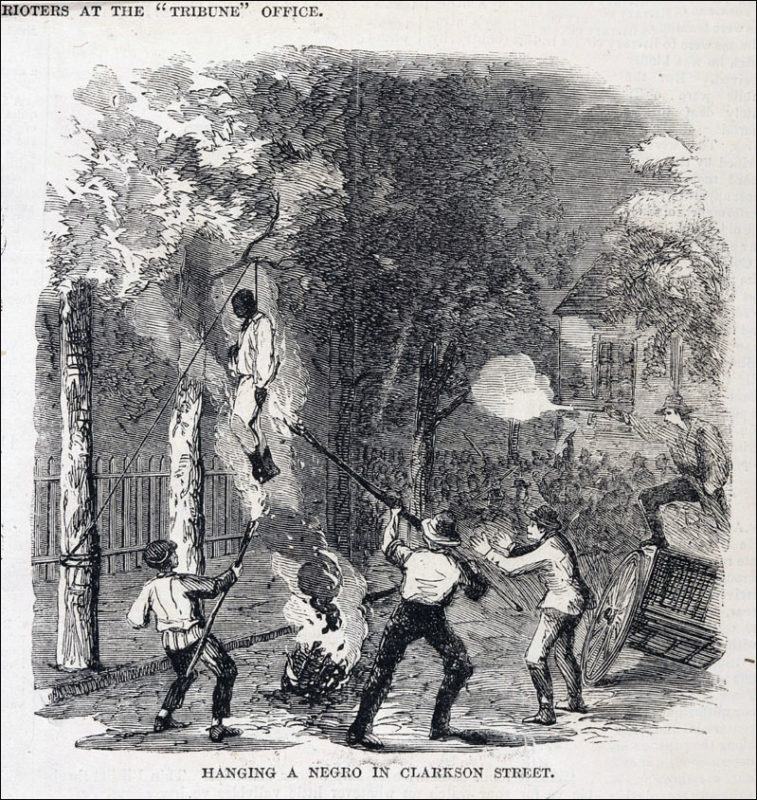
The Lynching of William Jones
On Wednesday, July 15, the third day of the riots, a group of black-occupied tenements on Thompson and Sullivan streets, between Grand and Broome, were set ablaze early in the morning. In five days of rioting, mobs lynched at least a dozen African American men, destroyed draft offices, burned and looted black neighborhoods and the homes of leading Republicans and abolitionists.
Culled from: The Greenwich Village Historic Preservation Society
Death Scene Du Jour!
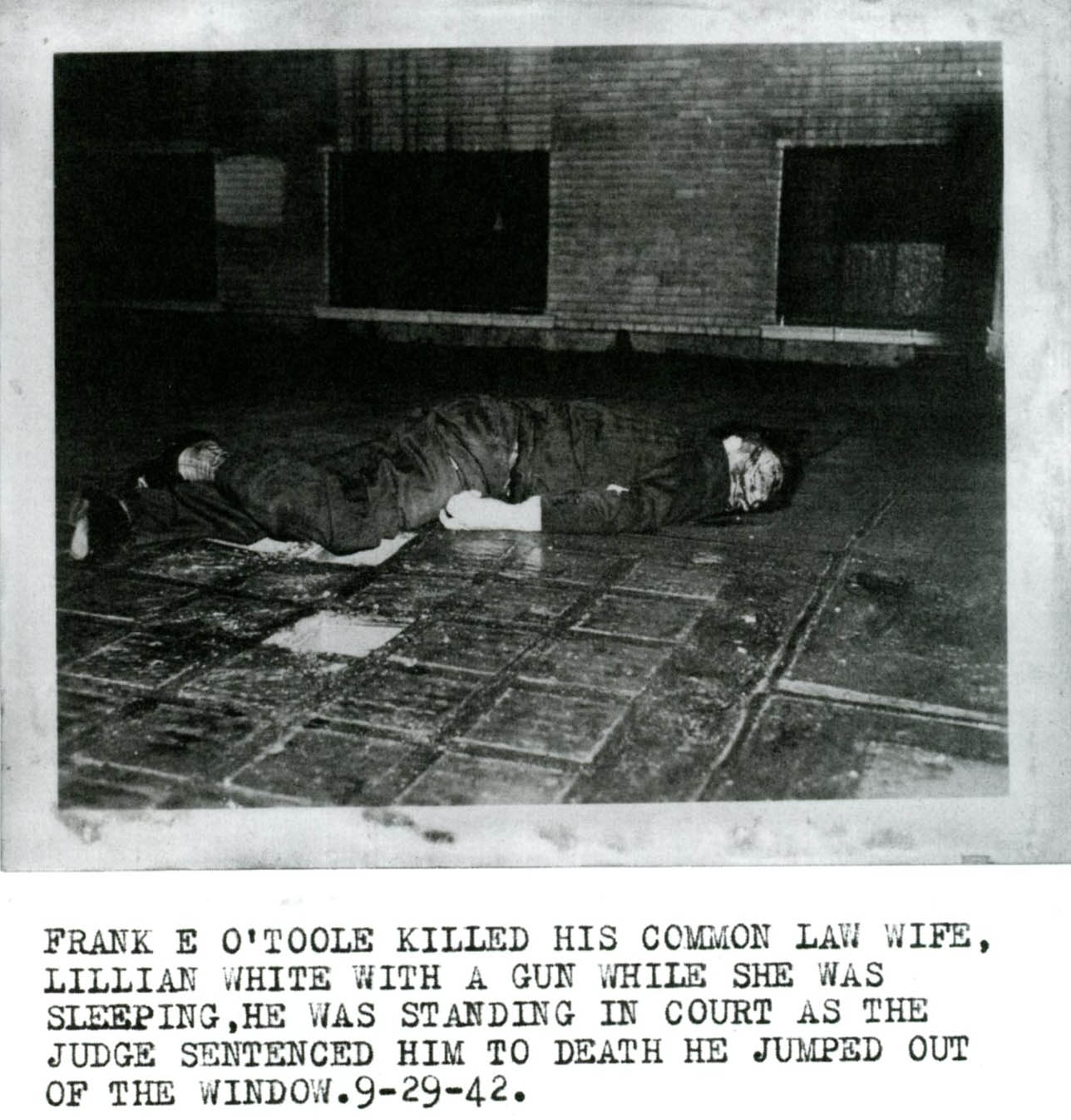
One of my favorite books is Death Scenes: A Homicide Detective’s Scrapbook. It is exactly what it says it is: a bizarre and oft-disturbing scrapbook collected over the years by Los Angeles area police detective Jack Huddleston, whose career spanned from 1921 to the early 1950’s. Here’s an image from the book: