Today’s Cost-Saving Yet Truly Morbid Fact!
Chicago history would repeat itself in 1993, when 20 residents of the Paxton Hotel died in a suspicious fire whose circumstances were strikingly similar to the Royal Beach fire 12 years earlier. Like previous cases, tragedy came during the pre-dawn hours when flames erupted inside the single-room occupancy (SRO) hotel that lacked adequate fire protection and featured open stairways and no fire doors. But even as deadly as the Paxton fire was, extraordinary heroics by Chicago firefighters prevented it from becoming an even greater disaster.
Like the Royal Beach, the Paxton was a four-story building of ordinary construction: the facade of the 60-year-old hotel was brick but its interior was made of wood, plaster, and other combustible materials. Unlike the Royal Beach, the Paxton was located not in a shabby part of town but at 1432 N. LaSalle Street in trendy Old Town, near Lincoln Park and the Gold Coast. Despite this desirable locale, the Paxton Hotel was home to residents on fixed incomes, mainly students, the elderly, and those trying to make a new start in life. Rents for each of its 140 rooms averaged $90 a week, enabling its occupants the convenience of month-to-month living. To keep costs affordable for such people, the city of Chicago did not require owners of SRO hotels to install expensive safety features such as sprinkler systems. As benevolent as this gesture seemed, the end result was a much heavier price paid in lives.
At 4 a.m. March 16, 1993, the Paxton’s estimated 160 residents were roused by screams, shouts, and the unmistakable smell of smoke. A fire that had originated in a rear stairwell was spreading rapidly throughout the hotel via the unenclosed stairway in the back of the building. Though it is not known who first noticed the fire, the first call reporting it to the fire department was logged at 4:05 a.m. In the next few minutes, five alarms plus numerous special calls for ambulances would be sounded, bringing much of Chicago’s on-duty firefighting force to the scene.
When the fire firefighters from Engine 8 and Tower Ladder 10 arrived at the yellow brick building, they saw dozens of residents hanging out windows as smoke billowed from behind. Some had already jumped and were lying on the sidewalk or in the alleyway next to the building. As residents opened their windows to escape, strong winds blew through the structure and fanned the flames. As the fire grew, occupants who opened their doors were forced back inside their rooms. With no other way out, they took to the window ledges and waited for ladders. The rapid spread of flames and smoke was aided by the removal of fire doors from stairway landings and hallways for remodeling and never replaced. A second source of fresh oxygen came from a back door that was left open.
These factors, together with 20- to 30-m.p.h. winds and a cold drizzle that kept the smoke from lifting, made firefighting very difficult. Nevertheless, rescuers scaled ladders placed against the front of the building and plucked dozens of residents from upper floor windows, lowering them one by one to the sidewalks and alley. The physical strain on the rescuers was enormous, but they continued to revive unconscious victims on the sidewalk, picking up others and carrying them to ambulances. Quick work by the fire department during those precious early minutes resulted in an estimated 70 lives being saved.
Eventually the intensity of the fire drove the fire fighters from the building, and they were forced to set up ladder pipes and wage battle from the outside. After water was poured on the hotel for several hours, its wooden interior collapsed onto the basement and the fire eventually burned itself out. But because several people were unaccounted for, rescuers used heavy equipment to knock down the walls and spent the next seven days scouring the ruins for the missing. Some turned up in hospitals or telephoned officials to let them know they were alive. But the whereabouts of a few others were left unknown. After a week of sifting the debris bucket by bucket, two more bodies were recovered. Finally, the search was terminated and the death toll ended at 20.
Like many big fires, the Paxton blaze remains a mystery largely because the extent of the destruction was so great that it made pinning down an exact cause difficult. Officials speculated that a frayed cord on a space heater in a first-floor room might have sparked it. Another theory said an unattended hot plate was responsible. As for life safety, though the Paxton was equipped with smoke detectors, it lacked an internal local fire alarm as well as any automatic means to alert the fire department to a fire. But because the city had chosen to ease building codes so operators of SRO hotels could keep the rates low, the hotel wasn’t required to have such devices. It’s no surprise that in the wake of the Paxton disaster, the city upgraded its SRO laws.

Scene outside the fire-wrecked Paxton Hotel
Culled from: Great Chicago Fires
I found some fascinating rough video from the fire department rescue. What an intense 38 minutes!
Vintage Crime Scene Du Jour!
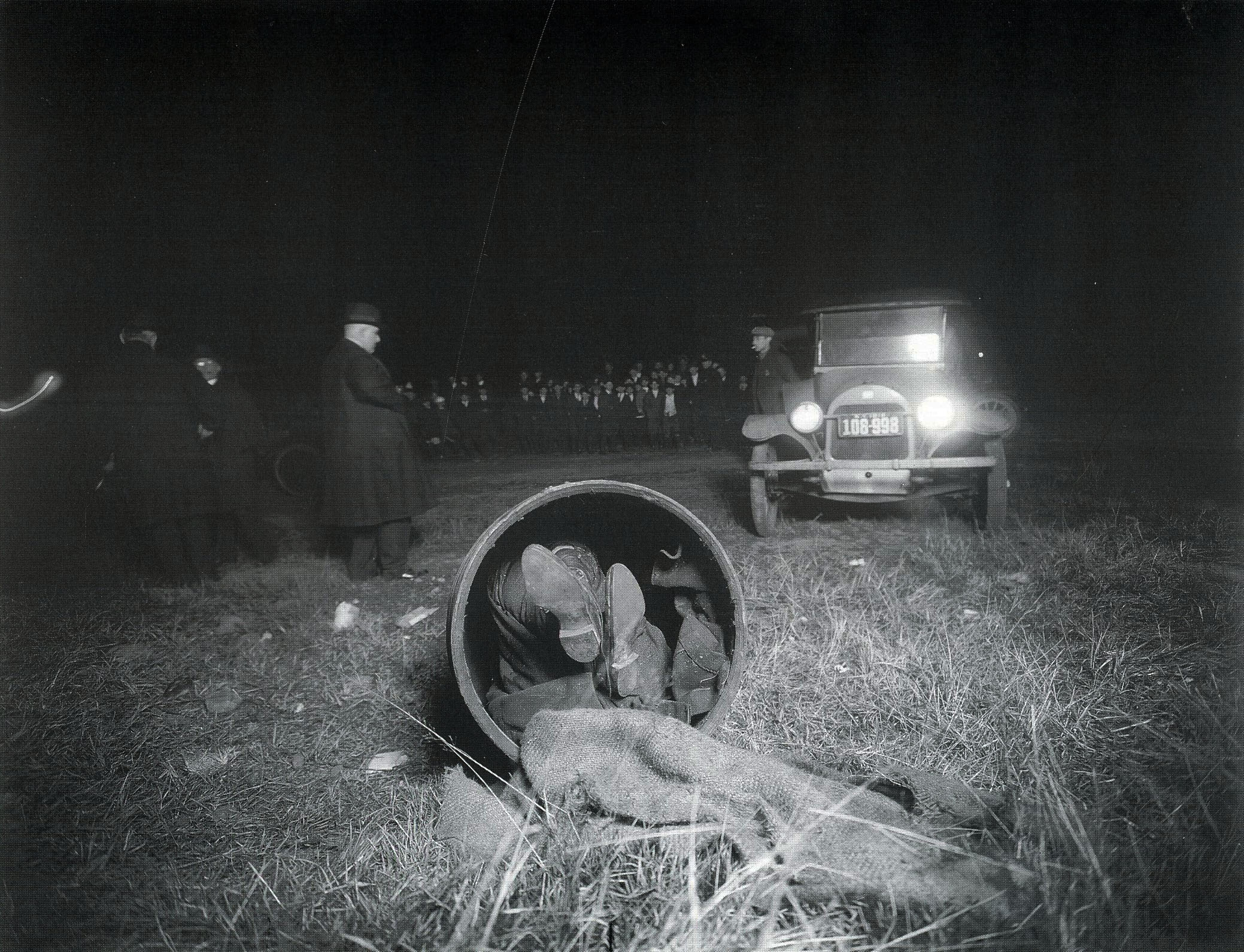
No caption. The license plate is of 1918 issue. The story is almost certainly the following:
FIND BODY IN A BARREL
MURDERED MAN HAD THROAT CUT AND 24 STAB WOUNDS
Three small children playing in a vacant lot in 45th Street, between Eighth and Ninth Streets [sic], in Brooklyn, at dusk yesterday came across a wine barrel the head of which had been covered by burlap nailed to the sides. They tore this off and saw a pair of feet sticking out. They ran away frightened and told a man, who notified the police of the Fourth Avenue Station. Captain Arthur Carey, Chief of the Homicide Bureau, took fingerprints and ordered the body removed to the Fourth Avenue Station.
There it was found the man had been murdered. [How surprising! – DeSpair] His throat was cut, his face and forehead gashed, and there were 24 stab wounds on the upper part of his body. Identity was established by means of a draft card found in a pocket of the coat. This showed he was Gaspare Candella, with a police record here, in Boston, and in Washington, D.C.
Candella lived at 1529 East 54th Street, Brooklyn. The police say the man was killed as a result of a feud.
[The New York Times, November 9, 1918]
The practice of stuffing bodies into barrels, usually with their tongues slit, is an old Mafia way of taking care of snitches. It was a habit associated with the New York City Mafia’s first great capo, Ignazio Lupo, and was probably not ignored by the Brooklyn Camorra, either. In 1918 Lupo was in jail and many other old leaders were in the process of being forcibly retired, while the young bloods of the Unione Siciliana were waging a citywide leadership war. Candella may well have been a victim of this fray. The only other conceivable explanation would be a particularly demented crime of passion.
Culled from: Evidence
Andersonville Prisoner Diary Entry Du Jour!
This is the continuation of the 1864 diary of Andersonville prisoner Private George A. Hitchcock (see the archived version for all entries up until now).
Here’s today’s entry:
November 5th. Drew two day’s rations, better in quantity and quality than at Andersonville, but suffer for want of shelter. Those who came in first have made comfortable winter-quarters of logs. Several hundred, in despair of exchange, have taken the oath, and gone into the rebel army.
Culled from: Andersonville: Giving Up the Ghost